huffpost Press
The 'Glass Cliff' Phenomenon Explains Why Trump Fired Pam Bondi And Kristi Noem
Images
1 / 12

2 / 12

3 / 12
4 / 12
5 / 12
6 / 12
7 / 12

8 / 12

9 / 12

10 / 12

11 / 12

12 / 12
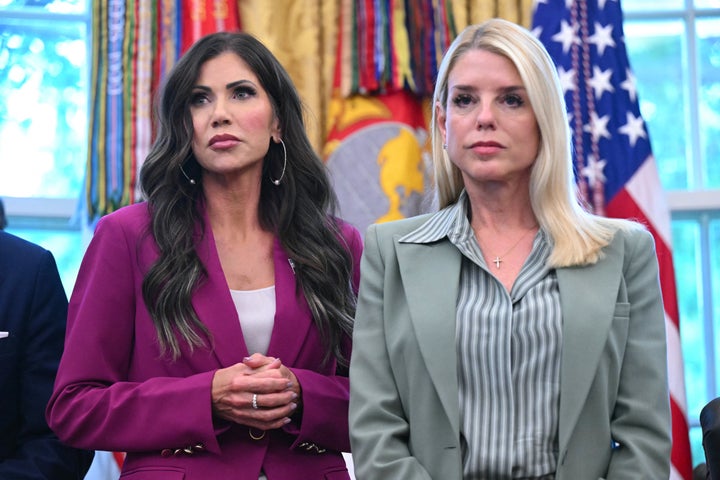
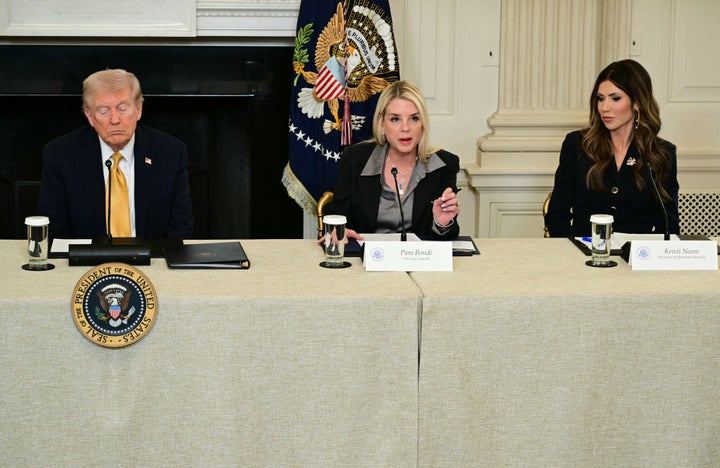
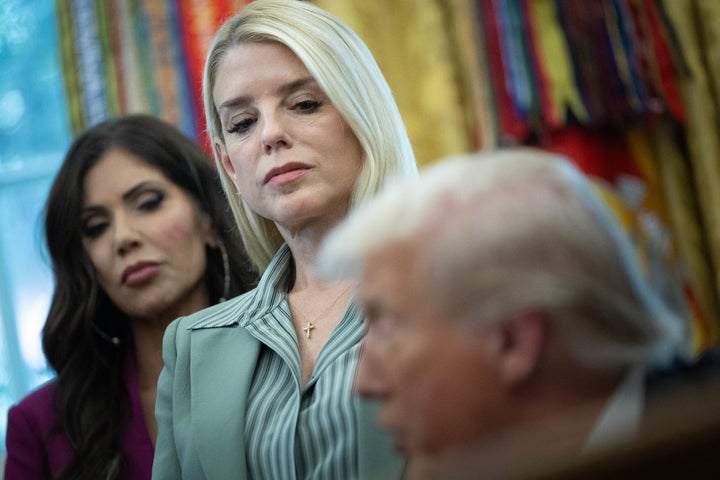
It’s a particularly bad time to be a woman in Trumpworld. Last week, Attorney General Pam Bondi learned she was out of a job after President Donald Trump reportedly lost patience with her botched handling of the Epstein files.

The dismissal came less than a month after Kristi Noem was unceremoniously ousted as secretary of homeland security in a Truth Social post, which also revealed her replacement: Republican Sen. Markwayne Mullin (R-Okla.). Minutes after the post went live, Noem still had to deliver the keynote speech at the Major Cities Conference in Nashville, Tennessee.

Both Bondi and Noem had scandal-plagued tenures: Noem oversaw an unpopular immigration crackdown that sent federal agents into Minnesota and other blue states, where they spent months brutalizing immigrants, terrorizing communities and fatally shooting two Minneapolis residents.

Controversy dogged Bondi’s time as attorney general, too, much of it tied to the release of the Justice Department’s files on sex offender Jeffrey Epstein. Critics across the political spectrum accused her of forsaking Epstein’s victims to protect the president, who was once friendly with Epstein. She also faced allegations of weaponizing the DOJ against Trump’s political opponents and tracking the search histories of Democratic lawmakers reviewing the Epstein files.

Trump’s first term was marked by a revolving door of Cabinet officials, with firings, forced resignations and reassignments frequently announced on Twitter. By contrast, turnover in his second term has been relatively minimal ― which makes it especially striking to many political observers that the two highest-ranking officials he’s axed so far are both women.

There’s incompetence to go around, many have noted, but it’s the women who’ve been told, “You’re fired.”

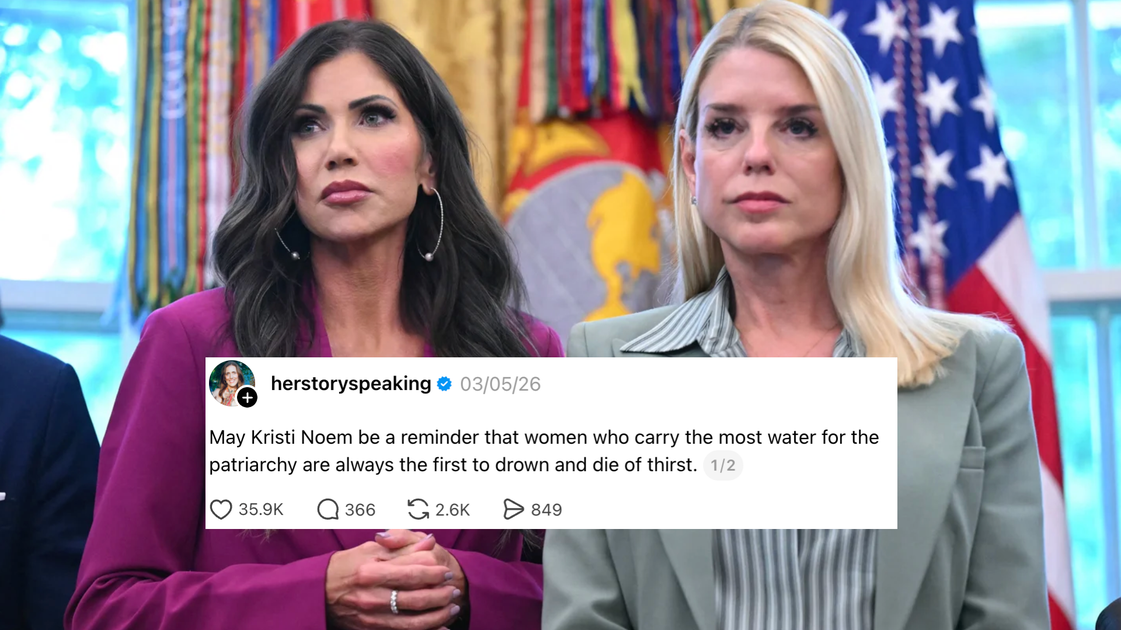
“May Kristi Noem be a reminder that women who carry the most water for the patriarchy are always the first to drown and die of thirst,” Andrea K. Miller, the host of the “Herstory Speaks” podcast, wrote on Threads after Noem’s firing in March.

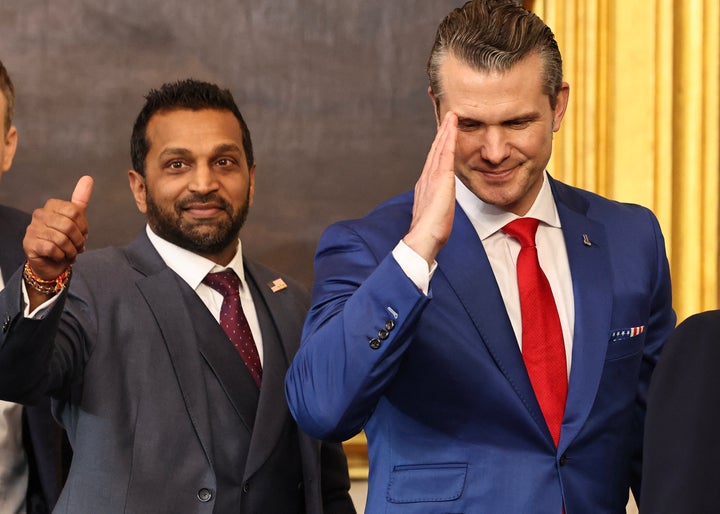
As conservative commentator Bill Kristol wrote on Bluesky last week, “Bondi was awful, but no worse than Patel. Noem was terrible, but no worse than Hegseth. Funny that it’s only the women who get fired.”

They went first because, in an administration full of incompetent leaders, women are more expendable when legitimate leadership is coded masculine.

Kash Patel, as fierce a Trump loyalist as they come, has endured nonstop criticism that he is unqualified for the position since taking the helm of the FBI last year. Meanwhile, critics say Defense Secretary Pete Hegseth, a former Fox News host, is out of his depth to command the U.S. military through a murky, already unpopular U.S.-led military conflict in Iran.

We’re watching the concept of gendered expendability play out in real time with the firings of Noem and Bondi, said Caroline Heldman, a professor of political science and the chair of gender, women and sexuality studies at Occidental College in Los Angeles.

“High-ranking women are inherently seen as more expendable because gendered ideas of leadership mean women are never seen as quite right for the job the way men are,” she said.

Women in power are either too aggressive or too weak, too polarizing or too passive, so while men will get the benefit of the doubt, women have to meet a higher standard, Heldman told HuffPost.

“Hegseth shared classified information in a Signal chat and still has his job,” she pointed out. “Patel has been a credibility disaster and is still standing.”

Women didn’t go first because they somehow failed worse, Heldman said. “They went first because in an administration full of incompetent leaders, women are more expendable when legitimate leadership is coded masculine.”

Other women in the administration have cause to worry, too. During a press conference last week, the president joked that press secretary Karoline Leavitt was doing a “terrible job” and quipped, “Should we keep her?” as she stood by.

And The Guardian reported Thursday that Trump is considering replacing Tulsi Gabbard as director of national intelligence. According to the outlet, the president has privately polled other Cabinet officials on whether he should remove her, though he reportedly hasn’t gone so far as to discuss a successor.

The Trump White House supplies us with a soap-opera-esque, trumped-up example of the “glass cliff” women in power all too often face, said Zeynep Somer-Topcu, a professor of government at the University of Texas at Austin.

“The ‘glass cliff’ is the idea that women are more likely to be placed in leadership roles under difficult or high-risk conditions, which increases the likelihood that they will be blamed when outcomes are poor,” she said.

As Democratic strategist Max Burns wrote for MS NOW on Monday, “it’s no coincidence that Noem and Bondi exited stage far right as voters delivered Trump his worst-ever approval ratings in what were stronghold areas for the Republican Party.”

The truth is, they’d always been standing in political quicksand. As Somer-Topcu describes in her book “Glass Ceilings, Glass Cliffs, and Quicksands,” female leaders often operate in more precarious environments.

“Some leaders stand on firm ground, while others are on quicksand,” she said. “For women in leadership, the evidence suggests that support can erode much faster, even when similar or worse issues are tolerated in male counterparts. Scrutiny is higher for them, and their perceived legitimacy is more fragile from the beginning.”

Gender is unlikely to be the only factor in these firings ― Noem and Bondi were both highly unpopular among the American people ― but it likely shapes how quickly responsibility is assigned and how expendable different leaders are perceived, Somer-Topcu said.

Laurie Essig, a professor of gender studies at Middlebury College and creator of the podcast “Feminism, Fascism & the Future,” said she’s not surprised that Noem and Bondi were first to go, in spite of being hyper-loyal to Trump. She thinks it speaks to Trump and his movement’s general disdain for women.

In his second term, the president ― accused by two dozen women of sexual assault and rape himself ― filled his Cabinet with men who have faced similar sexual misconduct allegations, including Hegseth, who was investigated for allegedly raping a woman working at the California Federation of Republican Women conference in 2017.

“This is a movement that does not value women or any feminized bodies, and it is also a movement deeply influenced by certain religious decisions that mark women as sinful and not deserving of full humanity or citizenship,” Essig said.

Within a patriarchal, male-dominated structure — which the Trump administration inarguably is — a woman who complies with the men in charge may be able to advance in her career, but only up to a point.

“This illustrates the classic feminist concept of patriarchal bargaining, where women align themselves with patriarchal men and institutions in exchange for elevated status,” Heldman said.

Women who make the patriarchal bargain believe their compliance will be rewarded with security, but they ultimately hold little power in the exchange, Heldman said, adding that Noem is a particularly stark example of this phenomenon.

“She dismantled reproductive rights in South Dakota, performed aggression on behalf of a man who openly denigrates women, and rebranded herself entirely around his approval, including, notoriously, the story about shooting her dog, which reads almost like a performance of masculine ruthlessness for an audience of one. And she was still fired,” she said.

Meanwhile, no amount of groveling before Trump —or mimicking his attacks on Democratic senators during her explosive House Judiciary Committee hearing in February — was enough to save Bondi. In Trumpworld, even the most loyal MAGA acolytes are disposable, especially if they’re women.

Ultimately, Heldman thinks the two firings reveal the limits of lean-in feminism: The presence of women in powerful positions is not, by itself, a feminist achievement, particularly when those women actively work to erode other women’s rights and autonomy.

“Noem and Bondi were never symbols of women’s progress,” she said. “They were symbols of how patriarchal systems use women’s presence to legitimize themselves while retaining all the structural prerogatives of male power.”

By entering your email and clicking Sign Up, you're agreeing to let us send you customized marketing messages about us and our advertising partners. You are also agreeing to our Terms of Service and Privacy Policy.
Comments
You must be logged in to comment.