yahoo Press
Palantir Faces Skepticism Despite Strong Growth
Images
1 / 4
2 / 4

3 / 4

4 / 4
Palantir Technologies Inc. (NASDAQ: PLTR) is one of the most hotly debated stocks in the investor and analyst communities. Benchmark is one of the latest to report. On April 1, the firm initiated coverage on PLTR with a Hold rating and a price target of $150.

That’s close to the stock's trading range within the last two months.

It’s also more than 20% below the consensus price target of $197.77.

→ Could Easing Iran Tensions Trigger an Amazon Pre-Earnings Rally?

However, the reason for the PLTR stock decline has been more about the general rotation out of technology stocks, and specifically software stocks.

Analyst sentiment about Palantir has generally been bullish. The question is whether the Benchmark rating is an outlier or a harbinger of future price movement.

→ AMC's Easter Surprise: A Bullish New Act?

Looking past the headline rating and price target, it’s important to understand why analysts feel the way they do. The reasons behind Benchmark’s bearish rating read like a distillation of much of the bearish sentiment that has surrounded Palantir for years.

To sustain the company’s lofty valuation, Palantir has to achieve annual revenue growth between 60% and 70% to avoid market drawdowns.

→ 1 Stock To Buy And 1 To Sell If The War In Iran Ends

In the company’s 2025 fiscal year, Palantir’s international commercial revenue only grew 2.5% from the prior year. The firm stated that this suggests that even Western nations that are allies of the United States may not have the demand.

Palantir’s $1.3 billion in total contract value (TCV) bookings illustrates the company’s ability to maintain client relationships. However, the company will have to add many more new customers to justify its valuation.

Each of Benchmark’s reasons comes back to Palantir’s lofty valuation, which is a debate that won’t be settled anytime soon. The bears have fundamentals on their side, but the bulls have history and a committed group of retail investors who aren’t likely to part with their shares anytime soon.

However, the bullish case for Palantir is rooted in some solid facts that come directly from the company’s latest earnings report.

The company posted total revenue of $1.41 billion in Q4 2025, representing 70% year-over-year growth, with U.S. commercial revenue surging 137% year-over-year to $507 million. That kind of domestic acceleration is difficult to dismiss as a fluke.

Plus, Palantir reported an 8% sequential increase in commercial customers. That percentage climbs to 49% year over year (YOY). Of course, Palantir has to continue delivering that growth, and high single-digit growth may not impress investors, but Palantir has been known to surprise to the upside.

The company also reported a record total contract value of $4.26 billion for the quarter, up 138% year-over-year, suggesting the demand pipeline is expanding, not contracting.

Perhaps most striking is Palantir's Rule of 40 score of 127% in Q4 2025 — a metric that combines revenue growth and adjusted operating margin. By that measure, Palantir leads the entire enterprise software universe, outpacing peers like Adobe (NASDAQ: ADBE), Salesforce (NYSE: CRM), and Workday (NASDAQ: WDAY) by a considerable margin.

The company's adjusted operating income hit $798 million at a 57% margin, while it closed the quarter with $7.2 billion in cash and zero debt. For full year 2026, management guided for U.S. commercial revenue in excess of $3.14 billion, implying growth of at least 115%. These are not the numbers of a company in demand trouble.

Investors can believe Benchmark’s assessment about potential weakness in commercial customer growth. However, it’s much harder to ignore the government side of the ledger. Palantir’s Maven Smart System is now a formal program of record, which will make Maven a long-term fixture across all branches of the U.S. military.

The designation firms up Palantir's military funding and helps secure future contracts, further stabilizing the company’s government business at a time when the commercial segment continues to surge. For the bears who point to valuation risk, durable multiyear government revenue commitments of this kind are exactly the kind of structural support that makes the premium harder to dismiss.

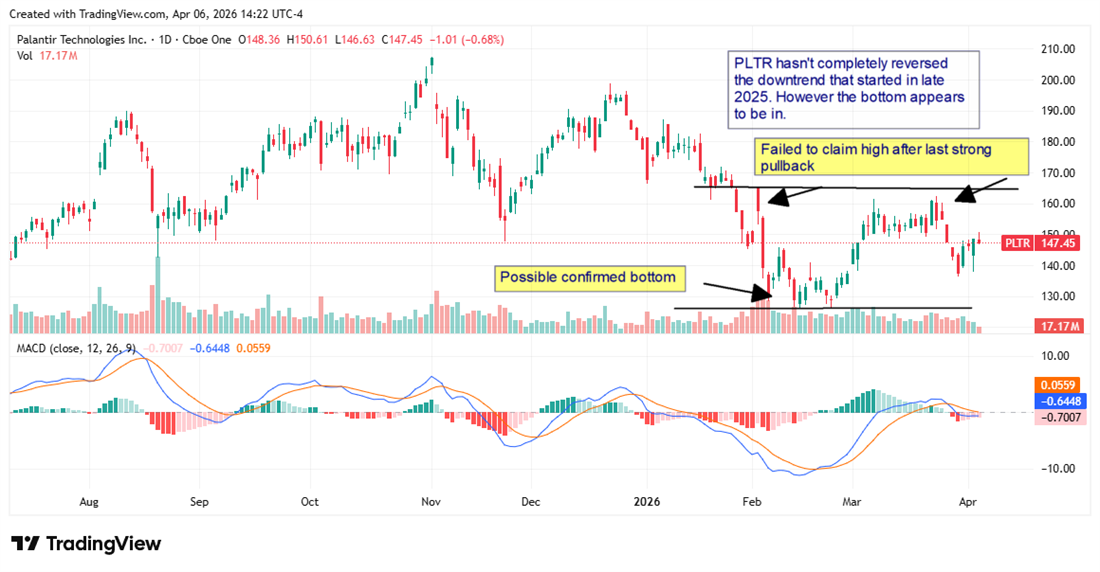
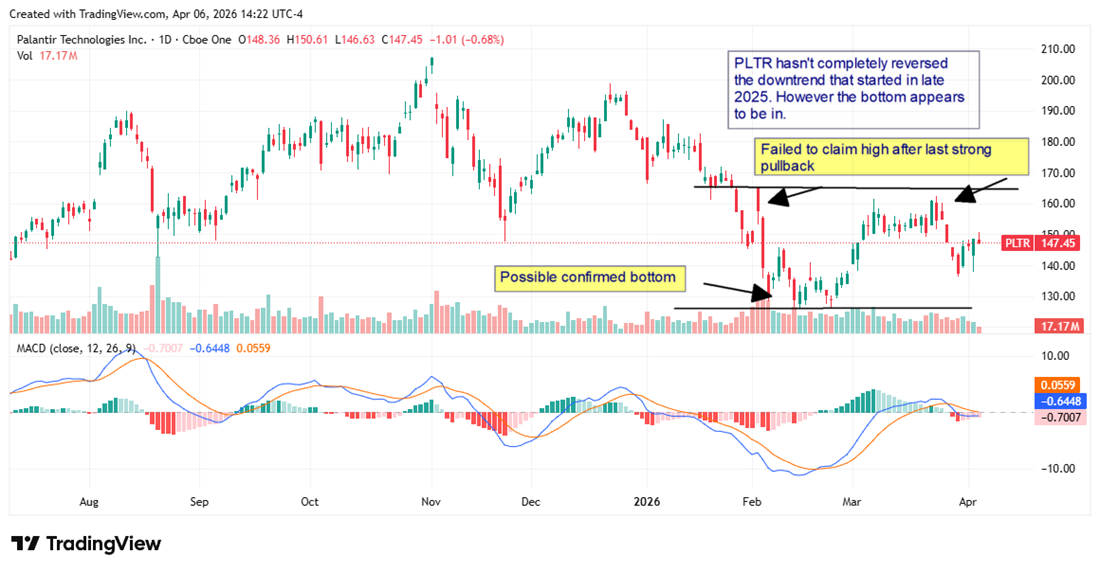
PLTR is down almost 20% in 2026, and although the stock has bounced off a level around $129, suggesting a solid floor, it has shown a pattern of dropping by 30% or more at several points in the last five years.

A recent analyst rating highlights ongoing concerns that high growth expectations may already be priced into shares.

Strong domestic growth, expanding bookings, and industry-leading profitability metrics continue to support the bullish case.

The stock remains under pressure in the near term, making timing a key factor for both bullish and bearish investors.

Interested in Palantir Technologies Inc.? Here are five stocks we like better.

No matter which side of the Benchmark rating fence investors sit in, PLTR stock continues to be under selling pressure. In late March, the stock price pushed toward $165, which was the level it was at before the latest pullback. However, that move was rebuffed, and that level is the first step that has to be reclaimed before the next move higher.

For investors who believe in the Benchmark analysis, PLTR will have to move much lower before it reaches a buy point. However, investors who look at the consensus price target may see this consolidation phase as an opportunity to accumulate more shares.

The article "Palantir Faces Skepticism Despite Strong Growth" was originally published by MarketBeat.
Comments
You must be logged in to comment.