yahoo Press
Stock market today: Oil surges, futures fall as Trump ratchets up threats against Iran
Images
1 / 6

2 / 6

3 / 6

4 / 6

5 / 6

6 / 6
Oil futures surged while US stock futures fell on Sunday evening as renewed threats from President Trump and destruction in the Gulf region over the weekend pushed geopolitical tensions higher, as investors remain focused on the US-Iran war as the market's main catalyst.

Futures on Brent crude (BZ=F), the international benchmark, rose roughly 2.5% to trade above $111 per barrel on Sunday night. Futures on the US benchmark oil price, West Texas Intermediate (CL=F), gained 3.1% to cross $115 per barrel.

US stock futures moved in the other direction at the open of futures trading, with futures on the S&P 500 (ES=F) dropping roughly 0.8% and those on the tech-exposed Nasdaq 100 (NQ=F) fell roughly 1%. Contracts on the Dow Jones Industrial Average (YM=F) lost 0.7%, or roughly 340 points.

Closer to 8:15 p.m. ET, stock futures had moved off their evening lows.

Investors on Monday will get their first real chance to weigh in on the March jobs report, which surprised on Friday as the US economy created 178,000 jobs as the unemployment rate fell to 4.3%.

Markets in the US were closed for Good Friday to finish last week. Markets in many countries worldwide, including the UK, Germany, France, and Australia, will be closed for Easter Monday.

In the week ahead, investors will also watch for key US inflation data due out Friday and earnings results from Delta, expected on Wednesday.

After a four-day trading week that both capped the end of the first quarter and saw markets lap the volatility from last year's "Liberation Day" surprise, the week ahead will bring investors a key inflation reading and the start of first quarter earnings season.

The week's key economic data comes on Friday, with the March CPI report. This report will be the first major piece of economic data to pick up impacts from the US-Iran war, which has sent oil prices surging.

Economists expect headline inflation, which includes the costs of energy, rose 1% last month, up from a 0.3% increase in February.

Delta's earnings will also offer color from an industry set to face negative impacts from the war on a number of fronts — energy costs, consumer confidence, and a potential downturn in international travel. Those results are expected out on Wednesday morning before the market opens.

At roughly 8 a.m. ET on Sunday, President Trump reiterated in an expletive-laden post to Truth Social his threat to begin mass bombardments of Iranian domestic power infrastructure and bridges throughout the country as his 10-day window for Iran to reopen the Strait of Hormuz nears its deadline.

"Tuesday will be Power Plant Day, and Bridge Day, all wrapped up in one, in Iran," the president wrote. "There will be nothing like it!!! Open the F*****’ Strait, you crazy bastards, or you’ll be living in Hell - JUST WATCH! Praise be to Allah."

A few hours later, President Trump posted to Truth Social, "Tuesday, 8:00 P.M. Eastern Time!" — seemingly the deadline for Iran to reopen the strait.

Fox News reported shortly after the president's first Truth Social post that Trump said to correspondent Trey Yingst, “If they don't make a deal and fast, I'm considering blowing everything up and taking over the oil."

Last Thursday, the US military severed a major bridge in Iran — one of the country's flagship infrastructure projects — that connected Tehran to the industrial center of Karaj.

Fox News also reported Sunday that Trump said he believes he will be able to reach a deal with Iran on Monday, before the president's imposed deadline expires on Tuesday.

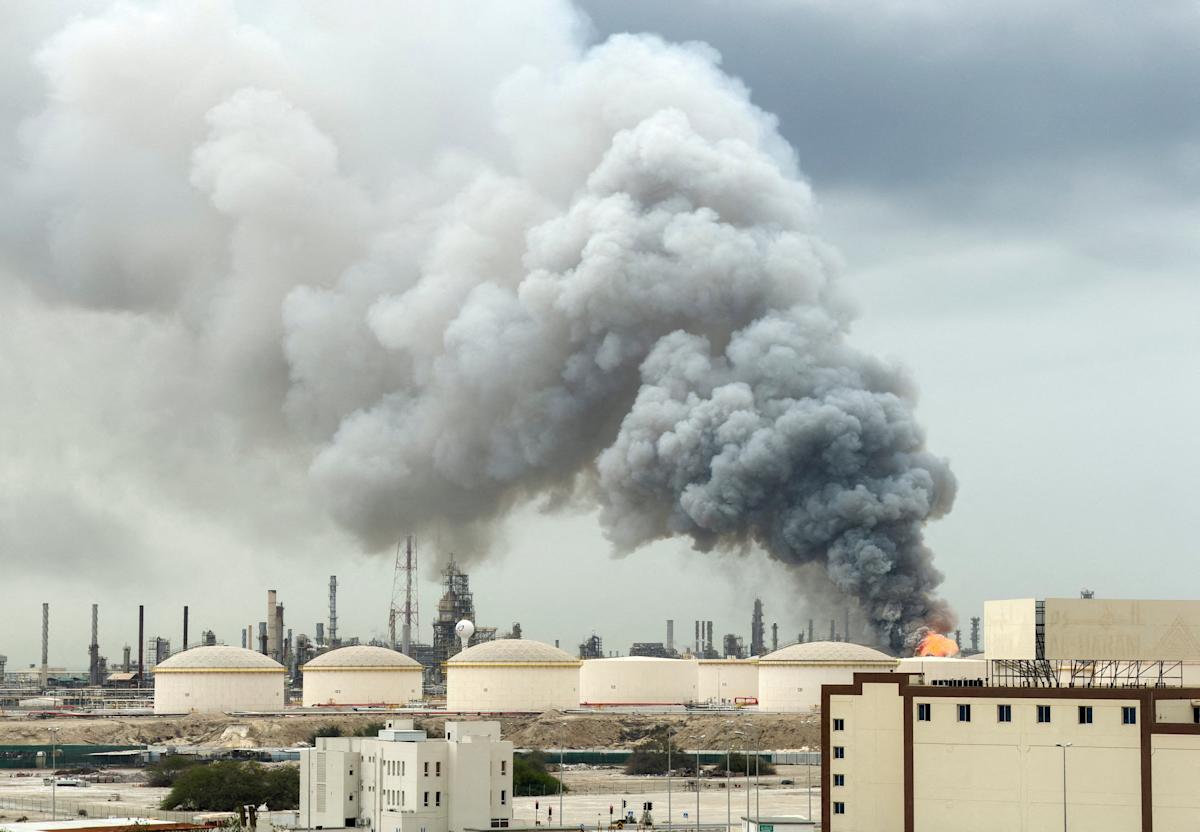
Attacks by Iran against major energy infrastructure continued over the weekend, including strikes against Bahrain's BAPCO oil refinery and the headquarters of Kuwait's state-owned Kuwait Petroleum Corporation.

Kuwait also reported attacks on several of the country's power and desalination plants.

In a post to X on Saturday, an account reportedly close to Iran's parliamentary speaker Mohammad Bagher Ghalibaf — a former IRGC general who has become a leading voice within the Iranian regime — said that if Iran "does not receive a credible signal by tomorrow of Trump reconsidering an attack on Iran's infrastructure, it will preemptively, irreversibly, and on a massive scale target the Saudi electricity and oil production infrastructure, as well as that of the Israeli regime."

"Iran has so far refrained from exercising this option in order to avoid entering an 'irreversible infrastructure war' and a 'Ukrainization of the region,' but the time for this restraint will end in the next 24 hours," the account wrote.

At the same time, oil market watchers digested signs of potential partial resumption of oil flows through the Strait of Hormuz, the world's most critical oil chokepoint.

Early Sunday morning, the foreign ministry of Oman announced that its leaders had met with Iran's foreign ministry on Saturday and discussed "possible options for ensuring the smooth flow of transit through the Strait of Hormuz amid the circumstances currently prevailing in the region."

Also on Saturday, Iran's military leadership said Iraqi ships would be allowed to transit the Strait of Hormuz, potentially bringing roughly 3 million barrels per day of oil back onto the market.

The semi-official state-run Iranian Mehr News Agency quoted the Iranian president's office saying, "The Strait of Hormuz will open when damages resulting from the war are compensated from transit fee revenues."

On Sunday, the Organization of Petroleum Exporting Countries (OPEC+) agreed to increase its monthly production quota by 206,000 barrels per day in May, the same increase the cartel's member countries agreed upon for April.
Comments
You must be logged in to comment.