aljazeera Press
‘Forget democracy’ says Burkina Faso’s military leader Ibrahim Traore
Images
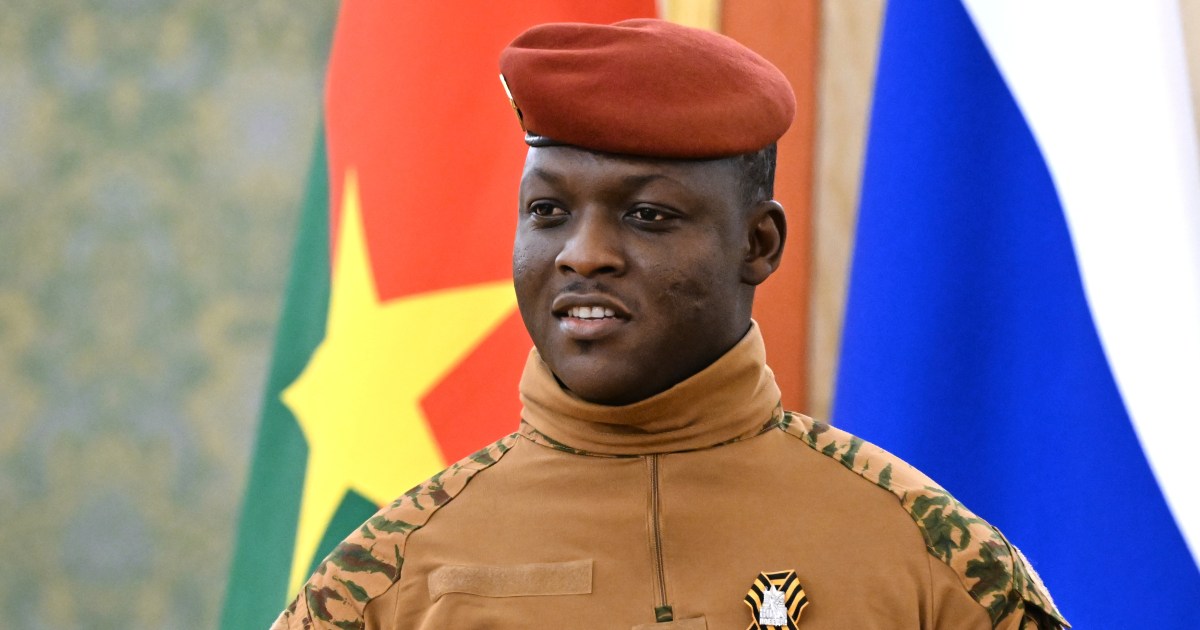
1 / 4

2 / 4

3 / 4

4 / 4
Traore reneged on promises to hold elections and has since scrapped political parties in the country.

Save

Share

Burkina Faso’s military leader, Ibrahim Traore, says that people need to “forget” about democracy, just three months after his government dissolved all political parties in the West African nation.

Speaking to journalists in a lengthy interview on state television on Thursday, Traore referenced Libya as an example of a country where he said outsiders attempted to “impose democracy” but failed.

“People need to forget about the issue of democracy,” he said. “We have to tell the truth: democracy isn’t for us.”

“Democracy kills”, Traore said, according to French broadcaster RFI.

“Look at Libya, it’s a prime example right next to us! Everywhere they try to establish democracy in the world, it’s done with bloodshed … Democracy is slavery…”

It’s the latest sign of Traore’s government distancing itself from the initial promises it made to set the country back on a democratic path.

Traore seized power in September 2022, eight months after an earlier military coup he was involved in overthrew the democratically elected government of President Roch Marc Kabore.

The military governments promised to battle al-Qaeda and ISIL-linked armed groups that have swarmed the country and now control large areas of territory. However, the country has continued to come under repeated attacks and hundreds of thousands of civilians are displaced.

Traore, who has gained widespread admiration from the African diaspora for his anti-Western rhetoric, initially promised to organise elections in 2024. A year later, the leader reneged and said elections would not be held until all parts of Burkina Faso are safe for voting.

In January, Traore’s government scrapped more than 100 political parties in the country and seized their assets.

Parliament and all political activity had previously been suspended after Traore took power. The Independent National Electoral Commission was dissolved in July 2025 after Traore’s government claimed the agency was too expensive.

Analysts have also raised concerns about the government’s apparent targeting of other institutions, including the media and judiciary.

Journalists, political opposition leaders and prosecutors critical of the military government have been forcibly conscripted and sent to the front lines in recent months, with some later released.

Similar moves against political parties have been taken by neighbouring military governments in Niger and Mali, which are also battling armed group violence.

All three countries exited the regional Economic Community of West African States (ECOWAS) bloc to form their own Alliance of Sahel States (AES) last January after pressure to hold elections.

They have also turned to Russian paramilitary fighters after evicting former colonial power, France, which had deployed some 5,000 soldiers to help fight armed groups in the Sahel region.

Violence has continued to mar Burkina Faso. Fatalities tripled in the three years since Traore took power reaching 17,775 by last May. That’s compared with the three years prior, when combined recorded deaths were 6,630, according to analysis by the US-based Africa Center for Strategic Studies.

Most of those killed were civilians, many by government forces and allied militias.
Comments
You must be logged in to comment.