yahoo Press
Trump tariffs live updates: Trump announces 50% tariffs on any country supplying weapons to Iran
Images
1 / 6

2 / 6

3 / 6

4 / 6

5 / 6

6 / 6
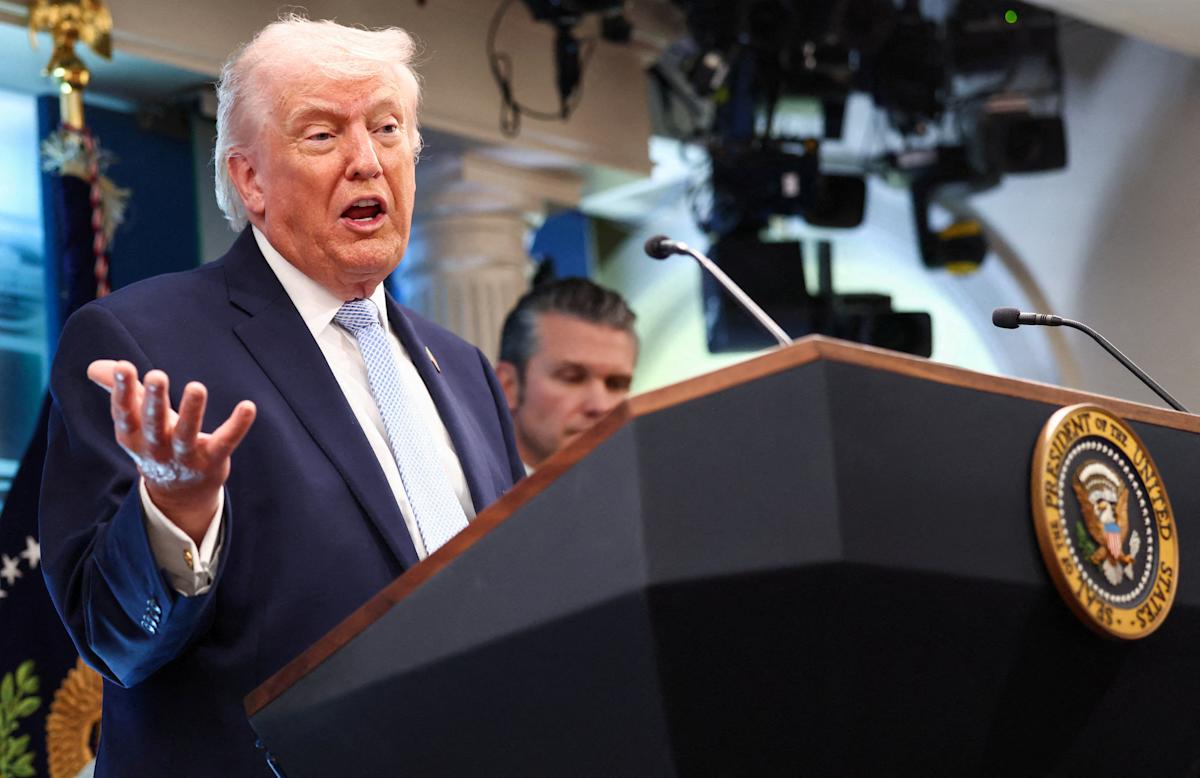
President Trump announced on Wednesday that the US will impose secondary tariffs of 50% on any nation supplying Iran with weapons, effective immediately. “A Country supplying Military Weapons to Iran will be immediately tariffed, on any and all goods sold to the United States of America, 50%, effective immediately. There will be no exclusions or exemptions!” the president wrote on Truth Social as a two-week ceasefire with Iran began. The announcement is the latest set of tariffs since Trump adjusted US tariffs on patented pharmaceuticals and metals last week. The White House raised pharmaceutical tariffs to 100% but announced extensive exemptions, putting the rate for many companies at 0%. Tariff rates for steel, aluminum, and copper will remain at 50%, though the Trump administration is changing how these tariffs are enforced — likely leading to higher duties for importers. Meanwhile, the US government is building a system to repay more than $160 billion in illegal tariff costs paid under the International Emergency Economic Powers Act (IEEPA). More than 25,000 importers, including Costco (COST) and FedEx (FDX), have requested refunds. Businesses continue to navigate a series of trade shocks, from the overturned IEEPA tariffs that the Supreme Court struck down to soaring energy costs stemming from the war in the Middle East. Read more: What Trump's tariffs mean for the economy and your wallet The US will impose secondary tariffs of 50% on any nation supplying Iran with weapons, effective immediately, President Trump announced on Wednesday morning. “A Country supplying Military Weapons to Iran will be immediately tariffed, on any and all goods sold to the United States of America, 50%, effective immediately. There will be no exclusions or exemptions!” Russia and China could be the targets of such a tariff policy through their complex supply chain networks. Stock futures were little changed after the announcement. Yahoo Finance’s Jennifer Schonberger reports: Read more here. After President Trump unveiled a 100% tariff on pharmaceuticals on Thursday, Switzerland's pharmaceutical association Interpharma said that the measure threatens global production, supply chains, and ultimately will harm patients. Reuters reports: Read more here. Yahoo Finance’s Ben Werschkul reports: Read more here. President Trump signed a series of new trade actions on Thursday, on the one-year anniversary of his “Liberation Day” speech, which included an order that could effectively raise steel and other metals tariffs paid by importers. The change doesn’t affect the steel, aluminum, and copper tariff rates themselves — those remain at 50% — but it changes how the tariffs are enforced and focuses on the US market price of these metals rather than what the importer declares. A senior administration official told reporters Thursday that the focus is on steel tariffs and the change will mean duties are applied to the US spot price to reflect “the full value, so you can't sort of artificially create too low a price and try to fool us with the tariff you're paying.” The official added that this change is likely to have an economic effect, meaning more tariffs will be paid to the government. It comes in response to a current situation in which “we did not receive the tariff revenue we expected,” the official said. Another change announced Thursday to Trump’s tariff setup concerned metals present in other products. Goods estimated to be made with less than 15% of a metal like steel are exempt from metal tariffs entirely (but still subject to regular tariffs). Meanwhile, those with a “substantial amount” will pay a standard 25% rate. The rationale for this latter change was explained as primarily aimed at simplifying the paperwork process (without changing the retail price) for products with a small amount of metal — like a dental floss dispenser with a metal pick — and those with more — like a washing machine. President Trump signed a series of trade executive orders on Thursday afternoon, including one to move forward with a 100% tariff on pharmaceutical companies. But the move was paired with extensive carveouts, meaning companies are unlikely to pay anything close to that in practice. The rate many more likely to pay is the years ahead is instead 0%. That’s because the provisions of Thursday’s executive order also include a way for companies to secure a 0% rate by making a commitment to build new facilities in the US by the end of President Trump’s term and also sign an agreement with the government for what’s known as Most-Favored-Nation (MFN) drug pricing. The announcement came on the one-year anniversary of Trump’s “Liberation Day” speech and also includes carveouts for companies in Europe, Japan, South Korea, Switzerland, and the United Kingdom, who have all signed trade deals with the US. Nearly every major drug company is expected to take advantage of the provisions and secure a lower rate. A number of major companies, like AstraZeneca (AZN), have already announced deals with the government. A senior administration official added to reporters on Thursday afternoon that companies have between four and six months to comply, and if they do, “they are correct that the lion's share currently of their patented pharmaceutical industry will be at zero.” The official described getting companies to a rate of zero as “one of our goals” in service of the greater effort onshore drug production and “make sure that our drug supply is protected, secure, and domestic.” Yahoo Finance’s Ben Werschkul reports: Read more here. Today’s trade data showed that the US trade deficit remains at roughly the same level as a year ago. But how did President Trump’s other promises pan out over the past year? My colleague Ben Werschkul evaluated how Trump’s tariff policy held up against his claims, many of which centered around strong jobs growth. "Jobs and factories will come roaring back into our country," Trump said last year. "We will supercharge our domestic industrial base." Yet, Ben writes, the labor market has been flat over the past year — and down in some key respects. Read more here. The US customs agency is making progress on its tariff refund system that will help return $166 billion in illegal tariff collections, according to a new filing with the US Court of International Trade. Reuters reports: Read more here. The US trade deficit jumped almost 5% in February to $57.3 billion, in a zigzag for the deficit one year after Trump declared trade deficits his top priority on “Liberation Day.” Yahoo Finance’s Ben Werschkul reports: Read more here. In Wednesday night’s address to the nation, President Trump declared, “We're now totally independent of the Middle East, and yet, we are there to help.” “We don't have to be there — we don't need their oil, we don't need anything they have.” These sentiments — which Trump has expressed many times in recent weeks — are a window into his worldview and how he hopes to make a clean exit from the war in Iran. But the assertions overlook key goods that come from the region and global energy interdependence, which anyone who has filled up a gas tank in the last month is all too aware of. Trump is correct that the US doesn’t “need” oil from the region, as the US is a net exporter of both crude oil and natural gas. But the global nature of these markets means that a shortage means rising prices not just in Asia, where most oil that passes through the Strait of Hormuz is actually sent, but around the world and in the US. Americans, for example, are now paying more than $4 for a gallon of gasoline on average, according to the American Automobile Association, a jump of more than a dollar since hostilities began. Trump is also overlooking that while the US is a net exporter of crude oil, it remains an importer of refined gasoline in many regions. The president is also factually wrong on other key goods that pass through the strait and whose absence has been felt directly in the US. Helium and fertilizer are two notable products made in high quantities in the region and relied on by an array of American industries. Helium is key in the production of semiconductors. Economist Andreas Steno Larsen, founder of Steno Research, recently told Yahoo Finance that the stoppage "could potentially turn into a bottleneck for the entire AI story." During his address to the nation Wednesday night, President Trump said the US would not let the Gulf state nations — including US allies such as Saudi Arabia and the United Arab Emirates — “get hurt or fail in any way, shape, or form.” Through the four weeks of conflict since the US and Israel launched airstrikes against Iran on Feb. 28, Iran has increasingly lashed out at the wider Gulf region, damaging critical energy infrastructure throughout the Middle East. In Qatar, state-run QatarEnergy’s Ras Laffan LNG export terminal, the largest such terminal in the world, has declared force majeure on shipments after the facility suffered sustained damage, and flows through the Strait of Hormuz have been shuttered. Refineries in Saudi Arabia, Kuwait, and Bahrain have shut units or suspended operations. Oil producers throughout the Gulf have been forced to shut in millions of barrels per day in oil production as storage tanks have filled, with nowhere to send the oil coming out of the ground. Airports, hotels, and other civilian infrastructure have also been struck throughout the major Gulf capitals, including the global airline hub of Dubai in the UAE. On Wednesday, the UAE signaled that it is prepared to enter the conflict and called for a UN-backed coalition to reopen the Strait of Hormuz by force. If the UAE launches military action, it will mark the first time a Gulf state has gotten directly involved in the war. Oil prices jumped and US equity futures fell as President Trump addressed the nation on Wednesday night. Futures on Brent crude (BZ=F), the international benchmark, reversed from multi-percentage losses to a gain of roughly 2.7%, trading around $104 per barrel after dropping below $100 earlier in the session. Those on US benchmark West Texas Intermediate (WTI) crude (CL=F) reversed from earlier losses to gain roughly 2.3% and trade near $102.40. Futures on the S&P 500 (ES=F) traded down by roughly 0.2%, while those on the Dow Jones Industrial Average (YM=F) lost roughly 0.3% on the session. Contracts on the Nasdaq 100 (NQ=F) lost roughly 0.4%. Without laying out any truly new information, the president implied Wednesday night that the US would be escalating the conflict in an attempt to end it, noting that the US is sending Iran “back to the stone ages” in an attempt to cripple their ability to threaten global security. While Trump was reported to have been considering pulling US military out of Iran within two to three weeks while leaving control over the Strait of Hormuz — the world’s most critical energy chokepoint — unsolved, the president did not take a strong stance on the issue Wednesday night. President Trump said Wednesday night that other countries should “take the lead” in reopening the Strait of Hormuz, doubling down on the possibility that the US may aim to leave Iran with that economically vital issue unresolved. Trump’s latest message on the crucial waterway came during an address to the White House that was billed as “an important update on Iran.” The president reiterated plans to leave Iran in 2 to 3 weeks. “We will be helpful, but they should take the lead,” Trump said of the strait, adding that other nations “must take care of that passage, they must cherish it, they must grab it,” claiming that it can be done easily. He also said the crucial 21-mile wide waterway, where one-fifth of the world oil passes, may also “open up naturally.” Trump acknowledged rising gasoline prices in the US in his speech Wednesday night, saying, “Many Americans have been concerned to see the rise of gasoline prices.” In his comments, Trump said those gasoline price hikes are the result of attacks by Iran on oil tankers in the Gulf region, which the president said have “nothing to do with the conflict. Gasoline prices this week crossed $4 per gallon nationally, per AAA. GasBuddy noted that gasoline and diesel prices notched their strongest monthly gain on record. In comments during his speech Wednesday night, President Trump claimed the US is “totally independent of the Middle East” and that “We don’t need their oil.” The US is “there to help … our allies,” Trump said. While US domestic oil and gas production provides some insulation from geopolitical shocks, analysts and other oil experts have said that the US is not fully independent — especially given the international nature of oil pricing. President Trump began speaking about the war in Iran, describing Operation Epic Fury as delivering “swift, decisive, overwhelming victories on the battlefield.” Watch a livestream of the speech below: As President Trump was set to address the nation about the war in Iran, oil prices traded down on reports that the US leader would announce a coming close to US involvement. Futures on Brent crude (BZ=F), the international benchmark, traded down by 1.8% to drop below the $100 mark. Those on the US benchmark West Texas Intermediate (WTI) crude (CL=F) lost 2% to trade near $98 per barrel. Prices have trended lower through the session amid a bevy of headlines suggesting an end to the conflict that has roiled the global oil market. Over the past 48 hours, both Washington and Tehran have signaled a willingness to end the war. Speaking to reporters on Tuesday, President Trump said US involvement would end within two to three weeks. In comments first reported by state media, Iranian President Masoud Pezeshkian told EU Council president António Costa that Iran has "the necessary will to end this war" but expects certain guarantees in exchange. Earlier on Wednesday, Iranian President Masoud Pezeshkian made his own appeal directly to the American people, by releasing a letter that seemed to keep the door to diplomacy open. “Today, the world stands at crossroads,” Pezeshkian wrote. “Continuing along the path of confrontation is more costly and futile than ever before.” The Iranian president directed blame toward the United States as the aggressor, telling Americans to “look beyond the machinery of misinformation.” Yet he also said that “the Iranian people harbor no enmity toward other nations, including the people of America, Europe, or neighboring countries.” The letter did not contain any concrete steps toward a ceasefire or resolution of the war, and it’s unclear to what extent Pezeshkian’s sentiments are shared by the Iranian regime. Earlier in the day, Iran's foreign ministry said that President Trump's claim that the country asked for a ceasefire is "false and baseless". Heading into President Trump’s national address, US equity futures turned slightly into the red. Futures on the S&P 500 (ES=F) and the tech-exposed Nasdaq 100 (NQ=F) both lost a bit more than 0.1%. Contracts on the Dow Jones Industrial Average (YM=F) hovered below the flat line. The president's speech, his first major public address since the war began, comes roughly a week ahead of his originally stated four-to-six-week timeline for war with Iran. Throughout the five weeks of conflict so far, Iran's closure of the Strait of Hormuz and attacks on the wider Gulf region have thrown the market into disarray. Just before the end of the trading session on Wednesday, Politico reported that President Trump is set to say US involvement in the war in Iran is winding down and that control over the Strait of Hormuz — the world's most critical chokepoint for the energy trade — will be left to other nations. Politico noted that the president will look to assuage concerns from Americans about both US military involvement in the Middle East and the rapidly proliferating economic consequences of the conflict. In a Truth Social post on Tuesday, Trump said to other nations impacted by Iranian violence in the Strait of Hormuz, "build up some delayed courage, go to the Strait, and just TAKE IT. You’ll have to start learning how to fight for yourself, the U.S.A. won’t be there to help you anymore."
Comments
You must be logged in to comment.