yahoo Press
RKLB and Hypersonics: HASTE Missions Point to Defense Upside
Images
1 / 4

2 / 4

3 / 4

4 / 4
Rocket Lab Corporation RKLB is seeing defense urgency translate into durable demand signals across launch and space systems. That demand is showing up in hypersonic activity, expanding program awards, and a backlog profile built around staged milestones. The opportunity is paired with execution sensitivity. Supplier gating and regulatory timing can shift milestone pacing, while the company’s push to bring more capability in house is designed to reduce those frictions over time.

HASTE is becoming a more visible part of Rocket Lab’s launch mix as hypersonic mission demand increases. The company flew three HASTE hypersonic missions in 2025 and signaled additional HASTE missions in 2026. That setup matters because management expects 2026 Electron and HASTE launches to exceed 2025’s 21, supported by production being directed to significantly more rockets. As cadence scales, HASTE can add defense-driven volume that complements commercial and civil missions, reinforcing launch demand even when the broader market is uneven.

Rocket Lab linked its hypersonic activity to “Golden Dome” priorities, signaling that U.S. national security urgency is a meaningful demand driver rather than a one-off tailwind. The implication is multi-year. Management described defense demand as building durable volume across both launch and space systems, positioning Rocket Lab to participate as government programs scale. That matters for visibility because the company’s growth framework depends on recurring program activity and milestone conversion, not a single contract win. For investors watching defense spending more broadly, large primes can provide a reference point for sentiment in the group. Lockheed Martin LMT carries a Zacks Rank #3 (Hold). Even so, Rocket Lab’s opportunity set is tied less to prime-level platform cycles and more to mission cadence and program delivery across a staged backlog.

Rocket Lab’s $816 million SDA Tranche III Tracking Layer award expands its program scale and strengthens multi-year revenue visibility, with backlog reaching about $1.85 billion by the end of 2025. A portion of this backlog is expected to convert steadily over time through milestone-based contracts, supporting a clearer near-term revenue base.However, the timing of these milestones can create uneven quarterly performance. Revenue and margins may fluctuate as Space Systems programs ramp, with mix dynamics potentially pressuring percentage margins even as overall growth and program progress remain intact.

Rocket Lab is using vertical integration to improve schedule control and reduce dependency risk in areas that can gate milestones. Management highlighted that SDA revenue pacing is often constrained by subcontractor deliveries, with optical terminal availability cited as an industry bottleneck. Acquisitions are central to the strategy. GEOST expanded payload capabilities described as critical to SDA wins, while Optical Support, Inc. and Precision Components deepen optics and machining capacity to scale delivery. Mynaric is positioned to add optical terminals and a European foothold. The operational goal is practical: bringing optics and payload elements in house should accelerate milestones and improve economics, while reducing the risk that third-party delays push revenue recognition into later quarters. L3Harris Technologies LHX, another defense-exposed name, also carries a Zacks Rank #3 (Hold). Rocket Lab’s differentiator is that execution improvements can directly change milestone conversion tempo, which can influence quarterly outcomes.

Several signposts help track execution in 2026. First is HASTE mission cadence and whether the additional missions signaled for 2026 translate into higher launch volume. Second is Electron’s production tempo. Management stated Electron is running internally every 11–13 days, with 2026 Electron and HASTE launches expected to exceed 2025 levels. Third is SDA milestone conversion, especially where subcontractor deliveries have historically gated pacing. Progress on bringing optics and payload elements in house is central here. Fourth is Neutron progress, including testing and infrastructure buildout, as capital spending remains elevated for pad activation and recovery infrastructure. Finally, the market will watch for evidence that supplier constraints ease enough to smooth program delivery and reduce quarter-to-quarter variability in results.

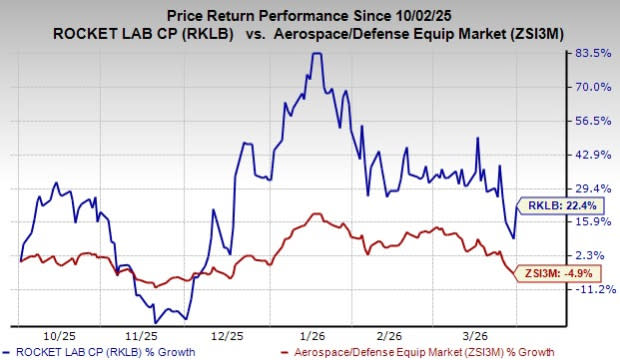
In the past six months, shares of the company have risen 22.4% against the industry’s 4.9% decline.

Image Source: Zacks Investment Research

RKLB currently has a Zacks Rank #3 (Hold). You can see the complete list of today’s Zacks #1 Rank (Strong Buy) stocks here.

Want the latest recommendations from Zacks Investment Research? Today, you can download 7 Best Stocks for the Next 30 Days. Click to get this free report

Lockheed Martin Corporation (LMT) : Free Stock Analysis Report

L3Harris Technologies Inc (LHX) : Free Stock Analysis Report

Rocket Lab Corporation (RKLB) : Free Stock Analysis Report

This article originally published on Zacks Investment Research (zacks.com).

Zacks Investment Research
Comments
You must be logged in to comment.