aljazeera Press
Iran War: What a Marine Expeditionary Unit is – and other US military terms
Images
1 / 9

2 / 9

3 / 9

4 / 9

5 / 9

6 / 9

7 / 9

8 / 9

9 / 9
The US has deployed thousands of additional Marines and airborne troops to the Middle East since the Iran war began.

Save

Share

The United States is continuing to build its military presence in the Gulf as its war with Iran enters its second month.

The February 28 launch of “Operation Epic Fury”, the joint US-Israeli air campaign targeting Iranian military and nuclear infrastructure, has continued for more than four weeks with strikes across Iran, killing thousands.

Secretary of Defense Pete Hegseth announced on Tuesday that the US had deployed a third aircraft carrier, the USS George HW Bush, to join two carrier groups already in the region – the USS Abraham Lincoln in the Arabian Sea, and the USS Gerald Ford, which is currently undergoing maintenance and repairs in Croatia.

On board these carriers and their accompanying warships are thousands of sailors, Marines and specialised support personnel.

Al Jazeera explains what the various forces sent to the Middle East are and their combat capabilities.

The military doesn’t deploy an aircraft carrier by itself. A Carrier Strike Group (CSG) is the aircraft carrier plus its escort ships and support units that act as a floating base. As of April 1, the USS Abraham Lincoln is the only carrier currently launching daily combat sorties against Iranian targets. The USS George HW Bush is currently in transit and is expected to eventually replace the Ford, which has been on an extended deployment in the Mediterranean.

An Amphibious Ready Group (ARG) acts as a mini aircraft carrier and carries US Marines and equipment for landing operations. The main feature of an ARG is that it can launch sea-to-land invasions. The USS Tripoli ARG is currently active and stationed, having arrived in the Middle East on March 27, while the USS Boxer ARG is en route and expected to arrive in mid-April.

The main difference between an Amphibious Ready Group (ARG) and a Carrier Strike Group (CSG) is their mission. An ARG is built to put troops on land, while a CSG is built to project air power and fight major wars at sea.

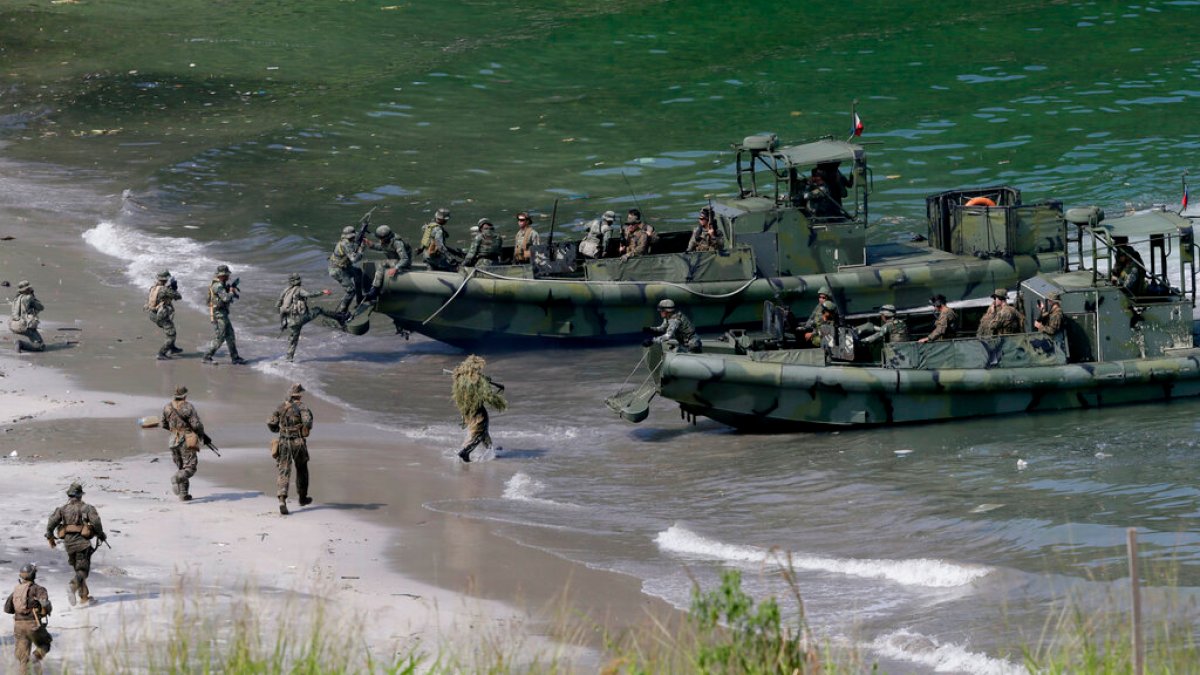
A Marine Expeditionary Unit (MEU) is a self-contained, rapid-response force typically consisting of 2,200 to 2,500 personnel from the United States Marine Corps, capable of conducting sea-based combat and humanitarian missions.

On Friday, US Central Command confirmed that 2,200 Marines from the 31st Marine Expeditionary Unit (MEU) had arrived in Middle Eastern waters after being ordered to depart Sasebo, Japan, where they are normally stationed, on March 13.

A second Marine Expeditionary Unit, carrying roughly 2,500 Marines from the 11th MEU, is also inbound after leaving San Diego on March 18.

Additionally, the Pentagon ordered approximately 2,000 soldiers from the US Army’s 82nd Airborne Division to begin moving to the Middle East.

The additional deployments will add to the 50,000 US troops already stationed in the Middle East.

The 2,200 Marines and Sailors within an MEU are divided into four specific roles, including:

MEUs are almost always deployed by sea, on board a three-ship Amphibious Ready Group (ARG), which essentially acts as a floating base.

These ships typically include:

MEUs can carry out sea-to-land assaults, raids, evacuations, humanitarian aid, disaster relief and other military operations. They are usually the first at the scene of a conflict.

The United States Marine Corps maintains seven active Marine Expeditionary Units, two of which – the 31st MEU and the 11th MEU – are assigned to the Iran war.

The MEUs are divided between the East Coast, the West Coast and the Asia Pacific. They include:

Typically, three MEUs are deployed or forward-positioned at any given time. They rotate through deployments around regions such as the Mediterranean, the Gulf and the Asia Pacific.

MEUs have been used in several US invasions.

During the 2001 invasion of Afghanistan, the 15th and 26th MEUs launched from ships in the Arabian Sea and flew more than 640km (400 miles) inland in one of the longest amphibious vertical-insertions in history.

In 2003, the 15th MEU was among the first units to cross the border from Kuwait, securing the critical port of Umm Qasr. The 31st MEU was also pulled in to fight in the Second Battle of Fallujah in 2004.

Most recently, the 22nd MEU provided sea-based support for the January 3 abduction of Nicolas Maduro in Venezuela.
Comments
You must be logged in to comment.