huffpost Press
Once You Realize This Quirk Of Trump's Speeches You Won't Be Able To Ignore It
Images
1 / 10

2 / 10
3 / 10

4 / 10
5 / 10
6 / 10

7 / 10
8 / 10
9 / 10

10 / 10
If you’re a seasoned consumer of the various communications from President Donald Trump, you’re familiar with his ol’ razzle-dazzle speaking style. Even if the sentences aren’t totally complete, he leaves a lasting impact.

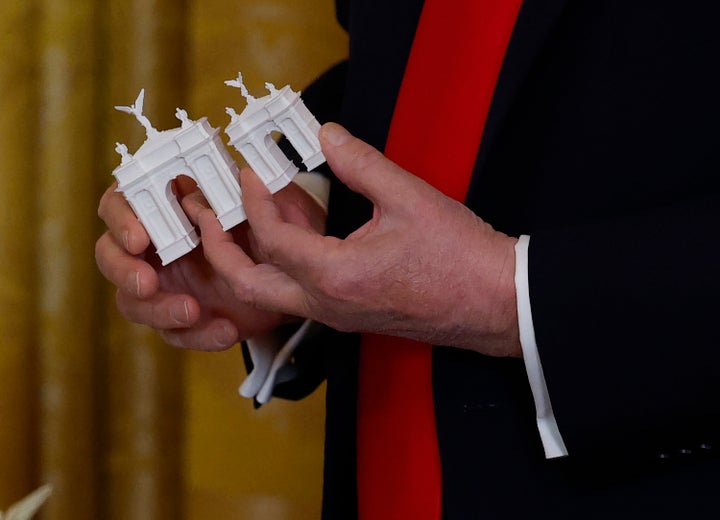
Another recurring theme in his political speeches and publicity moments is his use of props — which is frequent.

While it can at times feel a little like you’re up at 5 a.m., bleary-eyed, watching an infomercial for a blender, there’s actually real rhetorical power behind the objects (and people) Trump chooses to employ as props. And there’s neuroscience to back it up.

There are numerous cases of props being used in politics over the years — before and after the arrival of Trump on the scene. There are the silly props of the filibuster age — think Ted Cruz reading Dr. Seuss on the Senate floor to oppose the Affordable Care Act in 2013 — and more solemn props like President Barack Obama famously drinking the filtered water from Flint, Michigan, amid the ongoing contamination crisis in the city. There have been whole studies dedicated to how other leaders (like Israel’s Prime Minister Benjamin Netanyahu) use props to bolster their rhetoric.

And that’s because, in persuasion theory, props play a unique role in helping access the parts of an audience’s brain needed to get their point across, as Patti Wood, a body language and nonverbal communication expert, and author of “SNAP: Making the Most of First Impressions, Body Language, and Charisma” told HuffPost.

“Objects affect the brain in a totally different way — specifically the limbic brain, that primitive brain,” Wood said. ”That increases the speed in which we process it. If someone sees a prop, it hits their limbic brain, they’ll see it faster and it hits them emotionally.”

That speed is notably very fast, with an MIT study from 2014 finding that the human brain can process images in as little as 13 milliseconds. And it helps even more when there are other senses involved to better target the emotions of his audience — a tactile prop that comes with auditory cues, kinesthetic cues, scent cues — they can all fast-track getting the response you’re aiming for.

Targeting the emotions allows the points being made (and even ones being made less effectively in terms of facts, logic and data) to reach these audiences in a way that’s more “visceral,” Wood noted.

″[Using props] does help reach a different audience in a different way,” she continued. “Typically, in a regular speech, the audience retains 10-25% [of information shared], not more than 25% in just a stated speech with words. But props increase not only the attention but the retention.”

Just because props aren’t new to politics — especially in the digital attention economy — doesn’t mean Trump’s particular style isn’t an outlier.

A few of his highlights of prop use include the aforementioned binders of “Epstein files” prepared for influencers, riffing with a binder clip while discussing his “365 Wins in 365 Days,” using a garbage truck to attack Joe Biden over comments he had made in a back-and-forth over racist comments about Puerto Rico, “making fries” at a McDonalds, and the various miscellaneous photo opps featuring hard paper copies of documents with his signature.

To Wood, it’s clear that Trump really enjoys his props. They both work to assist him in his delivery and, in her view as a body language expert, he is visibly delighted by them.

“They know the power of the props, they plan the props and [Trump] likes to see the emotional effect of his presentations. He gets fed by that and that makes him speak better in those moments,” Wood said. ”I can see his [nonverbal communication], he delights and smiles when the props are on the table, when he’s holding a prop. He really enjoys it.”

Moments such as the infamous “steak infomercial” event in 2016 also stand out. After winning the Michigan and Mississippi primaries, Trump celebrated his victories at the Trump National Golf Club, flanked by Trump-branded bottled water, wine and steaks (all while dealing with a complicated legal battle over fraud involving Trump University, which he eventually had to settle over).

These moments in particular can be examples of Trump “flipping the narrative” and bolstering the brand he had been steadfastly building.

“He was using all the physical props of his business behind him — even though some of them were failures — to show his business acumen and credibility,” Wood said.

“The prop becomes a replacement for facts,” she continued. “That’s not a benefit, but it’s a power.”

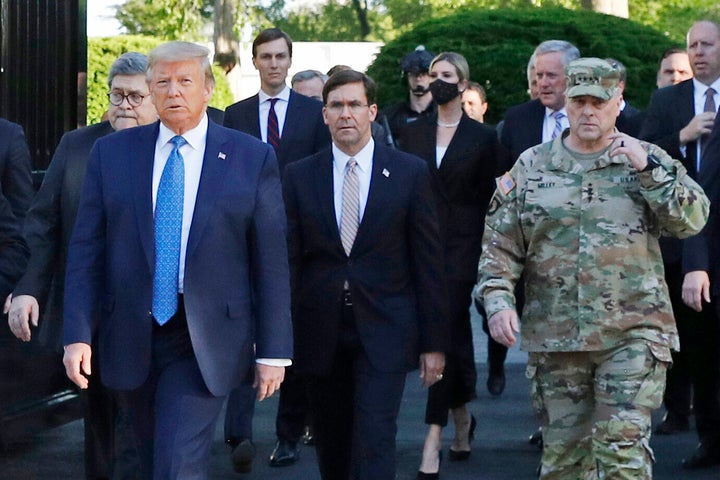
People can notably be props too — and Trump has had more than his fair share of those moments, from the use of Gen. Mark Milley in photos (with an often upside-down Bible) taken outside St. John’s Episcopal Church in Washington, D.C., after federal police used rubber bullets and tear gas on a crowd of peaceful protesters in June 2020.

“A lot of times, his team is having a sense of humor [about the props],” Wood said. “But the people who haven’t seen him interact with a prop before often look uncomfortable. Like [Milley]. He was so horrifically uncomfortable.”

One thing Trump is fairly successful at doing with a prop is making it a part of his brand. And Trump’s brand-building is incredibly strong: From his uniform (the blue suit, red tie, white shirt that is instantly recognizable), to the catchphrases and verbal quirks that have defined his entertainment and political careers.

Wood said Trump is particularly good at integrating his props into “artifacts” that often both stick the rhetorical landing he is shooting for with his base and work their way into his identifiable brand.

She cites the bandage he wore following the 2024 assassination attempt that famously had other Republicans sporting ear bandages in solidarity. “It has duality of power because there’s some part of our brain that always remembers him with the bandage on him. It becomes permanent, an artifact and part of the brand.”

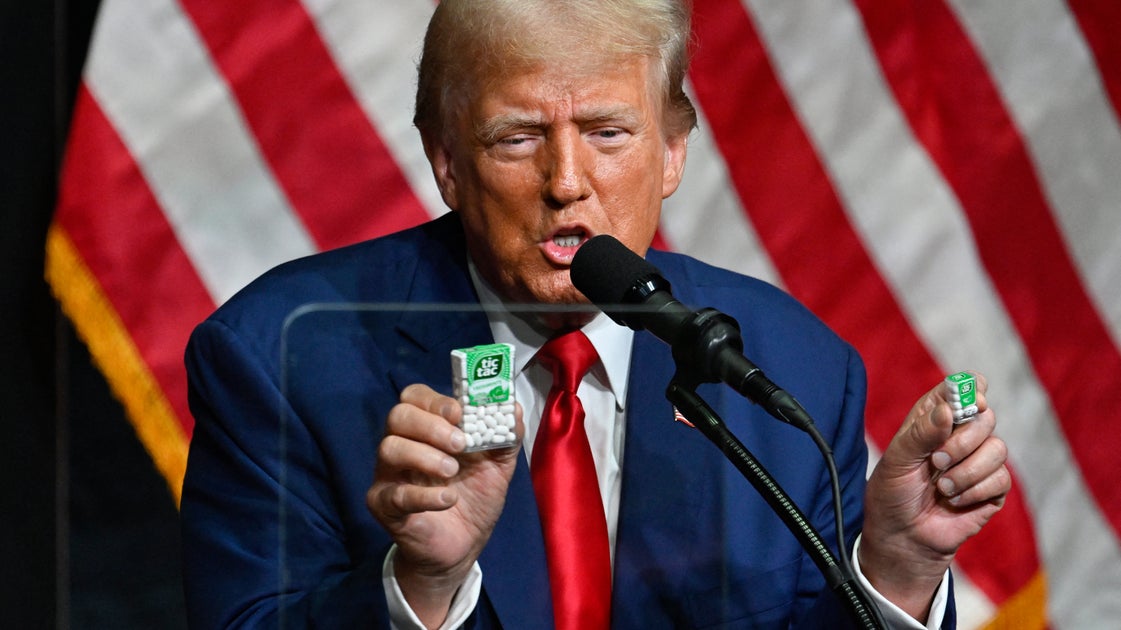
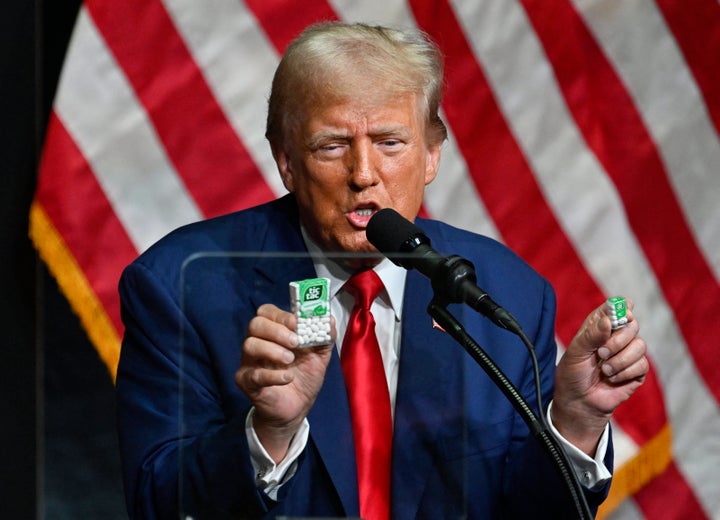
Another memorable moment that felt illustrative to Wood was when Trump famously used large and small containers of Tic Tacs to attempt to demonstrate his plans to combat inflation. It’s an example of the ways Trump specifically will use visuals to simplify (even if it’s not factual) concepts in a way that will please his base.

“The complex concept was inflation. He was saying he was going to reduce inflation, so you don’t have the small container of Tic Tacs,” Wood said. “It makes it easier for even someone who can’t read to comprehend what Trump’s saying because it simplifies it so much.”

And, yes, these oversimplifications can often get messy when facts, data and policy are examined too closely. So it helps that Trump and his team are likely aware that their base isn’t really going to do that — so the memetic shorthand of the Tic Tacs and the nature of the comments (“I’m going to fix this”) are able to linger in the memory.

“His people know that people aren’t necessarily going to read a heavy-duty article on how he’s going to affect inflation, but they’ll remember the Tic Tacs,” Wood said. “Things are turned into memes. The meme of the prop becomes the memorable message.”

The original version of this story was published on HuffPost at an earlier date.

By entering your email and clicking Sign Up, you're agreeing to let us send you customized marketing messages about us and our advertising partners. You are also agreeing to our Terms of Service and Privacy Policy.
Comments
You must be logged in to comment.