bbc Press
How a prolonged Middle East conflict could reshape how we fly
Images
1 / 15

2 / 15

3 / 15

4 / 15
5 / 15
6 / 15
7 / 15
8 / 15
9 / 15

10 / 15

11 / 15
12 / 15

13 / 15
14 / 15

15 / 15
It was once a humble outpost in the world of global aviation, a dusty overnight halt for luxury flying boats making the arduous journey from the UK to far-flung parts of the British Empire, such as India and Australia. By the 1960s, it had a simple runway made of desert sand, used as a refuelling stop by airliners en route to arguably more exotic destinations.

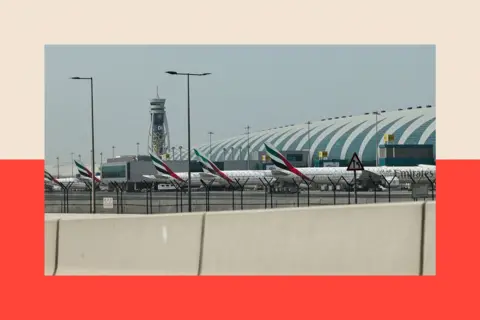
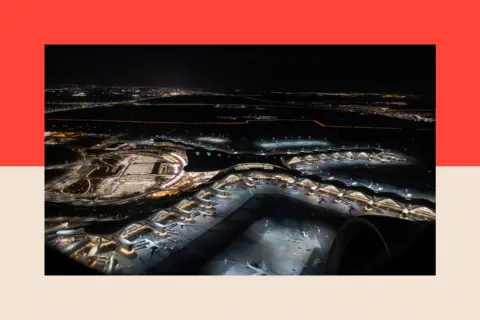
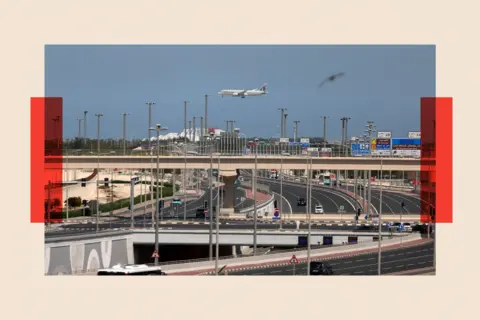
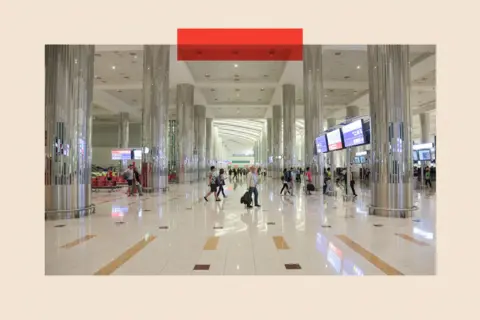
Yet today, Dubai is one of the key pillars of the industry, and Dubai International Airport (DXB) is its beating heart. In 2024, more than 92 million passengers made their way through its gleaming, marble-floored halls and sparkling, brightly lit shopping malls.

That makes DXB the busiest airport in the world for international passengers - far outstripping London Heathrow, for example, which accommodated just under 83 million. Nor is Dubai alone within the Gulf as a major hub. Rival airports in Abu Dhabi and the Qatari capital, Doha, are not quite as busy, but they still handled some 87 million passengers between them.

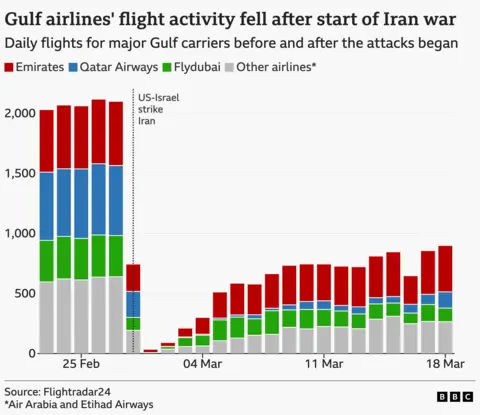
Under normal circumstances, these three Gulf airports together handle more than 3,000 flights every day, the majority of them operated by the local carriers, Emirates, Etihad and Qatar Airways.

But the conflict in the Middle East has had a dramatic impact on global aviation. First, there was the paralysis of flights through some of the busiest airspace in the world, leaving aircraft at major hub airports grounded and hundreds of thousands of passengers stranded. Air traffic in the region remains heavily disrupted.

Then there is fuel. With supplies from refineries in the Gulf choked off after Iran effectively blocked the Strait of Hormuz, it has become a serious concern. The region normally accounts for about half of Europe's jet fuel imports, and fears of scarcity have caused prices to double since the start of the conflict. Some carriers have already begun cutting flights in response.

But while these issues are likely to dominate the industry's thinking in the short-term - and will probably lead to higher prices in the months to come - there's also a question mark over what the longer-term implications will be.

In particular, insiders are asking what it all means for the hugely successful "Gulf model" of aviation - which has been widely credited with transforming long-distance travel and making it cheaper. And that has serious implications for airlines, passengers and businesses in the Middle East that rely on the region's abundant airline connections.

The Gulf hubs, normally well-oiled machines, shuddered to a halt following the first US-Israeli strikes on Iran in late February. With airspace closed across the region, aircraft were grounded. Some planes that had already taken off were forced to turn back.

Tens of thousands of passengers were left stranded in Dubai, Abu Dhabi and Qatar, many of them people who had only arrived in the region to change planes. Meanwhile, both the United Arab Emirates and Qatar were being targeted by retaliatory drone and missile strikes from Iran, creating a tense and fearful environment for those who were trapped in airports and hotels.

Many more passengers around the world were unable to travel on the services they had booked, because their flights were due to go via one of the Gulf hubs. They were left scrambling to find alternatives.

Emirates and Etihad did begin operating a limited service to get people home within days, and Qatar Airways followed suit shortly afterwards. Other carriers from outside the region also put on flights. Some governments, including the UK's, chartered their own aircraft to help people leave the region.

Since then, the situation has stabilised somewhat, with all three major carriers operating regular flights from their hubs. But schedules remain limited and prone to disruption. According to analysts at Cirium, more than 30,000 services to the Middle East as a whole have been cancelled since the start of the conflict.

Much of this took place in a harsh glare of publicity, as travellers took to social media or spoke to news networks about their experiences and frustrations.

Among them was Ian Scott, who had been flying from Melbourne to Venice via Doha. His outward flight from the Qatari capital was forced to turn back in mid-air, and he subsequently had to spend several days sheltering in a hotel, before choosing to spend two days driving through the desert to Oman. From there, he was eventually able to get a flight out.

He now says that in future, he would avoid flying via the Gulf hubs, even once hostilities have ceased – because he has "no faith" the region's troubles would end there.

And it's the verdicts of travellers like Ian that will be most worrying for the hubs' operators.

Even though Dubai, in particular, has developed into a major tourism and business destination in its own right, more than half of travellers through the Gulf hubs are not there to stay. They simply want to change planes.

Last year 47% of Dubai's passengers were there to board connecting flights, compared with 54% of Abu Dhabi's and 74% of Doha's, according to OAG, an aviation data firm.

And this is the essence of the Gulf aviation model. Passengers are flown in on long-haul services from cities around the world, to meet carefully timed connections, which can then take them on to a wide range of equally far-flung destinations. It means they can travel from Boston to Bali, or Amsterdam to Antananarivo with a single stop and a minimum of fuss.

This contrasts with the conventional "hub-and-spoke" model, which involves flying passengers into hub airports from a regional, short-haul network, where they can transfer onto large planes for long-haul services on busy international routes. It is also different from "point-to-point" flying, which sees passengers travelling on direct long-distance routes between secondary cities, generally aboard smaller aircraft.

The Gulf carriers' approach combines some of the convenience point-to-point gives passengers with the economies of scale for airlines associated with the hub-and-spoke system. It is a unique model and one that is very dependent on geography.

"Within three hours flying time of the Gulf, you have the Middle East, the Indian subcontinent, verging on China. It's a huge market," explains James Hogan, a former chief executive of Abu Dhabi-based Etihad Airways. He ran the carrier for 11 years - from 2006-2017 - overseeing a period of rapid expansion for the company, which began operations in 2003.

"The Gulf carriers were able to build a very strong network, not only of hub cities, capital cities – but also the major secondary cities and third cities, which enabled one-stop flying," he says.

Andrew Charlton, managing director of consultants Aviation Advocacy agrees. "The Gulf is just in that place where, with the current technology, you can get to practically anywhere on Earth," he says.

And so, in the early years of the century, that put the region's airlines in an ideal position to take advantage of rapid growth in markets such as China and India, which he believes European and American carriers initially overlooked.

"The Middle East was suddenly in exactly the right place for the emerging market, which was well east of the Atlantic," he says.

The Gulf carriers, as relative newcomers to the industry, were also able to invest in modern fleets ideally suited to the kind of model they were building. Initially, the twin-engine Boeing 777 was favoured for its 300-seat capacity and range of more than 7,000 nautical miles, while later, the Airbus A380 superjumbo also became a useful tool for carrying more than 500 passengers to and from congested airports where take-off and landing slots were scarce.

"The major differentiator was starting with a clean sheet of paper. That was the secret sauce," explains Mr Hogan. "You were able to create a service proposition that couldn't be matched by carriers in more traditional markets, whether that be the USA, Europe or Australasia."

As a result, the Gulf carriers and the hubs they serve have grown rapidly since the start of the millennium, becoming a key junction for long-distance aviation.

"It is the pivot point for passengers that arrive from Europe and North America… who are scheduled to connect onwards on another flight to Australia, South East Asia, Singapore, Hong Kong or the Indian subcontinent," explains John Grant, senior analyst at OAG.

"It is a hugely efficient, very effective operation that sees 90-100 flights arriving in a one-hour time window and then departing somewhere else an hour or two later."

All of this has also had a significant impact on the cost of long-haul aviation.

"Competition drove down prices, and the Gulf carriers were a competitive game changer," says Mr Charlton. "They added capacity to long-haul markets, they created long-haul markets… so of course they drove airfares down."

But the conflict in the Middle East has thrown all this into disarray, according to Kristian Coates Ulrichsen, a Middle East expert at the Baker Institute in Texas. He says a long drawn-out conflict could deter travellers from passing through the Gulf – and have a long-term impact on the way its airlines operate.

"Of course the business model is going to be called into question the longer it goes on," he says. "If people don't feel secure about travelling because they feel they'll get stuck, or that at any time the airport might be closed because of a drone, even if it's intercepted, that will do a lot of damage."

The key question is how much this has damaged the Gulf's reputation as a focal point for global aviation – and whether its model has suffered lasting damage.

According to Charlton, a great deal will depend on how long the conflict goes on for. If it is over quickly, he says, the Gulf carriers will recover lost ground quickly because "they will just flood the market with cheap airfares".

But the more it drags on, he says, "the more passengers will find alternate ways to fly", with rival carriers offering connections via alternative hubs such as Singapore, Bangkok, Hong Kong or Tokyo.

Meanwhile the long-term loss of capacity normally provided by the Gulf airlines, he says, would inevitably drive prices up.

"Did the Gulf carriers cause lower fares? Yes they did. Take Gulf carriers out of the equation, air fares are going to go up, as sure as eggs are eggs."

European airlines have already responded to the crisis in the Middle East by changing their own schedules, and adding flights that avoid the need for a stopover in the Gulf. British Airways, for example, has introduced a number of extra services each week to Bangkok and Singapore, while Lufthansa and Air France KLM have also added extra flights to Asia.

But according to Willie Walsh, the Director General of the International Air Transport Association (IATA), European airlines simply do not have the resources to replace the Gulf carriers, who normally account for 9.5% of global capacity, to any great extent.

Speaking to journalists at an event in Paris in mid-March, he said "there is no way the capacity provided by carriers in the Gulf can be replaced by European carriers", adding that he expected Gulf aviation to recover quickly once the conflict has eased.

It is worth mentioning that the future of the Gulf model has been questioned in the past, not least during the Covid pandemic, when some experts suggested carriers reliant on long-haul routes and transit traffic, using fleets of large aircraft, were not agile enough to respond to changing circumstances. In reality, the recovery was rapid, with Emirates, Etihad and Qatar Airways all showing healthy profits in recent years.

"The aviation industry has seen Sars, it's seen Covid, it's seen geopolitical events in various parts of the world," says Grant. "It's seen stock market crashes, and it bounces back."

There is, however, a great deal at stake, and not just for the aviation industry. In recent years, Dubai, in particular, has moved away from simply being a transit destination to become a hub for business and tourism in its own right.

"The Gulf states have always had very strong oil and gas sectors, but diversification has always been a key priority for their leadership," explains the former Etihad CEO, James Hogan. "With the ability to create aviation hubs, there was a major move in that diversification, because of the catalytic effect of aviation."

Ulrichsen agrees. The United Arab Emirates, he believes, has established itself as "a place where people aspirationally want to go and live and work and do business. And so much of that model is based on the attractiveness of Dubai".

That prosperity, however, could potentially be put at risk if air traffic to the region fails to recover quickly, with the tourism sector looking particularly exposed.

"My intuition is this will have a lasting impact… because of the safety perception you have in your mind," says Johannes Thomas, chief executive of the travel specialist Trivago. He believes it will take "maybe two to three years" before those safety concerns are fully overcome.

But Hogan is far more optimistic.

"This is a major crisis, but it will be resolved at a point in time", he insists. "I've seen it over the years. Some people in the early days may be apprehensive, but travellers will come back.

"I'm very bullish about what the Gulf has to offer."

There's no question that, in the short term at least, the conflict in the Middle East has come as a severe blow to the major Gulf carriers and the hubs they rely on. The region is now likely to be viewed with some trepidation by tourists and business travellers alike

Overcoming that reputational damage can only really begin once hostilities have eased. If the Gulf can resume its role as a junction to the world, then the industry will be able to carry on much as before - but if that isn't possible, the implications for long-haul aviation around the globe could be profound.

BBC InDepth is the home on the website and app for the best analysis, with fresh perspectives that challenge assumptions and deep reporting on the biggest issues of the day. Emma Barnett and John Simpson bring their pick of the most thought-provoking deep reads and analysis, every Saturday. Sign up for the newsletter here

The UK giant is optimistic but chief executive Greg Jackson tells the BBC he is making contingency plans.

There is indirect contact and channels between the two sides - but a deal may still be a long way off.

Crude rose back above $100 a barrel as the US and Iran clashed over bringing the conflict to an end.

Trump says he is talking to "the right people" in Iran, but Tehran says no such negotiations are being held.

For every $10 rise in oil prices, motorists face paying roughly 7p per litre more in the UK.
Comments
You must be logged in to comment.