huffpost Press
Democrats See Hope In Numbers Beneath Florida Special Election Wins
Images
1 / 5

2 / 5

3 / 5
4 / 5

5 / 5
Buried in the results of Tuesday’s special elections in Florida are numbers offering hope to Democrats both there and across the country: The winning candidates won far more votes than the number of Democrats who cast ballots, meaning they drew significant support from independents or even Republicans.

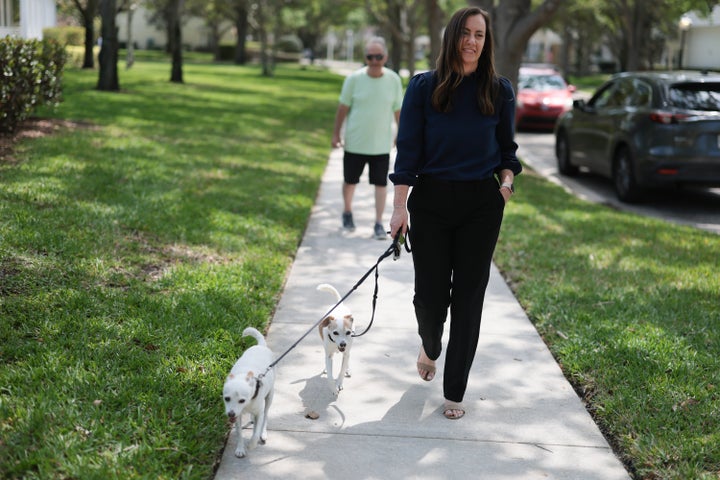
In the Palm Beach County state House district that includes President Donald Trump’s Mar-a-Lago home, Democrat Emily Gregory received 17,113 votes, even though only 12,100 Democrats cast ballots, according to a HuffPost analysis of voter turnout data.

In Tampa Bay’s Hillsborough County state Senate district, Democrat Brian Nathan received 40,212 votes, considerably more than the 29,674 Democrats who voted in the election.

The math means that both Democrats must have dramatically overperformed with independent voters — known as “no party affiliation” in Florida — or pulled from Republicans, or a combination of both. In Nathan’s race, more than 25% of the votes he received came from independents and Republicans. In Gregory’s case, that figure was nearly 30%. In both races, thousands more registered Republicans cast ballots than Democrats.

Just 16 months earlier, Trump had won the Palm Beach district by 11 points and the Tampa district by 7.

“Winning in Donald Trump’s own backyard isn’t an accident, it’s a road map to how Democrats can compete and win everywhere,” said Democratic National Committee chair Ken Martin.

While Democrats have won special elections across the country since Trump’s 2024 victory, it’s often been because their base ― which loathes Trump ― is simply more motivated to vote. The Florida results show the party is now also performing strongly with persuadable voters.

David Jolly, a former Tampa Bay Republican lawmaker now running for governor as a Democrat, said Tuesday’s results prove the point he has been repeating at campaign stops for months. “Motto this year is: You don’t have to be a Democrat to vote for a Democrat,” he said.

To this point, Florida has not been viewed as a top battleground for the 2026 midterm elections. But Jolly and others hope that Tuesday’s results can convince national Democrats to invest in both the governor’s race and the Senate contest.

There could also be a more immediate impact: While Florida Republicans had long planned to redraw their state’s congressional maps later this spring to squeeze out as many as five more seats for themselves, Tuesday’s results may well spook the party’s incumbent U.S. House members and make them reluctant to import more Democratic voters into their districts.

“I think the legislature needs to be very cognizant of the fact that if they get too aggressive … you could put incumbent members at risk,” Sarasota-area Rep. Greg Stuebe, a Republican, told Politico.

One prominent Florida Republican consultant, who spoke on condition of anonymity, said GOP Gov. Ron DeSantis’ desire to boost his presidential resume for 2028 will collide with incumbent House members’ desire to protect their jobs.

“Legislative leaders are eager to please Trump so they will push for a modest redraw, but DeSantis will take their product, tear it up and say they are weak RINO mappers and then insist on a plan that will try for too many Republican districts,” he predicted.

His analysis of Tuesday’s results was that the two Democratic candidates likely won independents by a 60-40 margin and took 10% of ballots cast by registered Republicans. “The Republican bleed was higher than the Democratic bleed,” he said.

“This is like the third time in the last few weeks that Dems were able to flip seats when they are getting outspent 10 to one.”

A big reason for the Democratic victories, in his view, was obvious: Donald Trump.

“A lot of independents voted for Trump because he said he would lower prices, and he didn’t do it,” he said, adding that the qualities of the candidate Trump had endorsed in the Palm Beach district, Jon Maples, had little to do with it.

“They’re not voting against Jon Maples. They don’t even know who he is,” the GOP consultant said.

In the case of the Tampa-area Senate seat, the Democratic candidate was outspent 10 to 1 and still squeaked out a 400-vote victory.

Democrats “don’t even need to spend money to turn their base out,” said Zachary Donnini, who has been tracking special elections around the country for VoteHub. “This is like the third time in the last few weeks that Dems were able to flip seats when they are getting outspent 10 to one.”

Donnini said that while candidates in some special elections can win simply by driving turnout within their own party, that was clearly not the case in either of the two Democratic wins Tuesday, where the registration advantage for Republicans was just too large.

(Florida held a third special election Tuesday, for a House district in Polk County that was won by the Republican, but it is likely not a good data point because the Democrat was technically ineligible to run or serve, and for that reason, received little support. The turnout in that race was less than half that of the other two. Even there, though, the Republican won by eight points in a district Trump had won by 14 in 2024.)

“These races weren’t won by Democrats casting ballots alone. Our early estimates show that there had to be significant NPA and Republican crossover in Tuesday’s elections to achieve this result,” said Florida Democratic Party chair Nikki Fried. “The reason why is simple: Floridians are tired of the chaos.”

By entering your email and clicking Sign Up, you're agreeing to let us send you customized marketing messages about us and our advertising partners. You are also agreeing to our Terms of Service and Privacy Policy.
Comments
You must be logged in to comment.