yahoo Press
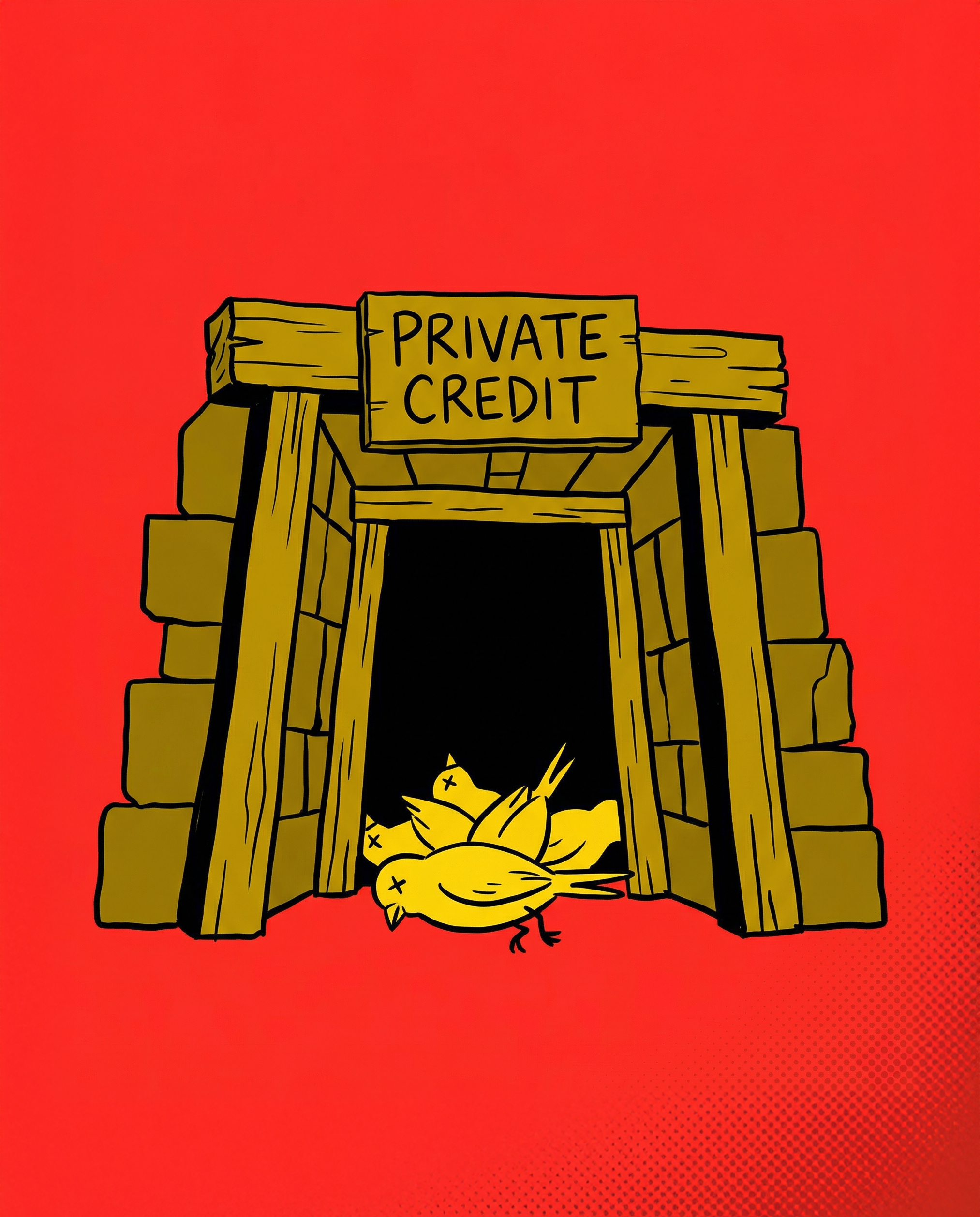
Private Credit Is Having Its Moment…Unfortunately It’s This One
Images
1 / 5
2 / 5

3 / 5

4 / 5
5 / 5
Private credit has spent the last decade telling everyone it was the smartest money in the room. Patient, disciplined, above the noise. Funny thing about that is the room is now on fire. Moody's just downgraded KKR’s private credit fund to junk, borrowers have stopped repaying their loans, and retail investors who were promised "steady returns" are learning the hard way that those allegorical “gates” can literally close. So let's skip the jargon: a $3 trillion market is slowly turning septic, and the infection could hit Wall Street in a way we haven't seen since 2008.

Feel better?

Moody's pushed FS KKR from Baa3 to Ba1 late Monday, which is the rating agency's way of saying, “You look terrible, go lie down.” FS KKR is a business development company, or BDCm which is essentially a publicly traded fund that loans money to mid-sized businesses that traditional banks would likely never. Non-accrual loans, (meaning credits where interest payments have stopped entirely) hit 5.5% of total investments at year-end 2025, one of the highest rates among rated BDCs. FS KKR posted a net loss of $114 million in Q4 alone and earned $11 million in net income for the full year, which, for a fund that size, is like finding a dollar in an old jacket.

Moody's also noted that FS KKR carries more leverage than its peers, a higher share of PIK loans, and fewer first-lien positions (the loans that actually get made whole when a borrower implodes). Since FS KKR borrows money to juice its own returns, a downgrade raises its borrowing costs, which compresses its yields, which makes the already-underwhelming income story even harder to tell at the next investor dinner.

The pitch was simple: non-bank lenders fill the void that Basel III left when it effectively told banks to stop making interesting loans, charge higher rates, and deliver consistent returns. The five largest managers (Apollo, Ares, Blackstone, Carlyle, and KKR) grew the asset class at 14% annually, compounded, for a decade, and now control roughly $1.5 trillion in perpetual capital. Over $520 billion of that sits in retail-facing vehicles like BDCs and interval funds. Main Street money, playing a game designed for institutions with 10-year time horizons and no Twitter account.

The vulnerabilities were always there, just never tested. PIK loans, where a company that can't pay interest in cash just adds it to the principal instead, are now everywhere. It is the financial equivalent of the "I'll Venmo you later" that you both know is never coming, and 90% of managers expect to see more of them in 2026. The headline default rate is 2%, which looks fine until you count the restructurings, the liability management exercises, and the "maturity extensions": euphemisms the industry has spent years cultivating precisely because they don't technically count as defaults. Add those in, and the real rate looks closer to 5%.

Our analysts just identified a stock with the potential to be the next Nvidia. Tell us how you invest and we'll show you why it's our #1 pick. Tap here.

There is a movie people have seen before that rhymes with this one. Complex, opaque credit instruments with flattering headline numbers, rated and packaged and sold down to retail, carrying structural protections that turned out to be more decorative than functional, in a market that had never actually been stress-tested. The MBS vintage of 2006 would like a word.

We're not saying that private credit is not subprime mortgages. The underlying assets are different, the leverage is lower, and the systemic footprint is smaller. But the pattern of "this worked great for a decade, how bad could it get?" has a pretty consistent track record.

FS KKR is what happens when all of this compounds in one place: deteriorating asset quality, a software-heavy portfolio under sustained valuation pressure, and a retail investor base that, unlike the pension funds this game was built for, can and will demand its money back at the worst possible time.

As we covered earlier this week, even Apollo, which has spent considerable energy telling investors it lends to bigger, more stable companies than its rivals, just had to gate its flagship BDC after redemption requests hit 11.2% of shares outstanding against a 5% quarterly cap. Apollo will return roughly 45 cents on the dollar to shareholders seeking out. Software loans, the thing Apollo said it wasn't really exposed to, make up 12.3% of the fund. Liquidity mismatches are fine until they're not, and "until they're not" has arrived for parts of this market. Blue Owl tried to merge its gated retail fund into a publicly traded sibling last year; investors noticed they'd be taking a 20% haircut on the conversion and the deal died on the table. The February fix was a $1.4 billion asset sale at 99.7 cents on the dollar, which management called proof of rigorous valuation and everyone else called cherry-picking. Blue Owl is heavily exposed to software, its shares are down over 38% in 2026, and the canary is not doing well.

The Fed is expected to cut rates three times this year, which helps some borrowers but compresses the yields that made private credit worth the trouble in the first place. The smarter managers are already pivoting toward asset-based finance, lending against data centers and real infrastructure rather than corporate promises. The ones who aren't are watching their "high single-digit" return targets get harder to explain with a straight face.

Private credit likes to market itself as the scrappy, bank-free alternative to Wall Street, which is a great story and mostly fiction. Traditional banks stopped lending directly to risky middle-market companies, then turned around and lent to the funds doing it instead, providing the credit lines that private credit shops draw on to fund deals, essentially lending against the value of the fund's own loan portfolio. The banks sit senior, collect fees, and are effectively financing the competition that stole their clients. Capitalism contains multitudes.

The catch is that a loan backed by a portfolio of other loans is only as good as those loans, and since none of this trades on an exchange, funds are largely marking their own homework. A software-heavy portfolio worth 20% less than advertised makes the bank's collateral more of a hallucination. The ECB and Fed are reviewing these relationships to figure out whether a $1.7 trillion private credit stress event could shake the $3.5 trillion banking system quietly backstopping it. The plumbing is groaning. 2026 is the year everyone finds out if it holds.

One stock. Nvidia-level potential. 30M+ investors trust Moby to find it first. Get the pick. Tap here.
Comments
You must be logged in to comment.