huffpost Press
Supreme Court Signals Mail-In Ballots Could Be At Risk For Millions
Images
1 / 8

2 / 8
3 / 8
4 / 8
5 / 8
6 / 8

7 / 8

8 / 8
WASHINGTON — Signaling a threat to millions of voters who cast mail-in ballots across the country and overseas, the Supreme Court’s conservative majority appeared ready Monday to bless a recent push by Republicans to restrict how and when late-arriving mail-in ballots are counted.

The Republican National Committee, and Mississippi’s Republican and Libertarian parties have asked justices to unwind a Mississippi law passed in 2020 that allowed absentee voters to mail in their ballots with a postmark as late as Election Day. Under the state law, election officials were ordered to count ballots received as late as five days after Election Day. (Over 30 states currently have grace period rules for mail-in ballots that are similar.)

Paul Clement, the attorney representing the Republican National Committee, told the justices that all ballots, including mail-in ballots, must be received “into official custody” and counted by Election Day or be invalidated.

Seemingly suddenly disinterested in preserving states’ rights, Justices Neal Gorsuch, Clarence Thomas, Amy Coney Barrett and Brett Kavanaugh repeatedly appeared to share the RNC’s sentiments about the necessity of a singular Election Day —or one without grace periods for the counting of ballots. Justice Samuel Alito appeared to put a fine point on the majority’s grievances.

“We have lots of phrases that involve two words, the second of which is ‘day.’ Labor Day, Memorial Day, George Washington’s birthday, Independence Day, birthday and Election Day. They are all particular days. So if we start with that, if I have nothing more to look at than the phrase ‘Election Day,’ I think this is the day in which everything is going to take place,” Alito said.

And in a passing shot at early voting as well, Alito added: “We don’t have Election Day anymore. We have Election Month or we have election months,” Alito said. “I mean, the early voting can start a month before the election. The ballots can be received a month after.”

But for Mississippi, Election Day has been historically understood as the day of “final choice” for voters, not the final day that ballots can be completely tabulated. And this applies more broadly, too, according to arguments Monday from Mississippi Solicitor General Scott Stewart.

Since the Civil War, mail-in or absentee ballots have been part and parcel of the American voting experience, and since at least the 19th century, Scott explained, it has been acceptable for postmarked votes to be counted well after Election Day.

“This is the structure of our system: The states go first. If Congress doesn’t like it, they override it, and we respect what Congress said, but no further. That’s the history of voting and election law,” Scott said.

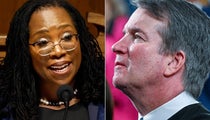
Appearing to support Scott’s position, Justice Ketanji Brown Jackson pointed out that if Congress meant to preempt how states receive or count ballots by Election Day, then it likely would have never passed laws like the Uniformed And Overseas Citizens Absentee Voting Act in 1986. Or amended it in 2009. (The legislation requires states to send absentee ballots to members of the military or citizens overseas at least 45 days before a federal election.)

Keeping the conservative justices focused on that question instead of a cascading list of hypotheticals was a tall order for Scott.

Thomas, Gorsuch and Barrett, for example, pressed Scott about whether votes would be accepted by a state if the voter’s ballot had been 1) given to someone else to turn in on their behalf, like a neighbor or even a notary public and was postmarked by Election Day, but 2) had not been received until after Election Day, though still received within the five-day grace period.

Gorsuch pondered, too, whether voters would be able to recall their mail-in ballots if a scandal involving their candidate (like a “sexual escapade or colluding with a foreign power,” he said) broke out after Election Day.

“Let’s say... the competing candidate immediately goes on the airwaves and urges voters to recall ballots and tells common carriers [of mail or ballots] not to deliver. Many common carriers will do that. You just call up FedEx and say, ‘I want it back,’” Gorsuch said.

But Scott told the court that ballot recalls like that aren’t allowed in Mississippi. And while Gorsuch told him he couldn’t find that in the state’s laws that he reviewed, Scott argued that even if Mississippi put a disclaimer on its ballots stating that said recalls were forbidden, the hypothetical ultimately doesn’t matter because there is no federal law that explicitly —or implicitly — states that absentee ballots must be received by a certain time.

Gorsuch, in turn, got stuck on whether it would be possible to prosecute every person who may have signed a ballot and then hypothetically recalled it.

Another hypothetical came from Kavanaugh on Monday when he suggested that late-arriving ballots may be major magnets for election fraud.

Did Scott have a “real concern” that the longer after Election Day that it takes to count votes, “the greater the risk that the losing side will cry that the election has been stolen?” he asked.

Voter fraud is minimal across the U.S., and as Scott pointed out to Kavanaugh: Even as the Justice Department throws its weight behind the RNC now, it provides no examples of fraud to support its claim, but instead points to vague or generalized fears.

“They haven’t cited a single example of fraud from post-Election Day ballots,” Scott said.

When Congress set out to make Election Day occur uniformly across the U.S., the “fraud” it was primarily concerned about was double voting, Scott argued.

Staggered Election Days opened the door for people to run across state borders to vote twice. That was the fraud states were concerned about.

“Mail-in voting has been part of the American election system since the Civil War.”

As Kavanaugh suggested that mail-in voting only became popular in recent years because of major disruptors like the COVID-19 pandemic, Stewart reminded the high court that states are supposed to adapt to changing circumstances.

“It’s the same way to think about the broader history of election law. When states have seen a problem, they have adapted and adjusted and often in the direction of making sure that more votes could be counted,” he said. “We wanted to widen the tent and make sure people could vote.”

Only Justices Jackson and Sonia Sotomayor appeared in strong opposition to the RNC’s arguments. Should the justices rule in favor of the committee, Mississippi won’t be the only state to see changes. At least 13 states currently have grace periods on the books.

Lisa Graves, co-founder of Court Accountability, a judiciary oversight group, said in a statement Monday that what’s at stake now is the votes of millions of Americans who want to cast a ballot in the midterms.

“Mail-in voting has been part of the American election system since the Civil War, and this method of voting is relied upon by nearly one million Americans serving in the military abroad and nearly 50 million Americans living in the U.S. Donald Trump has been irrationally at war with mail-in voting since the 2020 COVID-19 pandemic, despite state officials having decades of experience securely handling and counting mailed-in votes,” she said.

“Trump’s appointee to the U.S. Postal Service, the controversial Postmaster Louis DeJoy, has degraded the operations of the Post Office by delaying post-marking until mail is transferred to a small number of processing centers rather than at local post offices,” Graves continued. “And, now the Republican Party is trying to deny people from having their votes counted if their ballots were mailed by Election Day but received a day or two later.”

“With the stroke of a pen, John Roberts and his fellow Republican appointees could continue their assault on Americans’ voting rights by cancelling the votes of millions of servicemembers, seniors, and rural voters who rely on vote-by-mail. It is only common sense that Americans’ ballots be counted if they are postmarked by Election Day, as has been the practice for decades,” she added. “The question is whether John Roberts and his co-horts will continue to abuse the judicial power to aid the party that installed them or if they will suddenly start acting like fair judges devoted to protecting the hard-fought rights of [American] voters.”

This is a developing story. Please check back for updates.

By entering your email and clicking Sign Up, you're agreeing to let us send you customized marketing messages about us and our advertising partners. You are also agreeing to our Terms of Service and Privacy Policy.
Comments
You must be logged in to comment.