yahoo Press
The Saudi Oil Pipeline the World Didn’t Know It Needed
Images
1 / 5
2 / 5

3 / 5

4 / 5

5 / 5
(Bloomberg) -- Saudi Arabia had prepared and planned for the worst-case scenario for decades. So within hours of the first US and Israeli strikes on Iran which resulted in the effective closure of the crucial Strait of Hormuz waterway, the world’s biggest crude exporter rolled out a contingency plan — one that had waited 45 years to come to fruition — to keep its oil flowing.

Most Read from Bloomberg

Iranian Navy Guided Indian Tanker Through Hormuz, Crew Member Says

Trump Gives Iran 48 Hours on Hormuz, Threatens Power Plants

Super Micro Co-Founder Charged With Smuggling, Departs Board

Iran Says Ready to Let Japan Vessels Use Hormuz, Kyodo Reports

Target Plans to Tighten Dress Code Rules for Store Employees

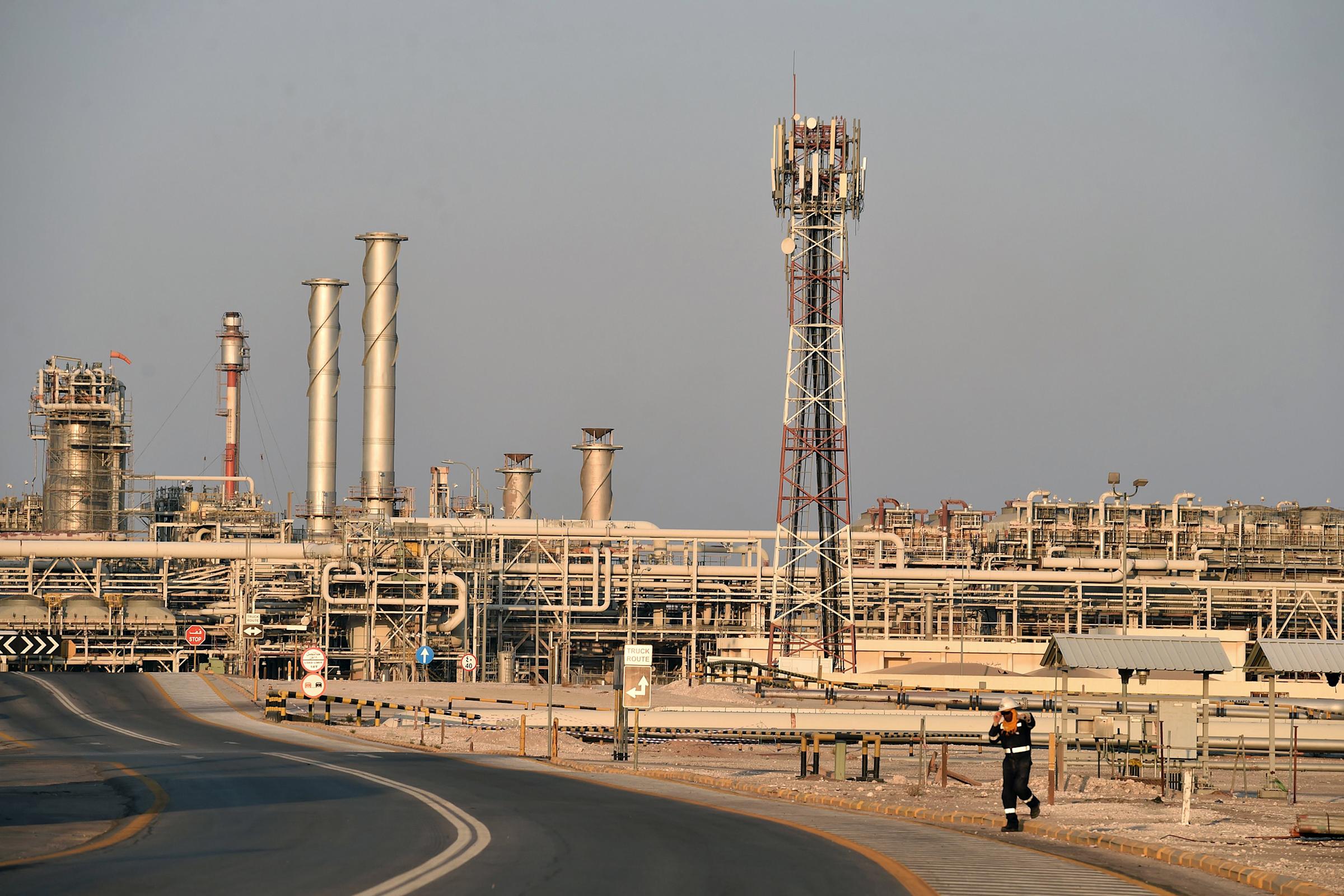
The cornerstone of that plan is a 1,200-kilometer pipeline, built in the 1980s, which has become a pivotal character in the evolving Middle East conflict. Running the breadth of the Arabian Peninsula from Saudi Arabia’s massive oil fields in the east of the country, the East-West pipeline empties out at the port of Yanbu on the Red Sea — a modern industrial city where a huge flotilla of oil tankers is massing to load Saudi crude, with more vessels arriving every day.

State-owned oil giant Saudi Aramco now faces the test of how quickly and sustainably it can ramp up flows through the new route. Crude exports from Yanbu hit a five-day rolling average of 3.66 million barrels on Friday, according to ship-tracking data compiled by Bloomberg, around half of Saudi Arabia’s prewar total. On Thursday loadings were briefly halted following an Iranian attack, a reminder that flows can be uneven in such a volatile environment.

The pipeline route offers a vital release valve to the pressure building on global oil supplies. About 20 million barrels, one-fifth of global consumption, normally flow through Hormuz on a daily basis. With no outlet for their barrels, producers have had to reduce output. However, Saudi Arabia, which has long framed itself as a stabilizing force in the market, has a substantial workaround.

“The East-West pipeline is looking like a strategic masterstroke right now,” says Jim Krane, the Wallace S. Wilson Fellow for Energy Studies at Houston’s Rice University. “The entire global economy is better off with the line in operation.”

“Were it not for this seamless Hormuz bypass, there’d be even more desperation in Trump’s calls for allied help,” adds Krane, referring to Donald Trump. On Saturday the US president issued Iran with a 48-hour ultimatum to unblock Hormuz or face attacks on its power plants. Tehran responded with a threat to strike US and Israeli infrastructure — including energy assets — in the region.

A by-product of an earlier conflict — the 1980s Iran-Iraq war — the pipeline has come into its own since the start of March. Aramco, which prides itself on high-tech drilling, complex processing and a logistical machine spanning the globe, is now reliant on something a little more low-tech to keep its business running. The East-West pipeline has fed a surge in crude exports from the port of Yanbu which have risen more than fourfold from pre-war levels of below 800,000 barrels a day, as Aramco rushes oil to market.

Aramco began contacting customers as soon as war broke out, asking if they would divert their vessels to Yanbu with Hormuz now impassable. Saudi tanker giant Bahri began making similar requests of shipowners. By March 4, Aramco confirmed that it had begun ramping up operations on the pipeline. Within days a major Indian refiner snapped up cargoes from Yanbu, the first sign that the workaround was gaining traction.

By March 10, a flotilla of at least 25 supertankers was heading to Yanbu. It’s not a cheap operation — people active in shipping markets said Bahri was paying rates of $450,000 a day and more to amass enough vessels to service the Red Sea port. Yet each day the number of ships pointing at Yanbu continued to climb, a sign the kingdom was flexing its logistical might. At times last week the port was loading more than 4 million barrels of oil a day as the number of waiting tankers continued to grow.

“The mere existence of an alternative route helps calm markets by reassuring buyers that not all the region’s exports are trapped,” says Carole Nakhle, chief executive officer of energy consultant Crystol Energy Ltd. “That said, it’s not a risk-free alternative. If Yanbu and the East-West system were to come under sustained pressure, that would mark a serious escalation.”

Iran’s strike on the Samref refinery in Yanbu — a joint venture between Aramco and US oil major Exxon Mobil Corp. — on Thursday highlighted the threat. It came a day after Israel struck Iran’s biggest natural gas production and processing infrastructure, which prompted Tehran to attack energy sites across the Gulf in retaliation.

The East-West pipeline was targeted as recently as 2019, and could again be in the firing line if there’s a fresh outbreak of tit-for-tat strikes on energy infrastructure in the region.

Aramco declined to comment for this story.

“While we have faced disruptions in the past,” Amin Nasser, the chief executive officer of Saudi Aramco, said in a March 10 conference call, “this one by far is the biggest crisis the region’s oil and gas industry has faced.”

Yanbu Moves Center Stage

Yanbu has, in modern Saudi history, played second fiddle to the massive crude and chemical-processing facilities that dominate the Persian Gulf coastline from Jubail to Ras Tanura from which Aramco exported its first crude by tanker in 1939. The east is where the world’s biggest fields are located and the Gulf coast is the home of Aramco’s operations.

The company has had to temporarily reorientate its center of gravity to Yanbu, the terminus of the East-West pipeline. Home to workmanlike refineries and petrochemical plants, it has less industry renown, but for now is Aramco’s main point of contact with its global buyers, energy traders and shippers.

It’s a plan that effectively dates back to the 1979 Iranian revolution. The initial connection from east to west was built to carry up to 1.85 million barrels a day of crude to the Red Sea when the Iran-Iraq War threatened navigation in the Persian Gulf. A spur was added a few years later to carry Iraqi crude, which was then decommissioned after Iraq’s Saddam Hussein invaded Kuwait in 1990, throwing oil markets into turmoil. The Saudis later took over the infrastructure, using the older pipeline segment for transporting gas liquids and eventually expanding the crude pipeline to a capacity of around 5 million barrels a day in the 1990s.

gained new momentum tension between Riyadh and Tehran including

“We are increasing our readiness” for a potential disruption of Gulf exports, Nasser said in a June 2019 interview. “We can supply through the Red Sea and we have the necessary pipelines and terminals.”

Months later, the need for a system with multiple back ups and fail safes became clear. In September 2019, drones and missiles fired by Iran-backed Houthi militants, based in Yemen, slammed into Aramco’s largest oil-processing facility at Abqaiq and the nearby Khurais processing facility on the east coast. The attacks knocked out half of Aramco’s output. But within days it had restored production and had relied on oil in storage to maintain supply.

Aramco, later that year, said it had temporarily been able to pump oil through the East-West pipeline at a capacity of 7 million barrels a day. Without fanfare, a single line in a 2024 earnings presentation revealed that work to make the expansion permanent had been completed.

It’s a potential lifeline for the global economy and one reason — along with the release of oil reserves coordinated by the International Energy Agency and the temporary US waivers on sanctioned Iranian and Russian oil — that prices have not spiked higher in the last three weeks.

The pipeline starts on the east coast near sea level at Abqaiq. It then traverses deserts to over 1,000 meter elevations as it crosses the Hijaz mountains before reaching the western coast and Yanbu, where the oil can feed refineries or be sent for export. In addition to its crude exports, Aramco has said that about 2 million barrels coming through the pipeline are destined for domestic refineries dotting the Red Sea coast, which Aramco’s Nasser said on March 10 were still exporting refined products like diesel.

A story, dated December 1980, in the Mideast Report — a newsletter specializing in the region —heralded the planned pipeline, which it said was expected to cost $495 million, saying that it provided an alternative to the “strategic yet vulnerable Strait of Hormuz, which could eventually come under Iranian guns.”

Saudi Arabia’s Red Sea option isn’t without danger, especially for voyages to Asia. Some vessels sailing to and from Yanbu will still have to navigate the Bab El-Mandeb Strait, where Houthi militants only recently paused missile, drone and small arms attacks that had plagued shipping for about two years. The shipping lane is a vital link on the trade route between the Mediterranean and Asia.

“The Houthis now have a veto on Saudi oil exports via the Bab al-Mandab,” Rice University’s Krane says. “If they decide to back Iran by shutting another critical chokepoint, oil markets will gyrate even more wildly.”

What Happens Next?

Iran’s blockage of the Strait of Hormuz is the existential risk that producers, consumers and traders had always feared, but never actually expected. Now it’s come to pass, the cracks in the system are evident.

The war has unleashed a global energy crisis. Commodities prices have surged with everything from metals to transport and cooking fuel jumping. Brent crude has hit some of its highest levels since Russia’s 2022 invasion of Ukraine, up 55% in the three weeks since the war began, closing at $112.19 a barrel on Friday.

Longer-term it could reshape the industry in the Middle East, forcing producers to look at the resilience and security of operations, and the need for additional options. Oman is offering its remote port of Duqm as an alternative regional hub. Government-backed companies are developing oil storage facilities with scope to potentially house tens of millions of barrels if fully built out. While Duqm is currently supplied by ship, a pipeline of similar length to the East-West one could bring Saudi oil from Abqaiq to the shores of the Arabian Sea.

The United Arab Emirates operates a 1.5 million-barrel-a-day pipeline from its main fields to Fujairah in the Gulf of Oman, which also bypasses the Strait of Hormuz. But the export terminal has come under repeated attack in recent weeks. The state-owned Abu Dhabi National Oil Co. resumed shipments on Friday having suspended operations earlier in the week, Bloomberg reported.

Iraq last week announced an agreement with the semi-autonomous Kurdish region to jointly use a pipeline carrying oil to Turkey’s Mediterranean coast to allow at least some exports. But that will fall well short of the more than 3 million barrels of crude Iraq normally sends through the Persian Gulf every day.

It’s expensive to build and maintain such major infrastructure projects. Aramco has long shouldered the cost of keeping idle a substantial chunk of potential production which earned Saudi Arabia the reputation as the “central bank of oil” with the resources to add barrels to the market to ease price shocks.

Now the Saudis are at the center of the crisis and a lot of the world’s spare capacity is trapped in the Persian Gulf. In that context, the Saudis — and the global economy — are likely to keep leaning on the East-West pipeline for a while yet.

“It’s a demonstration of energy security, planning and investment for a crisis like this,” says Karen Young, senior research scholar at Columbia University's Center on Global Energy Policy: “If the East-West pipeline can carry 7 million barrels a day, that would be a major relief valve. The issue is loading capacity and continuing port security.”

--With assistance from Grant Smith, Jody Megson and Maria Wood.

Most Read from Bloomberg Businessweek

American Retirees Want to Leave the Country. Italy and Costa Rica Are Happy to Have Them

Architect Bjarke Ingels Says Modern Buildings Are So Boring

Beware the Retirement Red Zone That Can Derail Your Savings Plan

Peter Attia’s Longevity Empire Rocked by Epstein Files

Why Diesel Prices Are the Real Concern for the Economy

©2026 Bloomberg L.P.
Comments
You must be logged in to comment.