foxnews Press
Never-before-seen photos of Neil Armstrong's near-fatal NASA mission surface 60 years later
Images
1 / 20

2 / 20

3 / 20
4 / 20

5 / 20

6 / 20

7 / 20

8 / 20

9 / 20

10 / 20

11 / 20

12 / 20

13 / 20
14 / 20

15 / 20

16 / 20

17 / 20

18 / 20

19 / 20

20 / 20
NASA simulates the view from Apollo 11 mission commander Neil Armstrong's window as he guided the Lunar Module Eagle down to the surface of the Moon.

Never-before-seen photos of late astronaut Neil Armstrong’s return to Earth following one of NASA’s closest calls 60 years ago are now available to the public.

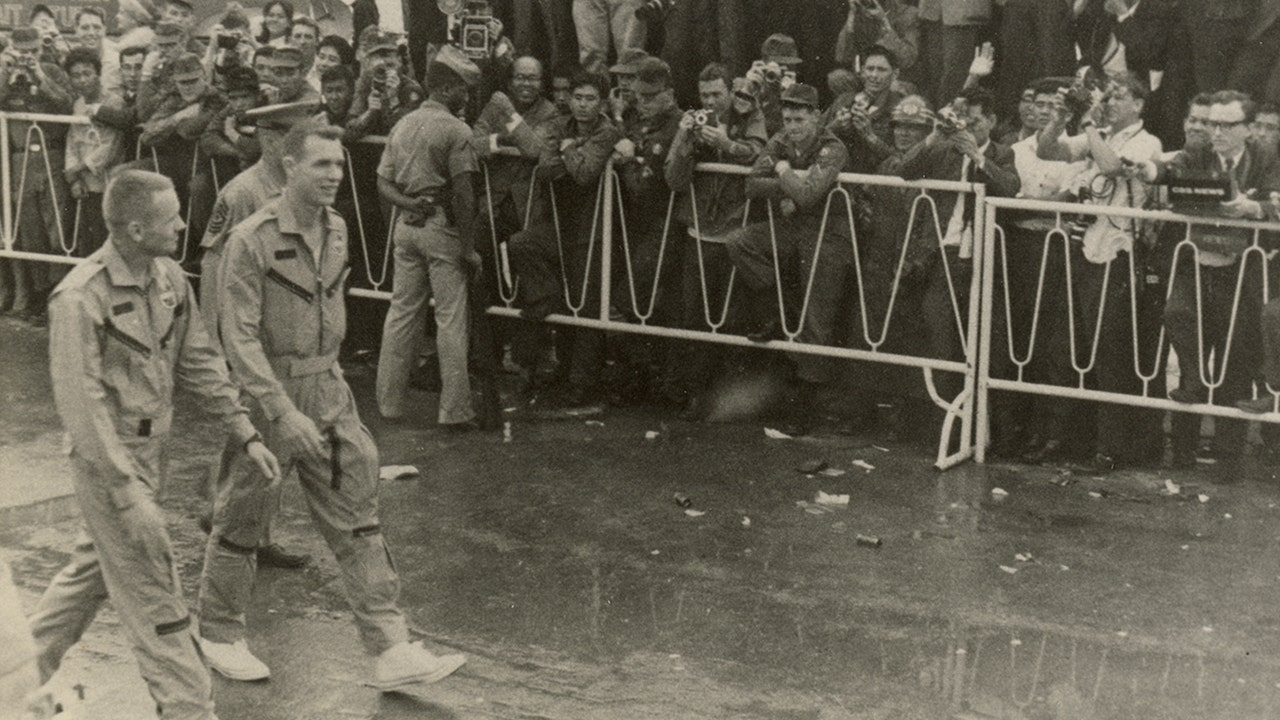
The photos of Armstrong, who died in 2012, and fellow astronaut David Scott after their unplanned splashdown near Japan following their ill-fated Gemini 8 mission in 1966 have been donated to the Armstrong Air and Space Museum in Wapakoneta, Ohio, by the widow of photographer Ron McQueeney.

Armstrong and Scott were forced to end the mission early when both spacecraft started to tumble uncontrollably after the astronauts completed the first successful docking in space.

They separated from the other spacecraft but continued to tumble at one revolution a second until Armstrong decided to deploy the thrusters to stop the spinning, which burned some of the fuel they would have needed to complete the mission. The astronauts risked losing consciousness during the spinning.

NASA DELAYS ARTEMIS MOON MISSION AFTER FINDING FUEL LEAKS IN TEST RUN

This 1966 image taken by Ron McQueeney shows astronauts Neil Armstrong (second from right) and David Scott (third from right) standing on the deck of the USS Leonard F. Mason at Naha Air Base in Okinawa, Japan.  (Ron McQueeney/Ohio History Connection via AP)

The men splashed down off Okinawa, Japan, about 10 hours after their launch on March 16, 1966, and were brought to Naha Air Base.

McQueeney, an Army veteran, was called in to document the astronauts after the splashdown, an event little media was at because it was unexpected.

This 1966 photo taken by Ron McQueeney shows astronauts Neil Armstrong (left) and David Scott walking through a crowd of U.S. service members at Naha Air Base in Okinawa, Japan. (Ron McQueeney/Ohio History Connection via AP)

"Sometimes, an incredible event can actually be documented by some of the most ordinary means," Dante Centuori, executive director of the museum, told The Associated Press.

The photos show the men on the deck of a U.S. Navy ship that brought them to the base in Japan and waving to U.S. service members once they got to the base.

This 1966 image taken by Ron McQueeney shows the Gemini 8 spacecraft being lifted for transport at Naha Air Base in Okinawa, Japan.   (Ron McQueeney/Ohio History Connection via AP)

Another photo shows the Gemini 8 spacecraft being lifted following the splashdown.

NASA ASTRONAUT REVEALS HE WAS THE ONE WHO HAD MEDICAL ISSUE THAT LED TO CREW'S EARLY RETURN TO EARTH

"The obvious thing that sticks out to me is that they are very happy to be alive," historian Robert Poole, of the University of Lancashire, told the AP.

He added that Armstrong's composure under pressure was one of the key things that led to him being chosen for the Apollo 11 moon landing three years later.

This 1966 photo taken by Ron McQueeney shows astronaut Neil Armstrong, center, waving to service members at Naha Air Base in Okinawa, Japan.  (Ron McQueeney/Ohio History Connection via AP)

Centuori said their smiles also show their ability to stay calm in a stressful situation.

CLICK HERE TO DOWNLOAD THE FOX NEWS APP

More than 50 years since the last moon mission, NASA is preparing to launch Artemis II, which will send four astronauts around the moon, next month.

"Seeing people launch to space frequently can suggest that it’s easy, but it’s very hard," Emily Margolis, a curator at the National Air and Space Museum added. "And it requires a lot of resources and attention."

A look at the top-trending stories in food, relationships, great outdoors and more.

By entering your email and clicking the Subscribe button, you agree to the Fox News Privacy Policy and Terms of Use, and
        agree to receive content and promotional communications from Fox News. You understand that you can
        opt-out at any time.

Subscribed

You've successfully subscribed to this newsletter!
Comments
You must be logged in to comment.