bbc Press
Iran launched unsuccessful attack on Diego Garcia, it is understood
Images
1 / 8

2 / 8
3 / 8
4 / 8

5 / 8

6 / 8
7 / 8
8 / 8
The Ministry of Defence has accused Iran of "reckless attacks" and "lashing out across the region", as it emerged that Tehran had targeted the joint US-UK military base in the Chagos Islands.

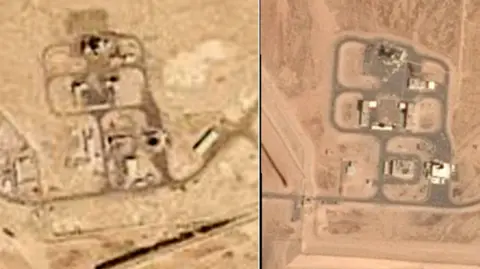
Two ballisitic missiles were fired at the island of Diego Garcia, the Wall Street Journal and CNN reported overnight, citing unnamed US officials, but neither weapon reached its target.

One missile reportedly failed in flight, while the other was intercepted by a US warship. It is unclear when the missiles were supposedly fired.

The BBC understands the reports are accurate. In a statement on Saturday, the MoD said: "Iran's reckless attacks, lashing out across the region and holding hostage the Strait of Hormuz, are a threat to British interests and British allies."

The US military declined to comment on the incident.

There are doubts whether Iran, which until now was believed to have intermediate range ballistic missiles with a range of 1,250 miles (2,000km), has missiles capable of reaching Diego Garcia. The military base is about 2,350 miles from Iran.

However, some military analysts, including those at Israel's Alma Research and Education Center, believe Iran's Khorramshahr missile may have a range of up to 1,800 miles.

It is understood the attempted air strike occurred before the UK agreed to let the US use British military bases to hit Iranian sites targeting shipping through the Strait of Hormuz.

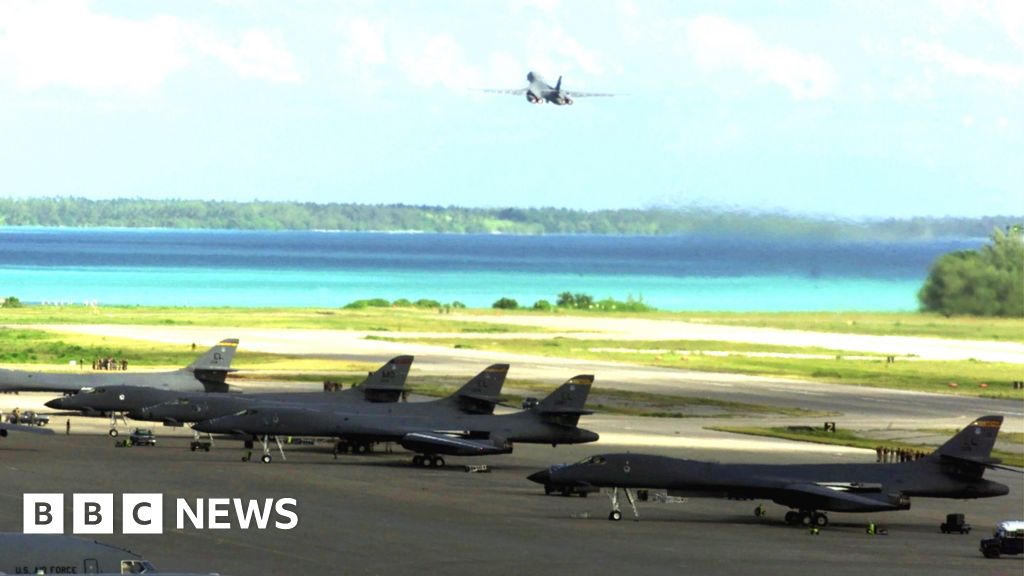
The airbase on the small, remote atoll is strategically located and is capable of accommodating long-range bombers. It has been used as a launchpad for operations in the Middle East for years.

However, its use in US strikes on Iran has been limited as the UK government has only allowed British airbases to be used for strikes on sites targeting UK interests and allies in the region.

It expanded targets under this "collective self-defence" justification to include Iranian sites being used to threaten vessels travelling through the Strait of Hormuz - a key shipping route through which a fifth of the world's oil flows - on Friday.

The UK's staid approach to the conflict has repeatedly drawn the ire of US President Donald Trump, who said it "should have acted a lot faster" to help secure the waterway and temper skyrocketing oil prices.

He earlier called Nato allies "cowards" for refusing to offer warships for what he described as a "simple" military task with "little risk".

Iran's Foreign Minister Abbas Araghchi said the UK's participation was "putting British lives in danger" and that Iran "will exercise its right to self-defence".

The Liberal Democrats and the Greens have called for a vote in Parliament on the allowing the US to use UK bases, while Conservative leader Kemi Badenoch called it the "mother of all U-turns".

Prime Minister Sir Keir Starmer will seperately hold a Cobra meeting next week on plans to help mitigate a rise in the cost of living caused by the war. The International Energy Agency expects the disruption to oil supply to affect wider energy markets.

The Chagos Islands are currently owned by the UK, but the British government has agreed to cede sovereignty of them to Mauritius and lease back the base on Diego Garcia.

Sir Keir has previously insisted the deal was necessary to protect the continued operation of the base, amid previous attempts from Mauritius to dispute the legality of British sovereignty over the islands.

The Chagos Islands have been under British control since 1814 and were administered from Mauritius while it was a British colony.

In 1965, the Chagos Islands were made a British overseas territory in their own right, ahead of Mauritius gaining independence.

But Mauritius has long argued that it was illegally forced to give the islands away to gain independence.

However, the deal has faced opposition domestically, as well as from Chagossians who were expelled in the 1960s to make way for the airbase.

Trump has gone back and forth on the deal, recently describing it as a "big mistake" despite his administration giving its official backing.

Iran has launched waves of strikes on nations in the Middle East hosting US facilities, as well as Israel, which is also striking Iran.

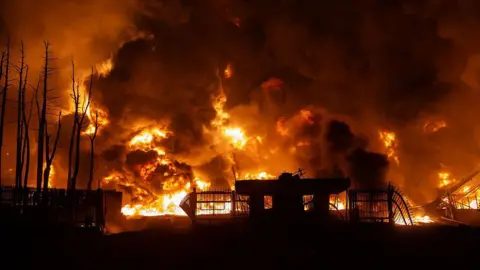
Tehran has launched several unmanned drones at RAF Akrotiri in Cyprus, one of which struck its runway causing "minimal" damage earlier this month.

The attack raised questions over the UK's preparedness for the conflict. The government has since dispatched HMS Dragon, a Type 45 destroyer, to the region to protect the base, as part of wider defensive efforts.

Conflict has spread across the Middle East since the US and Israel launched strikes on Iran on 28 February.

Downing Street says ministers approved the expansion after accusing Iran of "reckless strikes".

But more troops and warships are being sent to the region and the White House is seeking billions more in funding for the war.

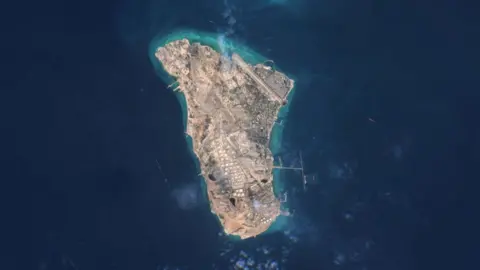
The tiny island is home to one of the most critical pieces of Iran's energy infrastructure.

Much of the damage was caused in initial retaliatory strikes by Iran in the week after the US and Israel launched its operation.
Comments
You must be logged in to comment.