yahoo Press
Stock market today: Dow, S&P 500, Nasdaq slide amid inflation worries as Iran war sends oil surging
Images
1 / 6

2 / 6

3 / 6

4 / 6

5 / 6

6 / 6
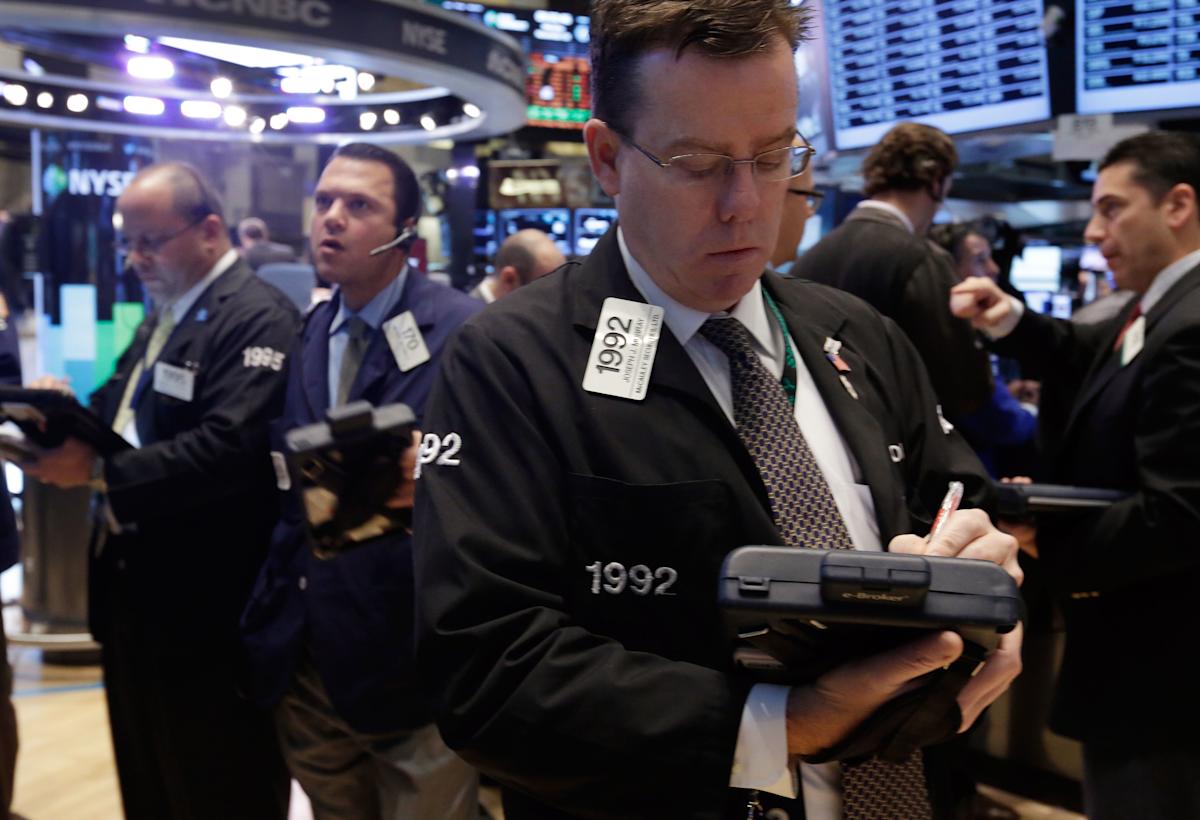
US stocks added to losses on Thursday as oil prices spiked amid strikes on key Middle East energy hubs, stoking already intense inflation concerns on Wall Street.

The Dow Jones Industrial Average (^DJI) fell 0.5%, coming off a bruising session that dragged the blue-chip benchmark to its lowest close this year. The S&P 500 (^GSPC) and Nasdaq Composite (^IXIC) shed 0.5% and 0.6%, respectively, after deeper losses earlier in the session.

Brent (BZ=F) crude futures surged as much as 10% to as high as $119 per barrel before paring those gains to hold around $112/bbl, as Iran and Israel exchanged attacks on highly important oil and gas facilities. The escalation in hostilities stoked fears of a more severe fallout from the conflict than foreseen. Gains for US benchmark West Texas Intermediate crude (CL=F) lagged, hovering around $96/bbl as the spread between the two products widened to its largest gap in years.

Markets were already contending with rising inflation forecasts from the Federal Reserve, which dampened expectations for interest rate cuts. While the Fed signaled one cut could still be on the table this year, bets are policymakers will stand pat — especially after hawkish comments from Chair Jerome Powell.

In economic updates on Thursday, jobless claims declined to 205,000. The Philadelphia Fed Manufacturing Index is due later.

On the corporate front, shares of Micron (MU) dropped in premarket as the chipmaker's AI spending plans overshadowed strong earnings. Meanwhile, Alibaba (BABA) stock slid after a 67% plunge in quarterly profit underscored the need for a payoff from its AI investments.

Five Below (FIVE) stock galloped 10% higher on Thursday after the off-price retail chain reported strong fourth quarter results.

Same-store sales growth of 15.4% in the fourth quarter pleasantly surprised investors expecting 14.7%, according to S&P Global Market Intelligence. And revenue rose 24.3% to $1.72 billion, also beating estimates.

But the company was a tad more cautious about its full-year financial guidance, citing tough comparisons in the quarters ahead. In Q2, Q3, and Q4 of last year, comparable sales grew 12%, 14%, and 15%, respectively.

Plus, executives said the macroeconomic backdrop may not be as favorable — even if consumers do prefer to shop at value chains.

"We just don't think it gets easier from here, whether it's the prices at the pump or this sticky inflation that seems to be hanging around or a job market that is somewhat sluggish," Five Below CFO Daniel Sullivan said on the earnings call. "We think the environment here is going to continue to be challenging."

The pricing spread between Brent (BZ=F) and West Texas Intermediate (CL=F) crude futures widened to its largest in more than a decade on Thursday.

The gap between the international and US oil benchmarks opened up amid an explosion in Middle East and European demand for barrels available quickly.

As of about 11 a.m. ET, Brent (BZ=F) was trading at $111.37 a barrel, while WTI crude (CL=F) was trading at $97.78 — a roughly $14 spread. Earlier in the session, the gap neared $20 as Brent changed hands at $114.

The spread is the widest since at least 2013, save for a few days during the depths of the pandemic in 2020.

The Brent benchmark reflects the price of globally traded seaborne crude, and it serves as the primary pricing reference for physical cargoes moving through chokepoints such as the Strait of Hormuz. By contrast, WTI is priced at a landlocked inland storage hub in Cushing, Oklahoma, and it's more closely tied to North American supply-demand balances.

The US does export a significant amount of its in-country shale oil output. But its large domestic production, pipeline infrastructure, and refining capacity along the Gulf Coast all help buffer WTI from the full impact of international disruptions.

As a result, Brent absorbs more of the geopolitical risk premium associated with Middle East conflicts — including threats to infrastructure, sanctions risk and higher tanker insurance costs. Meanwhile, US barrels are less exposed to those same factors.

The spread between the two benchmarks often widens during geopolitical shocks because Brent prices the global marginal barrel, while WTI reflects a more insulated regional market.

Earlier today, I explored how market gains can be concentrated in time. This chart shows something else beneath the surface: leadership keeps rotating.

I have to quote the godfather of technical analysis, Ralph Acampora, who famously said, “Rotation is the lifeblood of a bull market.” So this is what's supposed to happen.

Software, tracked here by the iShares Expanded Tech-Software Sector ETF (IGV), peaked on Sept. 22 and never got its groove back. Healthcare, via the Health Care Select Sector SPDR Fund (XLV), took over around that turn and had its day in the sun — then chopped sideways for three months before fading too.

Energy was the late arrival. The Energy Select Sector SPDR Fund (XLE) did not really wake up until the start of 2026. But once it cleared $50 — and broke out of a two-decade base — it was off to the races.

While the rotation has been healthy overall, energy is the only sector that’s really held up in March — and it isn’t big enough to carry the entire S&P 500 (^GSPC) on its own.

Eventually, new leaders will need to step up. The question is how much more damage this broad sell-off does — in price and in time — before they do.

Yahoo Finance's Ines Ferré reports:

Read more here.

The Dow Industrials (^DJI) and S&P 500 (^GSPC) opened near their November lows, while the Nasdaq Composite (^IXIC) is now testing September levels. All three are now negative over the trailing six months.

Powell’s penultimate Fed press conference as chair is landing as a hawkish surprise. Stocks and bonds are selling off as the dollar and bond yields push higher.

Markets now are not fully pricing in a Fed rate cut until October 2027. As recently as Tuesday, the expectation was for one cut by December.

Cyclicals are getting hit hardest, with materials (XLB) leading lower, followed by industrials (XLI), tech (XLK), and consumer discretionary (XLY).

One notable holdout in the sell-off is software (IGV), up as much as 1% — though it’s fair to ask whether that strength is real or just another round of short-covering.

Another concentration story is hiding beneath the surface of the S&P 500 (^GSPC) — not in a handful of stocks, but in the calendar itself.

Since the low on April 8, 2025, Mondays and Wednesdays have accounted for essentially all of the index’s 1,642-point gain. Monday has contributed 58% of the move, while Wednesday has added 43%. Put them together, and you get just over 100% of the entire advance. That’s a slightly imperfect way to slice it, but the concentration is still striking.

The other three days have mostly canceled each other out. Friday has been positive, contributing 21%, but that has been offset by a roughly flat Tuesday (-3%) and a deeply negative Thursday (-23%).

That Thursday pattern is especially interesting. Thursdays held up reasonably well until late September, then turned sharply lower right around the time software leadership faded and more defensive groups like healthcare and utilities started to take over.

Bottom line: The latest leg of this bull market hasn't been a steady climb each week. It’s been a rally that's done almost all its work on two days.

The US stock market moved further into the red on Thursday as oil prices spiked on an escalation in the Middle East and nerves around energy-driven inflation remained hot on Wall Street.

The Nasdaq Composite (^IXIC) notched the steepest loss at the start of open trading, dropping roughly 1.2%. The S&P 500 (^GSPC) lost roughly 0.8%, while the Dow Jones Industrial Average (^DJI) fell 0.7% after a session in the red on Wednesday that saw the blue-chip benchmark hit its lowest close this year.

Brent (BZ=F) crude futures briefly crossed $119 per barrel overnight and remain sticky above $110 after Iran and Israel both targeted critical energy infrastructure throughout the Gulf. The US benchmark West Texas Intermediate crude (CL=F) gained a slighter 2% to trade above $97.

The 10-year Treasury yield (^TNX) climbed 4 basis points to 4.30%, while the 5-year (^FVX) rose 8 basis points to 3.94%.

Initial jobless claims on Thursday showed that the weekly count of new claims declined to 205,000, with the Philadelphia Fed Manufacturing Index due later Thursday.

Micron (MU) lost roughly 7.3% as investors expressed concern over spending predictions. Alibaba (BABA) lost roughly 10% after reporting a 67% drop in quarterly profit.

Yahoo Finance's Hamza Shabanwrites:

Read more here in today's takeaway from Morning Brief.

Initial jobless claims fell from the previous week, coming in under economists' predictions for the labor market metric.

Data released by the Labor Department showed that 205,000 people filed for unemployment benefits in the week ended March 14, below economists' expectations of 215,000 initial claims and the previous week's count of 213,000.

Continuing claims for the week ended March 7 were 1.86 million, above both consensus estimates of 1.85 million and the previous week's 1.85 million.

This week's jobless claims come after the Labor Department's February jobs report, published March 6, showed that the US lost 92,000 jobs for the month, far below estimates of 55,000 jobs added. On Wednesday, the Federal Reserve voted to hold rates unchanged at 3.5% to 3.75% and kept predictions steady for one more cut this year and one in 2027.

In another big move in the robotaxi space, Uber (UBER) says it will invest as much as $1.25 billion in Rivian (RIVN) in exchange for up to 50,000 fully autonomous vehicles.

Shares of Rivian jumped almost 10% before the bell after the news, while Uber's stock was little changed.

Yahoo Finance's Pras Subramanian reports:

Read more here.

European natural gas futures exploded in early Monday trading, surging by more than 17% after Israel struck the South Pars gas field and QatarEnergy reported "extensive damage" from Iranian strikes at its Ras Laffan liquified natural gas (LNG) export complex, the world's largest.

Over the past 24 hours, Middle Eastern energy infrastructure has come increasingly under fire, marking a new height of escalation in the war in Iran, starting on Wednesday with strikes by Israel on Iran's South Pars gas field — the Iranian section of the largest natural gas reserve in the world, which the regime shares with Qatar.

After the South Pars strikes, Iran published a target list of energy infrastructure in the region and ordered evacuations from the sites. Strikes by Iran in the hours since have threatened a refinery in Saudi Arabia, taken two gas facilities in the UAE offline, and struck two refineries in Kuwait.

Earlier in the conflict, initial damage to QatarEnergy's Las Raffan industrial city pushed Qatar to declare force majeure on shipments from the export complex. The new round of strikes has now made the damage much more extensive.

While Europe gets the majority of its gas supply through pipeline gas from Europe and North Africa, LNG supplies from the Middle East — and especially Qatar — act as flexible cargo that balances the system. Without those deliveries, Europe loses the barrels cushioning its market.

Investors were closely watching Jerome Powell's post-policy meeting press conference for clues about how the war in Iran might change the Federal Reserve's calculus for future interest-rate cuts.

Here's a look at the takeaway from how far the Fed chair was willing to go in his comments

Yahoo Finance's Jake Conley writes:

Read more here.

Shares in the miner Newmont (NEM) fell 7% before the bell on Thursday as gold (GC=F), silver (SI=F) and copper (HG=F) futures edged lower.

Five Below (FIVE) stock rose 6% during premarket hours today after reporting higher quarterly profit and sales, citing an increase in customer footfall due to the retailer's low-priced offerings.

Align Technology Inc. (ALGN) stock rose 6% before the bell on Thursday after activist investor Elliott said it had built a significant stake in the maker of Invisalign teeth-straightening.

Alibaba (BABA) stock slumped 5% during premarket hours on Thursday as the e-commerce giant's earnings fell while revenue barely grew. Alibaba reported a 2% rise in sales to $41.3 billion for the three months ended December. Net income fell 67%, its worst result since 2024, caused by the company's heavy spending on promotions.

Bloomberg News reports:

Read more here.

Micron (MU) stock fell 5% before the bell on Thursday following the chipmaker's earnings report. The company's plan to increase capital expenditure left investors feeling nervous. The company's AI-fueled earnings for the quarter beat analysts' estimates.

Reuters reports:

Read more here.

Oil prices surged after Iran and Israel traded strikes on some of the Middle East’s most important energy facilities, spurring fears of a more severe impact from the almost three-week-old conflict.

Bloomberg reports:

Read more here.

Reuters reports:

Read more here.

Bloomberg reports:

Read more here.
Comments
You must be logged in to comment.