bbc Press
Demolition begins on building facade after Glasgow fire
Images
1 / 14

2 / 14
3 / 14
4 / 14
5 / 14
6 / 14
7 / 14
8 / 14
9 / 14
10 / 14

11 / 14
12 / 14
13 / 14
14 / 14
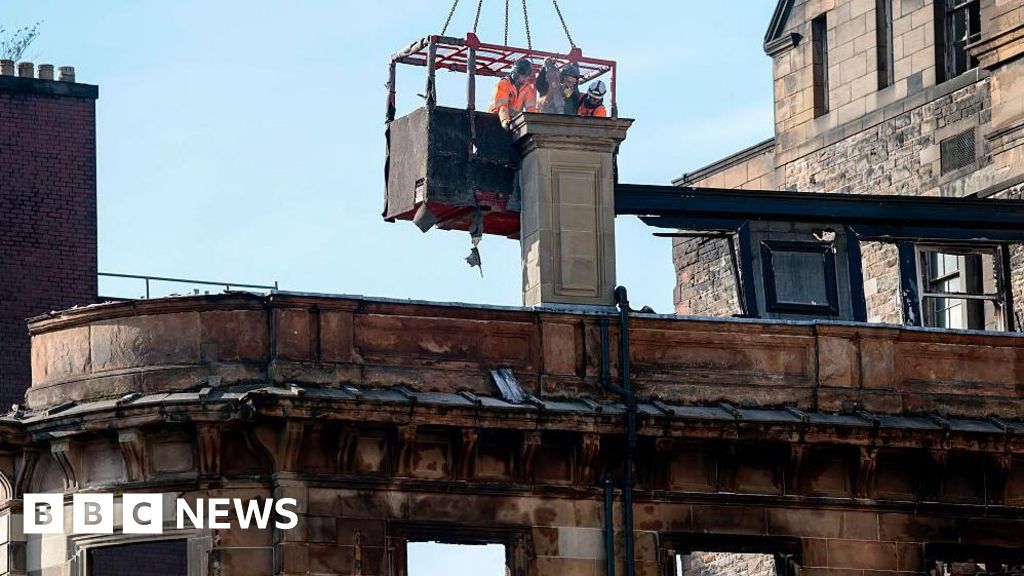
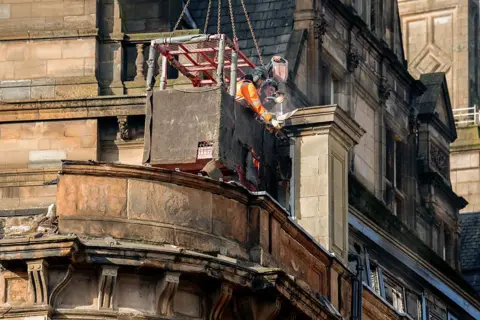
Demolition workers are using hand tools to dismantle the remaining facade of a historic Glasgow building wrecked by a fire.

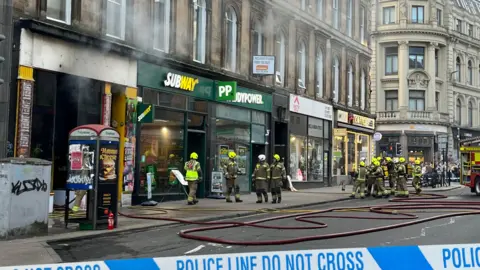
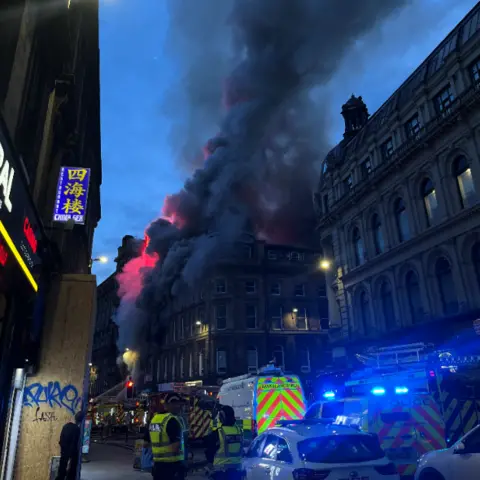
The huge blaze engulfed the B-listed Victorian building next to Glasgow Central Station on Sunday 8 March after starting in a vape shop on Union Street.

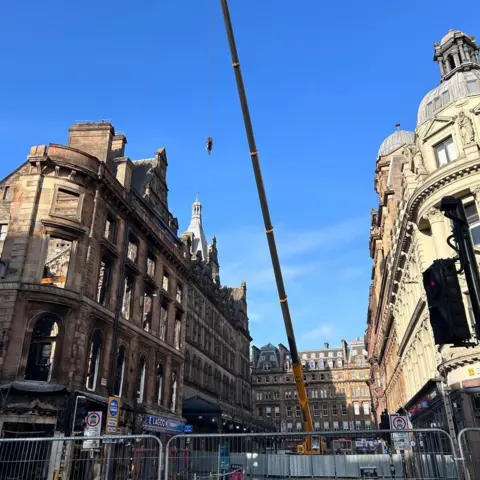
Only the facade of the building on Gordon Street was left standing, as well as a floating chimney stack which was gradually taken apart last week.

The station partially reopened after a 10-day closure on Wednesday, allowing a return of some Scotrail and cross-border train services.

Platforms seven to 15 on the west side of the station are back in use but the main entrance on Gordon Street remains closed.

It is thought the demolition work could take several days.

The council previously said crews were working around the clock but timescales were weather-dependent as cranes cannot be used in high winds.

During the fire, the flames reached the dome on the corner of the 19th Century building and the front wall collapsed to the ground.

Glasgow City Council said there have since been further collapses since and the remaining structure was "highly dangerous".

Raymond Barlow, from the council's building standards team, told BBC Scotland News that it was not possible to demolish the facade with a machine as it would cause an uncontrolled collapse.

"With an uncontrolled collapse, you cannot predict where it will fall and it could cause more damage, which we do not want," he said.

He added the operatives would work at a height above the danger and use hand tools to demolish the building.

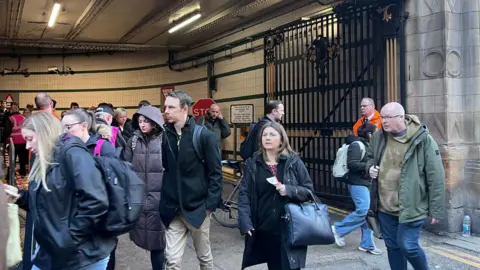
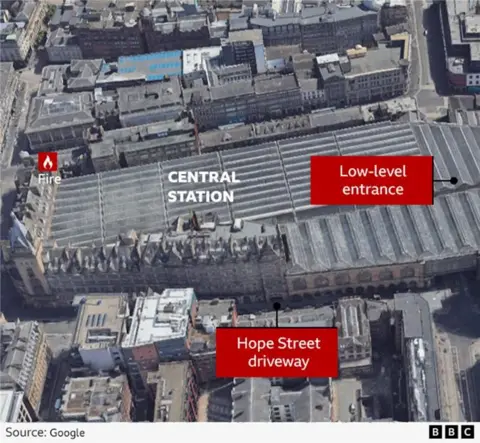
On Wednesday morning, commuters were seen coming in and out of the Victorian carriageway on Hope Street that was once used for people to drive into the station to drop others off.

There is a reduced timetable and passengers are asked to check their journeys before travelling.

Network Rail said commuters can access the station via the low-level entrances on Argyle Street, and the Hope Street carriage driveway, which is normally used during special events.

There is no access to the upper part of Central Station, including the Union Street, Gordon Street and upper Hope Street entrances.

Services from the smaller low-level station, which runs services to Balloch and Milngavie in the west and Motherwell and Cumbernauld to the east, resumed last Wednesday.

The famous clock is in the cordoned off area of the main concourse, but was seen on Tuesday to be stopped at ten to eight - perhaps the time when the electricity was turned off in the station on the night of the fire.

Facilities and shops in the station, including the main toilets, remain closed.

However two disabled toilets, including one with baby-changing facilities, are available and staff are on site to direct passengers.

Most of the main concourse is not accessible and has been screened off using solid metal sheeting.

Route director Ross Moran said Network Rail hoped to restore full access "as soon as it is safe to do so".

Scotrail's chief operating officer David Ross said resuming services on more than half the high level platforms was a "big step forward" and the timetable would be kept under regular review.

"The great news is that services at Glasgow Central high level are back open for business today and we're really delighted progress has been made," he said.

However it was not yet possible for trains to resume on all routes due to the reduced number of available platforms.

"The safety of our customers and staff remains our absolute priority, and while we have limited platforms and access points to the station available, we will operate as many services as we can," he added.

The following will operate from the start of service on Wednesday:

Avanti West Coast will run one train per hour from Platform 10. The first cross-border train out of the station on Wednesday was the 05:48 Glasgow to London Euston.

Network Rail said Caledonian Sleeper services will resume and serve Platform 11.

But there will be no Transpennine Express or Cross Country services.

The following routes are unable to run:

Some routes are operating but with significant alterations:

Greater Anglia services between Norwich, Cambridge and Stansted are affected - and some East Midlands routes.

Badreddin Bosh stabbed five people, including a police constable, during the incident at the Park Inn in Glasgow.

Campaigners say Watford passengers pay up to £1,000 a year more than those using similar stations.

The change would see the network open three-and-a-half hours earlier and close five hours later on a Sunday.

Nexus is replacing overhead line along part of the Tyne and Wear Metro serving South Tyneside.
Comments
You must be logged in to comment.