yahoo Press
Shell Rotella Is Paying for Your Parking — Here Is What the Deal Actually Is and Why It Matters More Than a Free Night on the Road
Images
1 / 5
2 / 5

3 / 5

4 / 5
5 / 5
The deal is straightforward. Shell Rotella and Truck Parking Club are running a promotion called “Night on Us.” Drivers who get a qualifying Shell Rotella T5 Synthetic Blend or T6 Full Synthetic oil change — at a minimum of 11 gallons — at a participating service location can submit their receipt at rotella.com/nightonus and receive up to $100 in Truck Parking Club Cash. That credit is usable at any of Truck Parking Club’s 4,200-plus locations across the country. The promotion runs through June 30, 2026.

The 11-gallon minimum is worth flagging specifically — this is a full heavy-duty engine oil change, not a top-off. If you change your own oil, this one is not for you. If you run a truck that takes a qualifying T5 or T6 oil change at a participating installer, it is worth knowing about.

But this article is about more than the promotion. The reason this partnership is worth covering in depth is that it puts two things in the same frame that rarely appear together: a real, immediate solution to truck parking, and the clearest evidence available that the private marketplace is solving this problem at a pace that the federal government cannot match.

Before getting into what Truck Parking Club is and how the promotion works, it is worth grounding the parking crisis in current numbers, because it is easy for the industry’s most persistent problems to fade into background noise.

The American Transportation Research Institute’s 2024 Critical Issues in the Trucking Industry report ranked truck parking as the number one concern among drivers for the second consecutive year and the number two concern across the industry overall. That is not a new finding — parking has sat near the top of the ATRI critical issues list for years. What makes it more than a recurring complaint is the cost data attached to it.

ATA and OOIDA submitted joint documentation to the Department of Transportation in 2022 estimating that 98% of drivers report problems finding safe and legal parking. The time spent searching — driving extra miles, waiting at rest areas, circling truck stops — averages 56 minutes per driver per day. Applied across a year, that lost time translates to an estimated $5,500 per driver in annual compensation loss, a figure that represents roughly a 12% effective pay cut before a single mile of load-generating freight is moved.

The industry-wide aggregate is even larger. Truck Parking Club’s own commissioned research, using ATRI data, pegs the total economic cost of the parking shortage at over $100 billion annually — a number that accounts for wasted fuel, unproductive time, HOS violations driven by inability to find legal parking in time, and the costs of unauthorized parking enforcement and accidents involving improperly parked equipment.

The federal government knows all of this. FMCSA published a Federal Register notice in late November 2025 announcing plans to conduct a new study — “Quantifying the Benefits of Creating New Truck Parking Spaces” — to survey thousands of drivers on their parking experiences. The Infrastructure Investment and Jobs Act allocated $500 million for truck parking expansion through 2026. The problem has been documented, lobbied over, studied, and refunded for over a decade.

The supply of safe, legal truck parking has still not caught up to demand. The estimated national deficit stands at 1.7 million spaces, according to a 2025 study commissioned by Truck Parking Club and conducted by transportation economist Noël Perry of Transport Futures, using ATRI data alongside proprietary TPC figures. That same study pegs the total economic cost at over $100 billion annually, accounting for wasted fuel, unproductive driver time, HOS violations, and costs related to unauthorized parking. The $100 billion figure has been challenged by some in the industry as self-serving given the source, but the underlying shortage is independently corroborated — ATRI ranked truck parking as the No. 1 driver concern for two consecutive years, and FMCSA has acknowledged the shortage as a major safety and productivity issue. New construction of dedicated truck parking infrastructure runs $100,000 to $200,000 per space and takes years to permit, design, and build. The math between the shortage, the funding, and the construction timeline does not close — not at any near-term horizon.

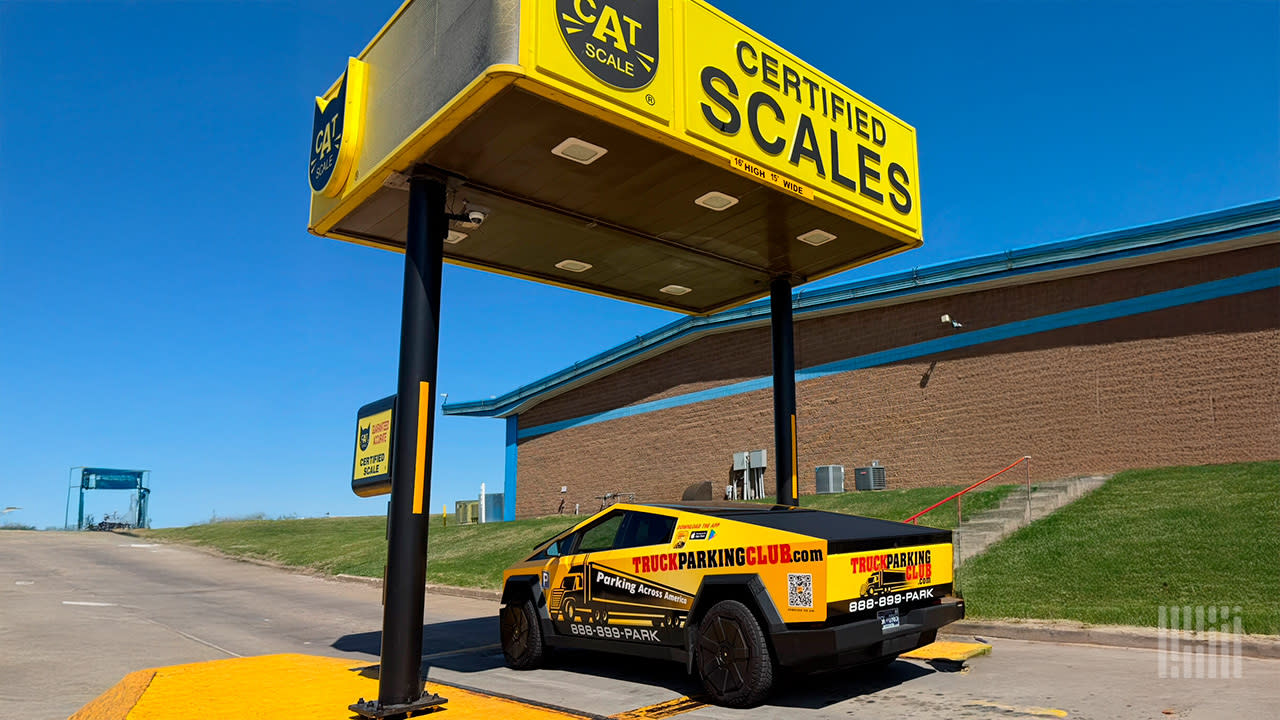
Truck Parking Club, founded and led by Evan Shelley out of Chattanooga, Tennessee, approached the parking problem from a different angle. Rather than building new spaces, the company built a marketplace to connect drivers with parking that already exists but is not accessible or listed — private lots, truck yards with excess capacity, CDL schools, trailer leasing facilities, storage operations, tow companies, and any other property with adequate space and willingness to host commercial vehicles.

The model is close to what Airbnb did for unused residential space, applied to commercial vehicle parking. Property owners list available spaces on the platform and receive income from bookings. Drivers search by location and book parking by the hour, day, week, or month through truckparkingclub.com or the mobile app. The transaction is handled digitally. The first-time booking process, according to the company, takes less than ten minutes.

The growth trajectory of the network makes the case for the model better than any marketing language could. Truck Parking Club crossed 1,000 locations in November 2024 — a milestone that itself represented rapid early growth. In the seven months that followed, the network more than doubled to over 2,000 locations by June 2025. By October 2025, it had surpassed 3,000 locations and 51,000 individually reservable spaces across 49 states. As of February 2026, the company announced it had reached 4,000 locations and set a target of 10,000 by the end of 2026. The current press announcement with Shell Rotella references 4,200-plus locations.

To put that growth in context: Love’s Travel Stops, one of the largest truck stop networks in the country, planned to add approximately 2,000 parking spaces in all of 2024. TA/Petro planned 1,200. Pilot Flying J around 500. Truck Parking Club added more reservable locations in a single quarter than those three combined networks added in a full year — without breaking ground on a single new structure.

The locations in the network are not all equivalent. They range from large commercial yards with full amenities to smaller private lots with basic secure space. But the relevant variable for most parking situations is not amenities — it is availability. A legal, reservable space you can count on being there when you arrive, in a location that works for your route and your HOS clock, is worth considerably more than a full-service truck stop that shows no availability when you need it.

Partnerships like the one announced between Shell Rotella and Truck Parking Club do not happen accidentally. They reflect the assessment of two established brands that the platform has reached the scale and credibility required to anchor a consumer promotion.

Shell Rotella is one of the most recognized names in heavy-duty diesel engine lubrication. The brand has been in the trucking industry for decades, with a history of driver-focused marketing that includes the annual SuperRigs show truck competition. For a brand with that kind of industry presence to put its name on a parking promotion, it needed a parking platform that drivers in the target market actually use and trust.

That trust is built on density. When Truck Parking Club had 400 locations in early 2024, it was an interesting concept with limited practical coverage. At 4,200 locations across all 48 lower states, it is a network that a driver on a real route can realistically find a bookable space within a viable distance of where they need to stop. The Shell Rotella promotion would have limited value if Truck Parking Club’s coverage had gaps wide enough that a driver in the Midwest or Southeast had no accessible locations. The fact that Shell is running this promotion now, at this scale, is a signal about where the platform’s coverage has gotten.

From Truck Parking Club’s side, the partnership with Shell Rotella does something beyond generating promotion redemptions. It introduces the platform to drivers who have never heard of it through a brand they already trust — and it does so at the moment of a service interaction that is directly relevant to their operation. A driver getting a T5 or T6 oil change is a driver who is actively investing in their equipment. Converting that moment into an awareness touchpoint for a parking platform that can materially improve their daily operation is well-targeted marketing for both brands.

The mechanics are simple. Get a qualifying Shell Rotella T5 Synthetic Blend or T6 Full Synthetic oil change at a participating service location. Keep the receipt. Go to rotella.com/nightonus and submit the receipt to claim the parking credit. The credit is issued as Truck Parking Club Cash, usable at any of the 4,200-plus locations in the network.

The promotion is called “Night on Us” — $100 in parking cash covers roughly one to several nights of parking depending on the location and market rate, which varies across the network. Urban and high-demand locations run higher. Rural and lower-traffic areas run lower. The credit gives you access to the network to find what works for your route and your schedule.

If you are not already using Truck Parking Club, the practical first step is downloading the app and searching your regular lanes for coverage. A driver whose routes consistently run through areas with strong network density will get more value from this promotion than a driver whose lanes run through coverage gaps. Checking coverage before you plan your route — rather than trying to find parking after you are already out of hours — is how the platform is designed to be used.

If you are a small carrier or fleet manager, the platform has fleet-oriented features beyond individual driver bookings — long-term storage arrangements, drop trailer positioning, and asset management without requiring long-term contracts with individual property owners. The fleet application is separate from the driver application but runs through the same network.

The parking crisis has disproportionate consequences for small carriers and owner-operators compared to large fleets. A carrier with 500 trucks has purchasing power and relationships that let it secure dedicated parking at shipper and receiver facilities, reserve blocks at major truck stops, and absorb the cost of occasional parking inconvenience across a large operational footprint. An owner-operator or five-truck carrier has none of that leverage. When parking is unavailable, the small operator is the one driving off-route, burning fuel looking for a spot, and making HOS decisions under pressure that large fleets manage through operational infrastructure.

A marketplace model that expands reservable parking without requiring infrastructure construction is structurally more aligned with the needs of small operators than with large fleets. The ability to book a reliable spot in advance, on a route you actually run, at an hourly or daily rate without a contract commitment, is exactly the kind of flexibility that makes a meaningful operational difference for an owner-operator. It does not require a corporate parking account, a fleet telematics integration, or a volume commitment. It requires a phone and a credit card.

The combination of that accessibility with a promotion that effectively gives drivers up to $100 in free access to that network — funded by an oil change they were likely going to make anyway — is the kind of practical, operator-level value proposition that this platform was built around.

The truck parking problem is not going to be solved by Washington’s study timeline. It is going to be solved by private platforms reaching enough density to make reserved parking a reliable operational tool rather than an occasional convenience — and partnerships like Shell Rotella’s “Night on Us” are how those platforms build the driver adoption that makes density sustainable.

The post Shell Rotella Is Paying for Your Parking — Here Is What the Deal Actually Is and Why It Matters More Than a Free Night on the Road appeared first on FreightWaves.
Comments
You must be logged in to comment.