yahoo Press
Researchers develop biodegradable, plant-based packaging from natural fibers – new research
Images
1 / 11
2 / 11

3 / 11

4 / 11

5 / 11

6 / 11
7 / 11
8 / 11

9 / 11

10 / 11

11 / 11
Jie Wu, an engineering graduate student, was studying a type of striking white beetle found in Southeast Asia and attempting to figure out how to mimic its brilliant color when an unexpected discovery upended the experiment.

Jie and I had been hoping to identify naturally occurring whitening pigments that could be used in paper and paints. The beetle’s white exoskeleton is made from a compound called chitin, which is a type of carbohydrate – one that is also commonly found in crab and lobster shells.

First, Jie extracted chitin nanofibers from crab shells obtained from food waste that are chemically the same as those found in the white beetles. But instead of creating a white material as intended, Jie produced dense, transparent films. The nanofibers more readily assembled in tightly packed films than in the porous structures Jie desired.

On a whim, Jie measured the rate at which oxygen passed through the film. The result was astonishing: The barrier allowed less oxygen through than many existing packaging plastics.

That serendipitous finding in 2014 shifted my team of engineering students’ focus from color to packaging. We asked whether natural materials could rival the performance of common plastics. In the years since, our team has used this discovery to create biodegradable films that offer a more sustainable and effective alternative to plastic packaging.

Plastic packaging is commonly used to protect food, pharmaceuticals and personal care products. These plastics keep out moisture and oxygen from the air, so products stay fresh and safe.

Most packaging has several layers that work together to keep air out, but these layers hinder reuse and recycling efforts. As a result, most of this plastic barrier packaging is discarded to landfills as single-use materials.

Many researchers have sought alternatives that are renewable, biodegradable or recyclable, yet just as effective. At Georgia Tech, my team of students and post-docs has spent more than a decade tackling this problem. This journey began with that beetle.

Chitin is widely available in food waste and mushrooms, and it is used in products such as water filters and wound dressing. However, our early attempts to scale up the film technology based on the beetle-inspired experiment failed.

In 2018, the team made an important leap forward by using spray coating to create layers of chitin and cellulose nanomaterials. Cellulose, like chitin, is a carbohydrate polymer – a chain of repeating carbohydrate units – and it is obtained from plants. These abundant natural materials have opposite electric charges, which led to better barrier performance when we combined them than either material alone.

In this approach, the team sprayed down a layer of chitin, followed by a layer of cellulose. The opposite charges between the chitin and cellulose created a long-range attraction between them that binds the layers to create a dense interface.

Later, in collaboration with Meisha Shofner, a materials scientist, and Tequila Harris, a mechanical engineer, other students showed these coatings could be applied with scalable, roll-to-roll techniques. Roll-to-roll coating methods are preferred in industry because the coatings are applied continuously to large rolls of a substrate material, such as paper or other biodegradable plastics.

Still, humidity posed a major challenge, limiting any real-world applications. Moisture swelled the film, allowing more oxygen to sneak through.

Then came another breakthrough. In 2024, another collaborator, Natalie Stingelin, and I discovered that two common food components resisted water vapor when combined: carboxymethylcellulose – which is found in ice cream, for example – and citric acid.

The result was a film that hindered the transmission of moisture. The citric acid reacted with the cellulose to form cross-links, which are chemical junctions that bind the cellulose molecules. Once bound, they reduced the film’s moisture uptake.

We integrated this new discovery with the prior work by combining the citric acid and cellulose, and then casting this mixture as a freestanding film by coating it onto a substrate, such as chitin.

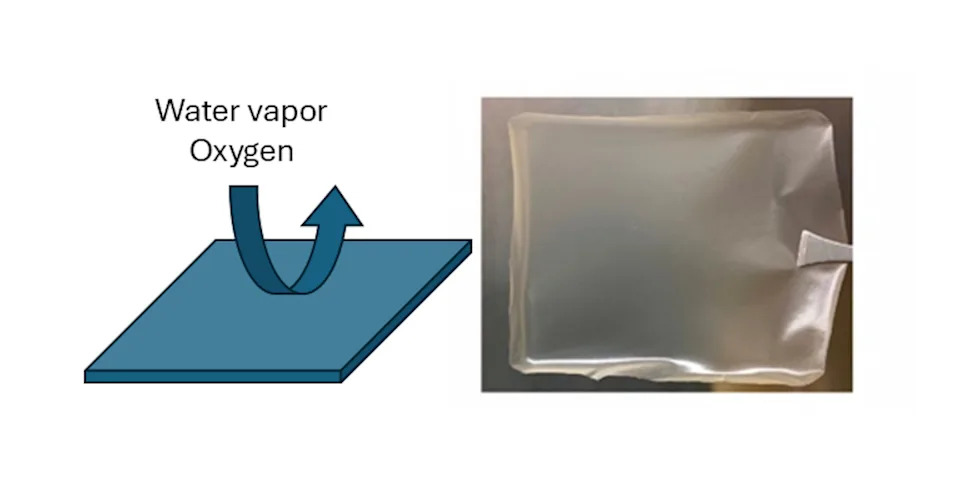
However, that formulation did not have strong oxygen barrier properties because it did not contain the highly crystalline cellulose nanomaterials from our first film. Our team’s most recent achievement, from October 2025, combines the above innovations. As a result, we’ve created a bio-based film that is an excellent barrier to both oxygen and moisture.

When cast into thin films, these components self-organize into a dense structure that resists swelling with water vapor. Tests showed that even at 80% humidity the film matched or outperformed common packaging plastics.

The materials are renewable, biodegradable and compostable. Our team has filed several patent applications, and we are working with industry partners to develop specific packaging uses.

One challenge that applications face is a limited supply of the bio-based components compared to the high volume of conventional plastics. Like any new material, it would take time for manufacturers to develop supply chains as the films begin to be used.

For example, the market demand for purified chitin is small right now, as it is used in niche applications, such as wound dressings and water filtration. Due to its variety of uses, packaging could increase that market demand.

The next challenge is scaling up from experimental films to industrial production, which would likely take several years. The team is exploring roll-to-roll coating techniques and working with industry partners to integrate these materials into existing packaging lines.

Policy and consumer demand will also play a role. As governments push for bans on single-use plastics and companies set sustainability targets, bio-based films could become part of the solution.

The story of this breakthrough reminds me that science often advances through unexpected results. From a failed attempt to mimic a beetle’s color to a promising alternative to plastic, this research shows how curiosity can lead to solutions for some of our biggest challenges.

This article is republished from The Conversation, a nonprofit, independent news organization bringing you facts and trustworthy analysis to help you make sense of our complex world. It was written by: J. Carson Meredith, Georgia Institute of Technology

Read more:

Genetically engineered bacteria make living materials for self‑repairing walls and cleaning up pollution

Buildings grown by bacteria – new research is finding ways to turn cells into mini‑factories for materials

A new type of material called a mechanical neural network can learn and change its physical properties to create adaptable, strong structures

Carson Meredith received funding from the U.S. Department of Energy, Mars, Nestle, Winpak, One.Five, and Dow. This technology has pending patents.
Comments
You must be logged in to comment.