yahoo Press
America has 2 kinds of households — and 1 is getting richer while the other survives on credit. 5 habits to get ahead
Images
1 / 4
2 / 4

3 / 4

4 / 4
The economic headlines have been reassuring enough, with GDP up — barely (1) — unemployment near historic lows, and inflation down from its 2022 peak, though prices of many essential goods remain much higher than pre-pandemic (2). As CNN has noted, broad economic indicators can look healthy, but those numbers are averages (3).

And averages can hide a lot. They mask a growing split between American households that has been widening for years.

Thanks to Jeff Bezos, you can now become a landlord for as little as $100 — and no, you don't have to deal with tenants or fix freezers. Here's how

This 20-year-old lotto winner refused $1M in cash and chose $1,000/week for life. Now she’s getting slammed for it. Which option would you pick?

Dave Ramsey warns nearly 50% of Americans are making 1 big Social Security mistake — here’s what it is and the simple steps to fix it ASAP

What’s actually happening is a split. Economists have spent the past few years calling it a “K-shaped economy,” and getting into 2026, the divide is sharpening, Business Insider reports (4).

At the top of the K, high earners are thriving — booking premium airline seats, spending freely on fresh groceries and leisure activities, and watching investment portfolios grow. At the bottom, lower- and middle-income households are cutting back on produce, using Buy Now, Pay Later to cover groceries and running up credit card balances they can’t get ahead of.

The numbers back it up. According to the Federal Reserve, Americans’ collective credit card balances climbed $44 billion in the last quarter of 2025 to hit $1.28 trillion (5).

Bank of America Institute notes the spending gap between high-income households and everyone else reached its widest point since mid-2022 as of January (6). The top 20% of earners now account for nearly 60% of all U.S. consumer spending, according to Moody’s Analytics, reports CNBC (7).

Bank of America Institute also found nearly 24% of U.S. households spent more than 95% of their income on essentials in 2025 — a share that has risen every year since at least 2023. That’s the organization’s definition of living paycheck to paycheck (8).

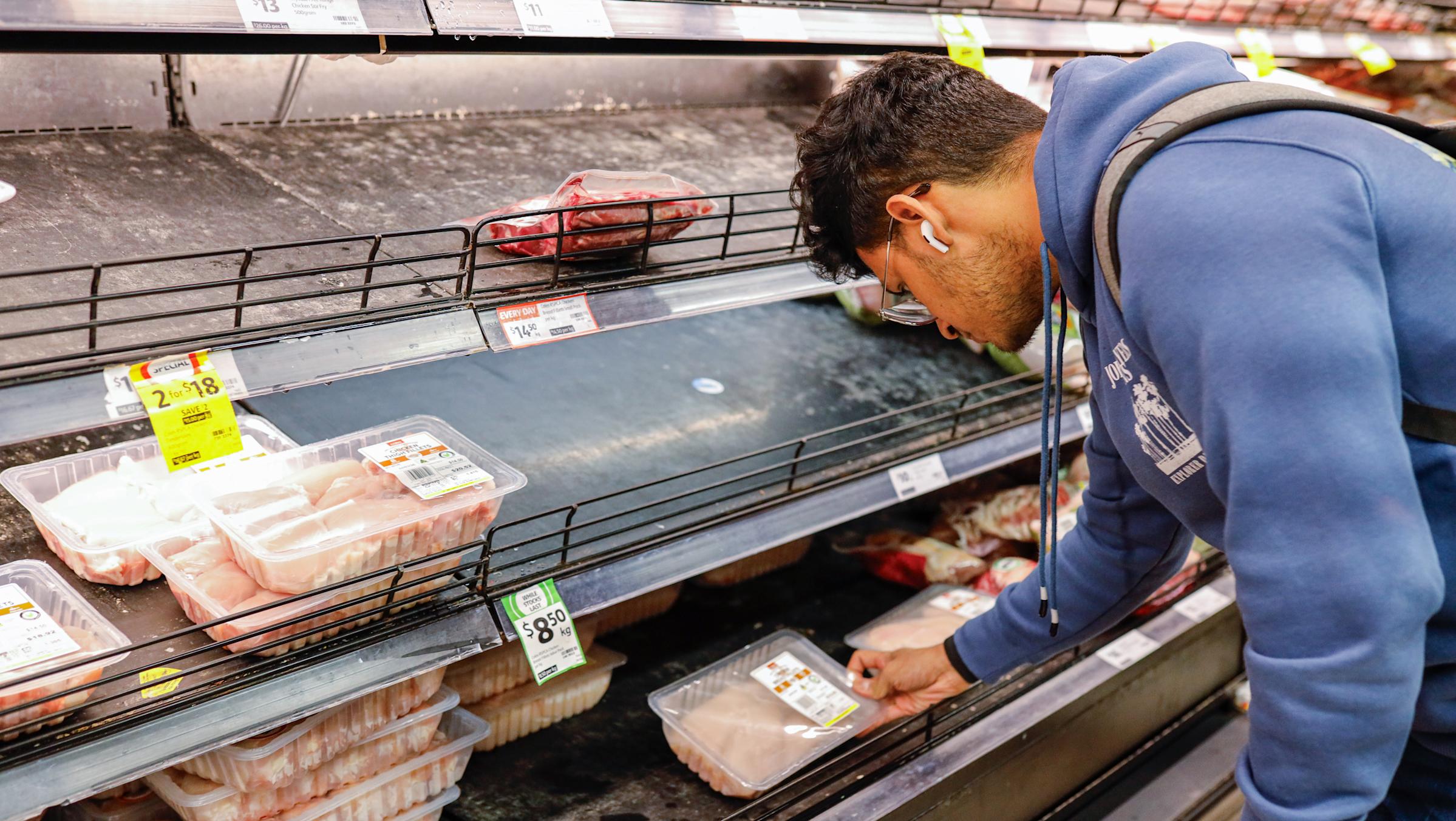
The divide shows up in concrete ways, Business Insider reports (4). Higher earners (making $150,000 per year or more) are spending more on meat, fresh vegetables and drinks at the grocery store.

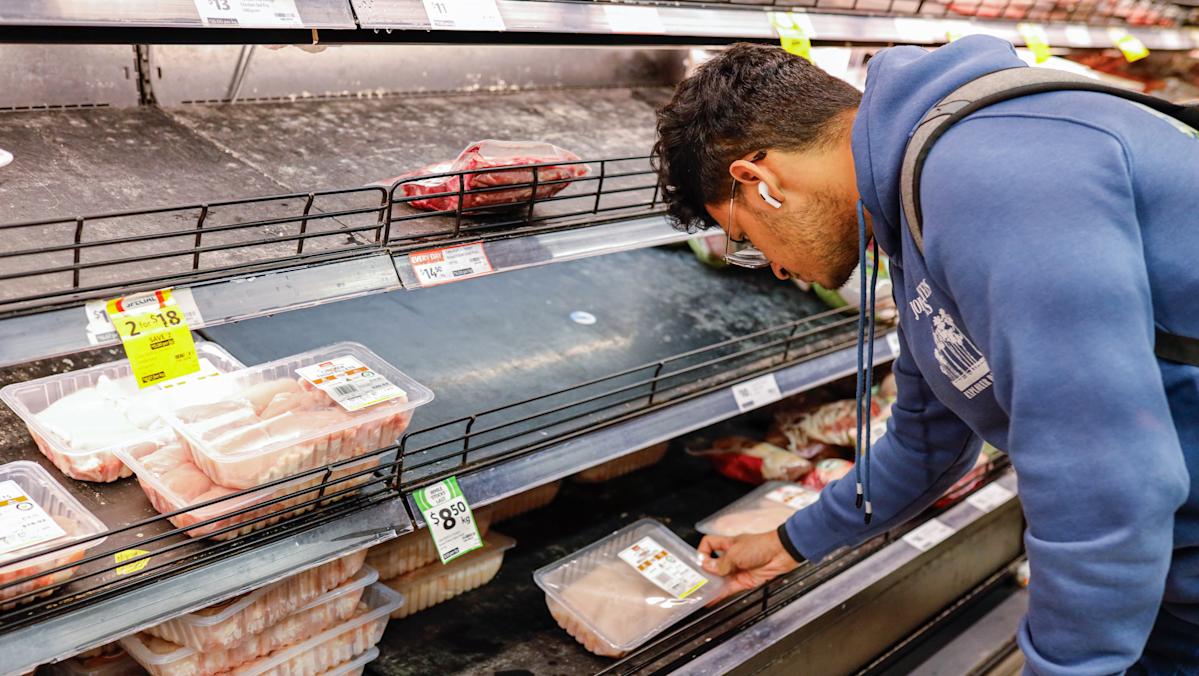
Lower-income consumers (earning under $50,000 per year) are pulling back on “perimeter categories” — fresh produce and meat, or bakery goods — because, as NielsenIQ e-commerce’s Jack O’Leary put it, those foods don’t have the most favorable “price-to-calorie” ratios (4). For what you get, they cost a lot.

A quarter of Buy Now, Pay Later users said they used installment loans to buy groceries last year, which was 11% more users than in 2024, per a Lending Tree survey (9).

Even the job market has a K. Recent college graduates aged 22 to 27 have been seeing higher unemployment rates than the broader workforce since 2021, a reversal from the pre-pandemic norm (4).

And Bank of America Institute found the wage growth gap between the top and bottom income thirds in February hit its widest point since 2015 or earlier, according to Business Insider reporting (4).

Some economists now describe it as an “E-shaped” economy, with the middle class forming its own fraying tier — still paying bills, but increasingly stretched.

Navy Federal Credit Union chief economist Heather Long calls it the “Costco economy”: people are not panicking yet, but they’re “spending in a nervous way” and buying in bulk to stretch every dollar, she told CNBC (2.

Read More: 8 essential money moves to make once you’ve saved $10,000

Read More: You can now invest in this $1B private real estate fund starting at just $10

The framing differs, but the underlying reality is the same: economic outcomes are diverging by income, and the trend is accelerating. Understanding which forces are driving this, and acting before you’re on the bottom rung, is the difference between being prepared and being caught off-guard.

Here’s what separates the households trending upward from the ones falling behind, and what you can do about it.

The core divide in a K-shaped economy isn’t just about how much you earn, but what you own. Higher-income households benefit disproportionately from rising financial markets and home equity (4).

To combat this, you can consider contributing enough to your 401(k) to capture your full employer match.

If you are able to put away a bit of money each month, make sure it’s working for you. For instance, if you’re building an emergency fund, look around for a deal on a high-interest savings account. That keeps your hard-earned money accessible, but helps prevent its value from being eroded by inflation.

If you own your home, you’re building equity. These compounding advantages are what make the upward arm of the K self-reinforcing.

The most concrete marker of which side of the K you’re on is credit card behavior. Among cardholders earning under $50,000, 59% carried a balance at least once in the past year, per the Federal Reserve’s Survey of Consumer Finances.

Among those earning $100,000 or more, only 38% did (10).

Carrying a balance at today’s average rate of around 20% is a wealth drain that compounds in the wrong direction. Pay in full, every month if at all possible (11).

Households at the top of the K often have multiple income streams — wages, dividends, rental income, capital gains. You don’t need all of those, but relying solely on a paycheck from a single employer exposes you to sector-specific K dynamics.

For example, Business Insider reports health care payrolls added 363,500 jobs in the year through February, per the Bureau of Labor Statistics (4) . Professional and business services shed 88,000. If your field is contracting, looking for ways to earn a side income or acquire a set of in-demand freelance skills could help provide you with a buffer.

This is about the longer-term math of nutrition and health costs. An National Heart, Lung and Blood-institute study found poor diet drives $50 billion a year in U.S. health care costs — with nearly 20% of heart disease, stroke and diabetes expenses linked to diet (12). With U.S. health care costs what they are, a medical disaster could become a financial one, too.

So, prioritize affordable, nutrient-dense foods, and consider reducing spending on packaged foods that don’t provide much in the way of nutrients on a dollar-for-dollar basis. One way to tell is by making a habit of looking at the unit price — the dollar spent per gram, ounce, or individual item. You might be unpleasantly surprised to find that prices are going up while package sizes are going down.

Getting off of the wrong side of the K-shaped economy is easier said than done.

The sectors adding jobs, like health care and social assistance, require credentials. If you’re not in a place to make that kind of investment — or that kind of job isn’t for you — you can look for short courses to gain or upgrade skills. This could help you transition to a higher-paying job, or boost your productivity in your current role, making you more attractive for a promotion. That’s one of the few levers individual workers still control in an economy sorting more aggressively by skill level.

Robert Kiyosaki says this 1 asset will surge 400% in a year — and he begs investors not to miss its ‘explosion’

Turning 50 with $0 saved for retirement? Most people don’t realize they’re actually just entering their prime earning decade. Here are 6 ways to catch up fast

Vanguard reveals what could be coming for U.S. stocks, and it’s raising alarm bells for retirees. Here’s why and how to protect yourself

Here’s how I’m keeping my $2M nest egg safe at 71 — and making sure my grandkids inherit every penny

Join 250,000+ readers and get Moneywise’s best stories and exclusive interviews first — clear insights curated and delivered weekly. Subscribe now.

We rely only on vetted sources and credible third-party reporting. For details, see our editorial ethics and guidelines.

(1) Bureau of Economic Analysis; (2) CNBC; (3) CNN; (4) Business Insider; (5) Federal Reserve Bank of New York; (6) Bank of America Institute; (7) CNBC; (8) Bank of America Institute; (9) LendingTree; (10) Federal Reserve; (11) Bankrate; (12) National Heart, Lung, and Blood Institute

This article provides information only and should not be construed as advice. It is provided without warranty of any kind.
Comments
You must be logged in to comment.