yahoo Press
Key Ally Instantly Slaps Down Trump’s Demand for Help
Images
1 / 16
2 / 16

3 / 16

4 / 16

5 / 16

6 / 16

7 / 16
8 / 16
9 / 16
10 / 16
11 / 16
12 / 16
13 / 16

14 / 16

15 / 16

16 / 16
Sometimes it takes a good friend to call you out when you’re wrong.

For Donald Trump, that pal is the nation of France, which has delivered an emphatic “Non!” to the American president’s request for military support in his Middle Eastern campaign.

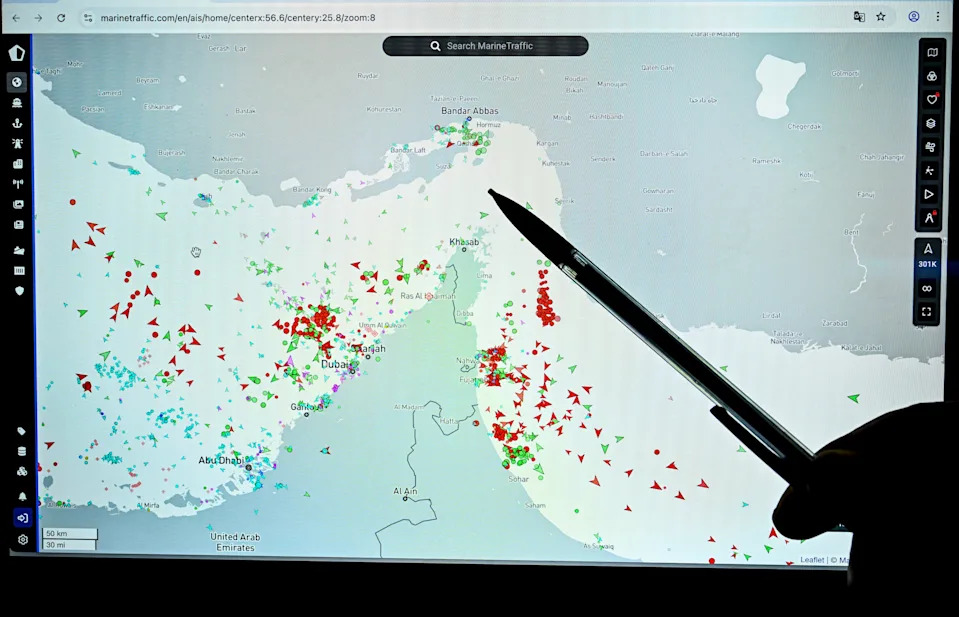
The 79-year-old conducted diplomatic relations via Truth Social on Saturday, begging America’s allies to intervene in the Strait of Hormuz. The maritime shipping lane, which is the only sea passage from the Persian Gulf to the open ocean, is currently being blockaded by Iran following the U.S. and Israel’s joint attacks on the country.

As a result, approximately 20 percent of the world’s oil supply is not moving, rapidly driving up the prices of gas and aviation fuel in America.

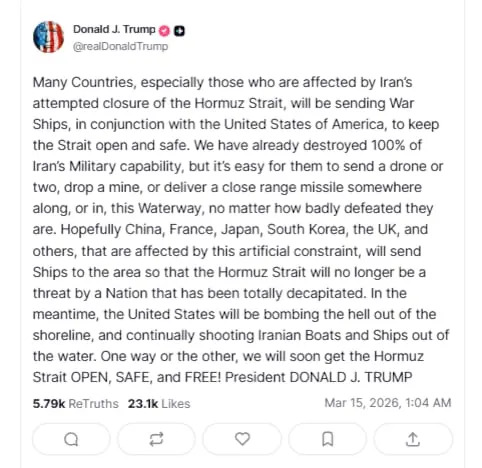
“Many Countries, especially those who are affected by Iran’s attempted closure of the Hormuz Strait, will be sending War Ships, in conjunction with the United States of America, to keep the Strait open and safe,” Trump wrote on Truth Social on Saturday.

“Hopefully China, France, Japan, South Korea, the UK, and others, that are affected by this artificial constraint, will send Ships to the area so that the Hormuz Strait will no longer be a threat,” he continued, in what appeared to be a veiled plea for help from America’s allies.

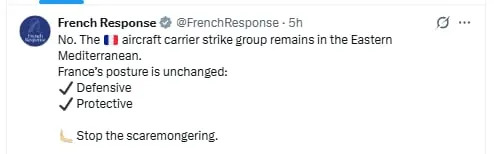
French Response, the official X account of the French government’s foreign office, was quick to clarify that it would not be sending the ships Trump requested.

“No. The [French] aircraft carrier strike group remains in the Eastern Mediterranean. France’s posture is unchanged: Defensive. Protective,” the diplomatic outlet wrote. “Stop the scaremongering.”

The account repeated the message to multiple posts on X that had claimed France would be deploying warships to the Middle East.

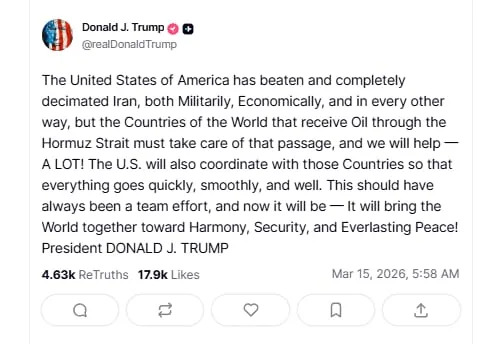
Earlier, Trump had posted a separate message, calling for a coalition to help reopen the Strait.

“The Countries of the World that receive Oil through the Hormuz Strait must take care of that passage, and we will help—A LOT!” he promised.

“The U.S. will also coordinate with those Countries so that everything goes quickly, smoothly, and well. This should have always been a team effort, and now it will be—It will bring the World together toward Harmony, Security, and Everlasting Peace!”

The United Kingdom’s Ministry of Defence has said that it is discussing “a range of options to ensure the security of shipping in the region.”

The Financial Times had previously reported that both France and Italy were seeking to negotiate a deal to guarantee safe passage of their ships through the Strait, though Italy has since denied the report.

Two French officials also previously told Reuters that the country was working on attempting to build a coalition to allow European ships through the strait, but French Response’s message suggests this may not include military activity.

Trump has made a series of posts in recent days suggesting that the Iranian military is both “completely decimated” and proving to be highly resilient, with continued bombardment required to open the vital maritime passageway.

“In the meantime, the United States will be bombing the hell out of the shoreline, and continually shooting Iranian Boats and Ships out of the water,” Trump wrote. “One way or the other, we will soon get the Hormuz Strait OPEN, SAFE, and FREE!”

Defense Secretary Pete Hegseth told reporters on Friday that the Strait of Hormuz is, in fact, open for shipping but that it carries a high risk of being bombed by Iranian forces.

“The only thing prohibiting transit in the Strait right now is Iran shooting at shipping. It is open for transit should Iran not do that,” Hegseth said.

Iranian military leaders have said that they will continue to block shipping through the strait and drive up the price of oil, which has already climbed to more than $100 per barrel. It is the largest disruption to global oil supplies in history.

While Iran’s historical Supreme Leader Ayatollah Ali Khamenei was killed in the opening salvo of the joint U.S.-Israeli strikes, his son, Mojtaba Khamenei, has since taken over and vowed to keep fighting.

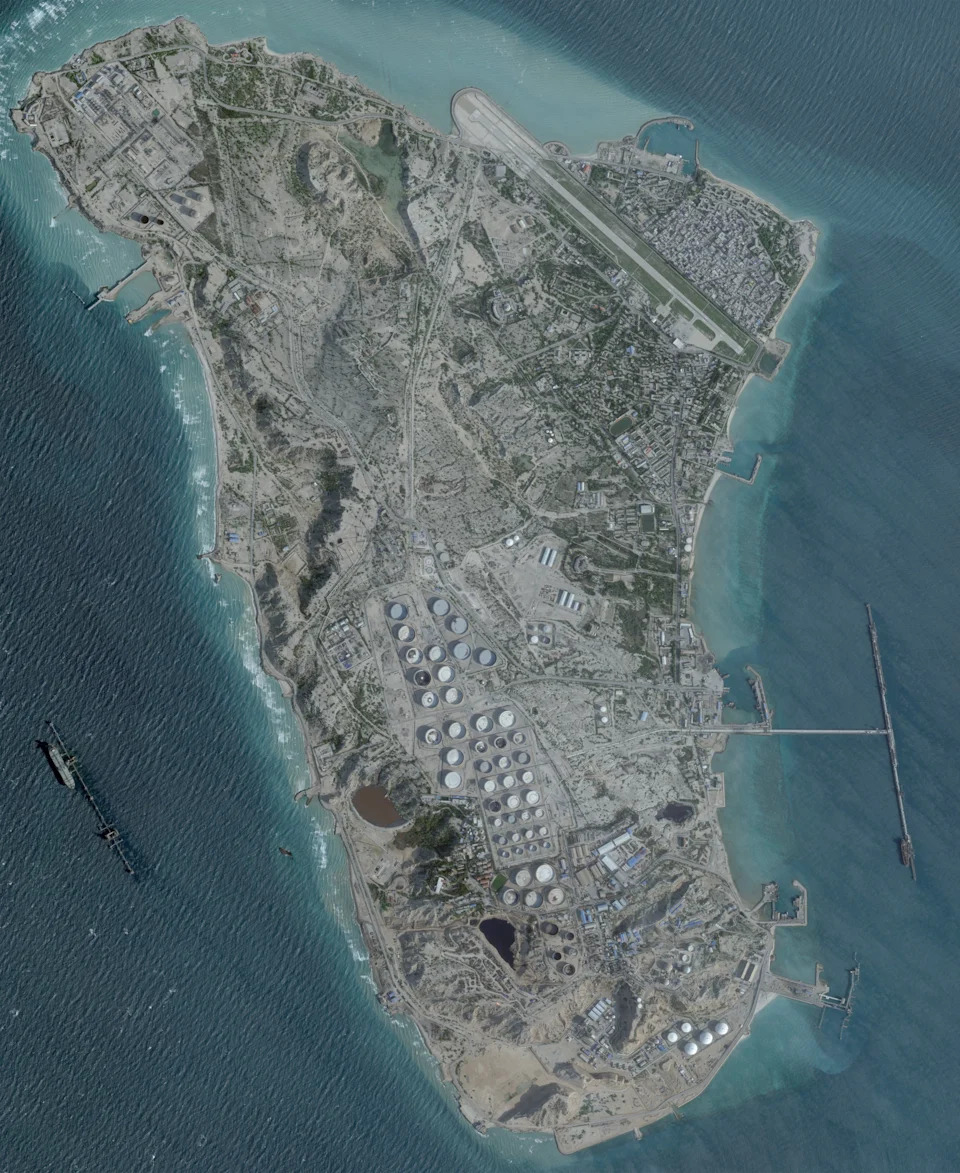
On Friday, Trump announced that the U.S. had struck more than 90 military targets on Kharg Island, the deep-water fuel terminal through which most Iranian oil flows, typically to its main buyer, China. Fuel infrastructure reportedly remains intact on the strategic island, which is considered vital to the regime’s finances.

On Saturday, however, Trump said the U.S. “may hit it a few more times just for fun,” telling NBC that Tehran is ready to make a deal but he won’t accept it as the “terms aren’t good enough yet.”

Iran has downplayed the damage on Kharg and is now targeting fuel ports in nearby Dubai, Abu Dhabi, and the United Arab Emirates.
Comments
You must be logged in to comment.