huffpost Press
Trump Mocks Biden And Obama For How They Walk — And It Reveals More Than He Realizes
Images
1 / 8

2 / 8
3 / 8
4 / 8

5 / 8
6 / 8

7 / 8

8 / 8
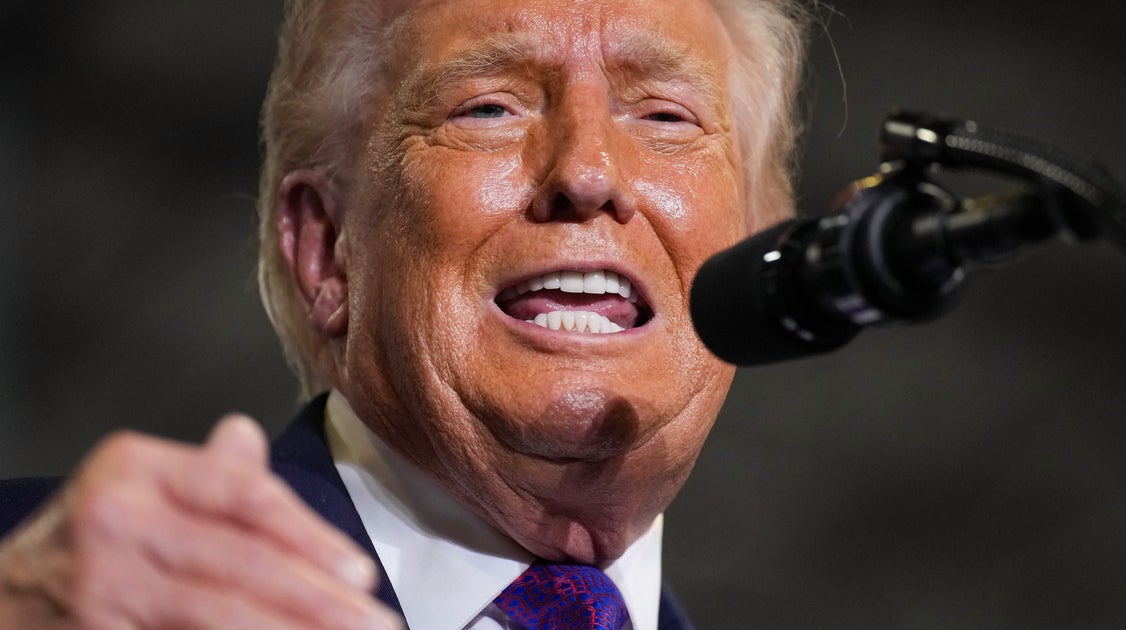
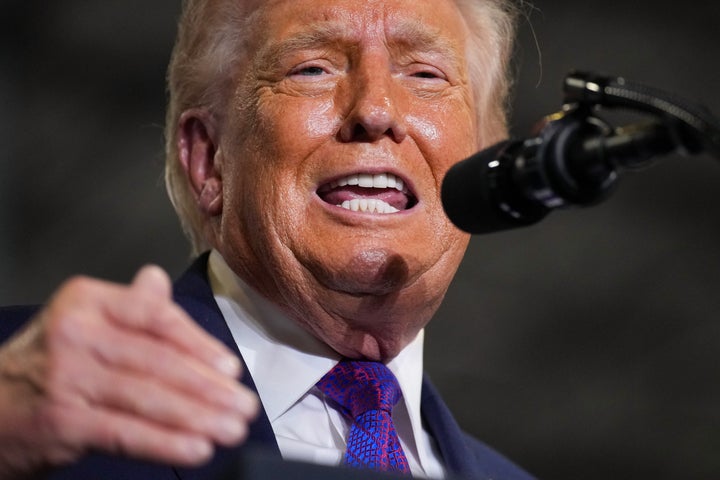
In his first rally since the United States and Israel launched a war against Iran, President Donald Trump touted his economic record and the U.S. military mission, but also took the time to rail against his political enemies’ physical abilities.

At a rally in Kentucky, Trump mentioned how he tried to avoid slipping down the soaking-wet stairs: “I do it very slowly...because nobody cares if you set a speed record.” He then said he “admired” former President Barack Obama’s ability to walk down stairs — but then disparaged him, claiming that Obama’s “bob down the stairs” was “unpresidential.”

Then he turned his attention to Joe Biden, recounting how the former president has fallen, “and the world watches that and they don’t like seeing it.”

Trump’s preoccupation with how his opponents stay on their feet is nothing new. He has fixated upon it in past speeches, seemingly equating strength with the ability to go up and down stairs, and it reveals a lot about his views on leadership and who matters, according to a variety of experts on ableism.

“His comments may reflect ableism, but they may also reflect general ageism and fear of getting older,” said Douglas Kruse, co-director of Rutgers University’s Program for Disability Research. “My guess is that he’s trying to prove he’s still able, as many older people do.”

Ableism is a system of oppression that privileges people whose bodies and minds are considered ”‘normal’ while excluding and marginalizing people whose bodies or minds are not considered ‘normal,’” explained Davey Shlasko, CEO and founder of Think Again Training & Consulting.

And Trump is not the only person who uses ableist logic in their everyday language.

“The comments reflect a very common ableist assumption that an impairment in any area of functioning implies a general incompetence in every area,” Shlasko said. “You see this assumption in even well-meaning people’s impulses to speak extra slowly or loudly to someone who’s using a wheelchair, as if being unable to walk automatically makes someone unable to hear or think, which of course is not the case.”

This kind of mindset is not only limiting language. It can also lead to limiting policies.

“Equating cognitive decline with not being a valuable human is really the heart of ableism,” Shlasko said.

As the late disability activist Stacey Milbern describes it, ableism is “a system of oppression that favors ablebodied-ness at any cost, frequently at the expense of people with disabilities.”

When Trump uses ableist insults, his political opponents in response can inadvertently end up practicing ableism as well.

In this same Kentucky rally, Trump also mocked Gavin Newsom’s dyslexia, saying he has “mental problems” and that his “cognitive deficiency” makes Newsom unfit to be president. This is ableist because “a specific learning disability doesn’t imply anything about someone’s ability to reason,” Shlasko said, noting that Trump is implicitly saying you shouldn’t respect people with learning disabilities.

Newsom later responded to Trump’s critique of his dyslexia by calling him a “brain-dead moron” in an X post.

Shlasko said Newsom’s response contained “offensive ableist language about Trump” because “moron is an outdated and offensive diagnostic category for people with intellectual [or] developmental disabilities.” Shlasko said people may use ableism to fight ableism because, for too many, “ableism doesn’t stand out as a problem because they think it is a natural hierarchy, that it is correct and obvious, that everyone would prefer to be...able-bodied.”

But there are other, more pointed ways to critique Trump than mocking how he looks or walks or speculating about his cognitive abilities.

Take it from Rep. Ilhan Omar (D-Minn). In 2020, Trump said he was helping Omar’s home state of Minnesota, and she responded in a now-deleted X post, “You couldn’t help yourself off stairs, let alone any state.” After deleting the post, Omar wrote, “I’m taking down the tweet about Trump. Trump is a racist incompetent wannabe dictator. That is enough! We should criticize him on those grounds, not on his physical abilities—and that includes me.”

To critique Trump, it’s enough to look at the policies he is enacting towards people with disabilities and other vulnerable populations.

Last year, the Trump administration’s shutdown layoffs disproportionately impacted workers with disabilities. His administration has also rolled back “disparate impact” policies meant to limit discrimination against disabled workers. Trump’s choice to gut the U.S. Department of Education’s special education office affects over 7.5 million children with disabilities across the country who rely upon the agency’s services. The left-leaning think tank Center for American Progress has called the first six months of the second Trump administration “an all-out war against disabled people.”

“I hope we can focus not only on the inappropriateness of what [Trump] said, but also on the crucial programs and protections that his administration has sought to undermine,” Shlasko said.

For Trump’s critics, those policies are troubling enough.

By entering your email and clicking Sign Up, you're agreeing to let us send you customized marketing messages about us and our advertising partners. You are also agreeing to our Terms of Service and Privacy Policy.
Comments
You must be logged in to comment.