yahoo Press
Tech stocks today: Tesla earnings on deck, Google announces new chips, SpaceX looking at acquiring Cursor
Images
1 / 7

2 / 7

3 / 7

4 / 7

5 / 7

6 / 7

7 / 7
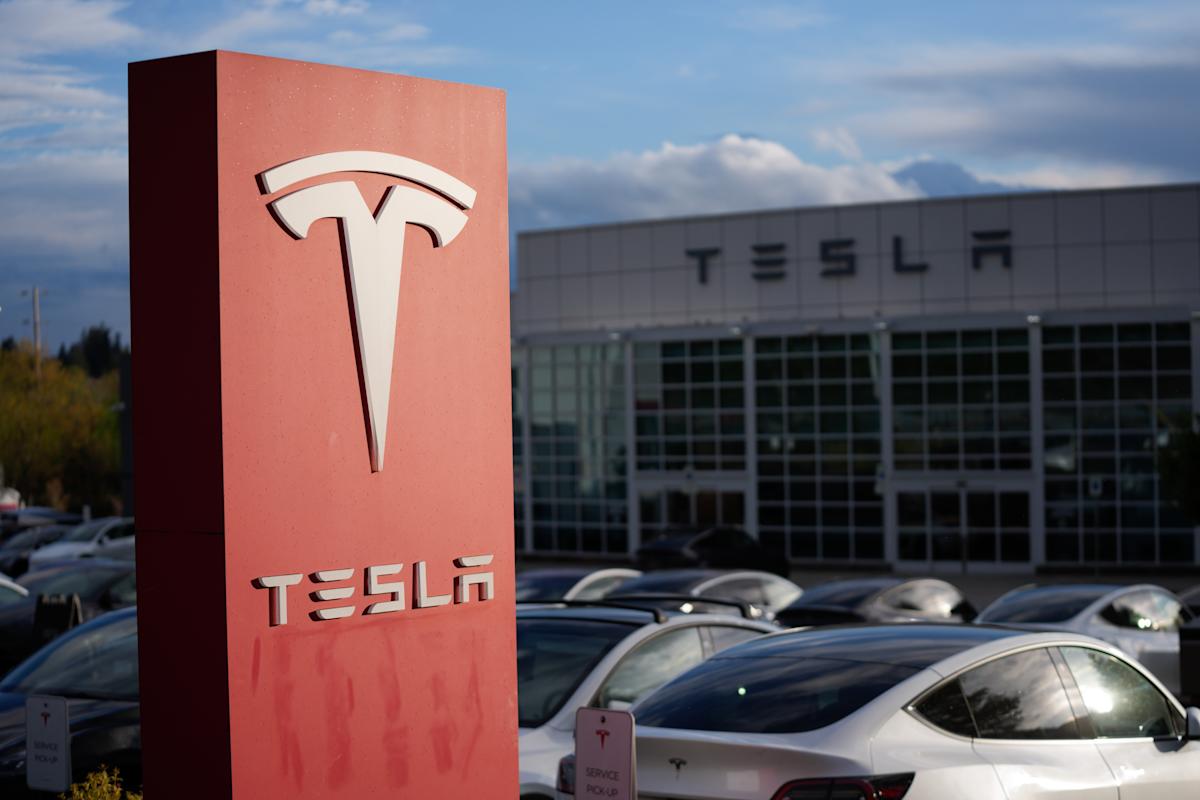
The above button links to Coinbase. Yahoo Finance is not a broker-dealer or investment adviser and does not offer securities or cryptocurrencies for sale or facilitate trading. Coinbase pays us for certain activity generated through this link. Prices displayed are informational. Tech stocks rose Wednesday, after President Trump said he would extend the ceasefire between the US and Iran Tuesday evening. The tech-heavy Nasdaq climbed 0.75%. Tesla (TSLA) will report its first quarter earnings after the bell on Wednesday, as Wall Street looks for more information on the company’s Robotaxi service and capital expenditures related to its AI products. But it’s the Robotaxi service that’s key to Tesla’s growth. Over the weekend, the company said it had expanded the offering to parts of Dallas and Houston. Elon Musk’s other big company, SpaceX (SPAX.PVT) , is also making news after the company posted on X that AI coding tool maker Cursor has given the company the option to purchase it later this year for $60 billion. Elsewhere, Google (GOOG, GOOGL) announced two new AI chips on Wednesday as part of its Cloud Next 2026 event that put it into even closer competition with Nvidia (NVDA). Google has signed deals with OpenAI (OPAI.PVT) and Anthropic (ANTH.PVT) to provide the company with its chips, and according to The Information inked a similar agreement with Meta (META). That raises the stakes for Nvidia, which must now compete with its own customers. Read more about today's market action. OpenAI (OPAI.PVT) has provided information about its latest Cyber AI model to the US government and its allies, according to Axios. Called GPT-5.4-Cyber, the model is designed to be more permissive with requests related to finding bugs and holes in software. The idea is to help governments and companies test their existing applications and services against GPT-5.4-Cyber to identify any flaws and ensure they’re better protected against potential malware attacks. OpenAI only provides access to GPT-5.4-Cyber to members of its Trusted Access for Cyber program. But AI models cut both ways when it comes to cybersecurity. Experts have been warning about the danger of AI models being used for nefarious purposes for some time. More recently, Anthropic announced that it would delay the release of its Claude Mythos Preview because it found that it was too good at finding holes in third-party software during internal testing. SpaceX on Tuesday posted on X that AI coding tool maker Cursor has given the company the option to purchase it later this year for $60 billion. “SpaceXAI and @cursor_ai are now working closely together to create the world’s best coding and knowledge work AI. The combination of Cursor’s leading product and distribution to expert software engineers with SpaceX’s million H100 equivalent Colossus training supercomputer will allow us to build the world’s most useful models. Cursor has also given SpaceX the right to acquire Cursor later this year for $60 billion or pay $10 billion for our work together,” the post said. The deal is part of SpaceX CEO Elon Musk’s plan to transform the rocket company into an AI behemoth ahead of its upcoming IPO. Musk merged SpaceX with his xAI startup in February. The SpaceX IPO, targeted for June, is aiming for a $1.75 billion to $1.8 trillion valuation, potentially making it the largest in history. Google (GOOG, GOOGL) debuted two AI processors during its Google Cloud Next 2026 conference in Las Vegas on Wednesday. The new chips, called the TPU 8t and TPU 8i, push Google further into competition with partners Nvidia (NVDA) and AMD (AMD). Earlier this month, the company announced an expanded deal with Anthropic (ANTH.PVT) to provide “multiple gigawatts of next-generation TPU capacity” to the AI lab. Google is also working to provide Anthropic rival OpenAI (OPAI.PVT) with TPU capacity to power that company’s own AI offerings. And in February, The Information reported that Meta signed its own multiyear, multibillion-dollar deal for access to Google’s TPUs. The TPU 8t, Google said, is optimized for training AI models and can “reduce the frontier model development cycle from months to weeks. Read more here. Apple (AAPL) CEO Tim Cook will leave the position he’s held since 2011 and turn the keys over to senior vice president of hardware engineering John Ternus on Sept. 1. The move elevates the 50-year-old Ternus into one of the most important chief executive roles in Silicon Valley at a time when AI continues to roil the broader tech industry. He’s a contrast from Cook, who joined Apple in 1998 and served as the company’s COO before becoming CEO in 2011. Cook is an operations expert, which helped him turn Apple into the $4 trillion behemoth it is today. It also allowed the company to navigate the pandemic and subsequent supply chain crunch, as well as President Trump’s tariffs. Now the company will be led by a product-centric executive with experience working on everything from the iPhone to AirPods. And the decision could provide a glimpse into where Apple is heading at a crucial time in its history. Read more here. President Trump signaled that the US government may be preparing a deal to end its ongoing standoff with AI leader Anthropic (ANTH.PVT). During an interview with CNBC, Trump said Anthropic representatives met with him in the White House “a few days ago” and that he believes the government will “get along with them just fine.” Trump said it’s possible a deal will be made, because he “wants the smartest people,” but noted that the government has replaced Anthropic with OpenAI. The blowup between the company and the government came after Anthropic told the Department of Defense that it wouldn't allow the department to use its AI models for the mass surveillance of Americans or to develop fully autonomous weapons. The government then shot back, labeling Anthropic a supply chain threat, which would force government contractors that use the company’s software to abandon it for any government work. And while Anthropic won a temporary reprieve from the designation in a federal court in California, it still faces a fight in the DC Circuit Court of Appeals over the grounds for the government’s efforts. Anthropic already works with the DOD, and reports say the Pentagon used the company's technology during its operation in Venezuela in January and in the current conflict with Iran. Apple’s (AAPL) Tim Cook is stepping down from his role as CEO, turning the reins of the $4 trillion company over to senior vice president (SVP) of hardware engineering John Ternus. Rumors have been swirling since at least 2024 that Ternus was up for the chief executive position, and that will become reality on Sept. 1. While Ternus holds one of the larger leadership roles at Apple and makes appearances at the company’s high-profile product launches, including the debut of the MacBook Neo last month, he’s still a relative unknown for those who haven’t been following the company closely in recent years. Ternus joined Apple in 2001 as a member of the company’s product design team, before being elevated to VP of hardware engineering in 2013. He was named SVP of hardware engineering in 2021. He’s also the kind of perfectionist Apple is known for. Read more here. Apple (AAPL) on Monday announced that CEO Tim Cook will step down from the role he’s held since August 2011 on Sept. 1. During his time as CEO, Cook oversaw the launch of a variety of new products, including the Apple Watch, AirPods, and the company’s new MacBook Neo. He’s also been instrumental in increasing Apple’s Services segment revenue to more than $100 billion, the company’s second-largest business behind the iPhone. Cook leveraged his supply chain expertise to dramatically expand Apple’s business. The company’s market capitalization has grown from $350 billion to just north of $4 trillion as of the end of the trading day Monday, a staggering 1,000% increase. Yearly revenue has quadrupled from $108 billion in 2011 to $416 billion in 2025. Apple’s iPhone revenue, in particular, has skyrocketed under Cook’s leadership, from $47.1 billion to $209.6 billion this year. Read more here. Amazon said Monday it will invest another $5 billion into Anthropic — and potentially up to $20 billion — as part of a new agreement with the AI startup that will see Anthropic commit to spending at least $100 billion with AWS over the next ten years. Amazon has previously invested $8 billion in Anthropic. In a press release, the company’s said this deal, “encompasses current and future generations of Trainium (Amazon’s custom silicon) and tens of millions of Graviton cores (Amazon’s widely-adopted CPU chip) to provide superior price performance. Adding: “Anthropic will secure up to 5 gigawatts (GW) of capacity to train and power their advanced AI models, including significant Trainium3 capacity expected to come online this year. The collaboration also includes a meaningful expansion of international inference in Asia and Europe to better serve Claude’s growing international customer base.” Amazon stock was up more than 2% in extended trading on Monday after the news. The Tim Cook era at Apple is coming to a close. On Monday, the company announced that Cook would step down as CEO, effective Sept. 1. John Ternus, who currently leads the company’s hardware engineering division, will take the role. Cook, who has served as Apple CEO since 2011, will take a role as the company’s executive chairman. “It has been the greatest privilege of my life to be the CEO of Apple and to have been trusted to lead such an extraordinary company,” Cook said in a statement. “John Ternus has the mind of an engineer, the soul of an innovator, and the heart to lead with integrity and with honor.” The change comes after what Apple said in a statement was a “thoughtful, long-term succession planning process.” Apple also announced Monday that Johny Srouji was named to a new role as the company’s chief hardware officer. Srouji had lead the company’s hardware technology efforts; this role will combine Apple’s hardware efforts under one unit. Google (GOOG, GOOGL) is making a hard push to ensure its internal AI coding models can keep up with those from rival Anthropic (ANTH.PVT). According to The Information, the effort, which the publication refers to as a “strike team,” is focused on ensuring that Google’s coding models can eventually write AI software on their own. The move comes after individuals within Google’s AI teams look to catch up to Anthropic’s own AI coding capabilities. Anthropic’s Claude Code is considered among the best on the market and is a key component of the company’s success with enterprise users. But Google’s coding efforts aren’t part of a planned public release. The Information says the software would instead be trained using Google’s internal code and then deployed within the company itself, rather than offered to customers. Companies have rapidly adopted AI coding technologies to accelerate the rollout of new software and reduce costs. But that’s also led to concerns over job losses among junior developers, as well as fear among cybersecurity experts that the speed at which code is being written and released could result in more unseen bugs entering the public sphere, leading to future cyberattacks. Yahoo Finance’s Jared Blikre reports: Read more here. Yahoo Finance's Brian Sozzi reports: Read more here. Tesla (TSLA) will report first-quarter earnings after the bell on Wednesday, with Wall Street focused on the company’s slow-to-evolve robotaxi rollout and cap-ex spending, which is expected to balloon due to its AI ventures. Analysts expect Tesla to post revenue of $22.08 billion, down 9% year over year, according to Bloomberg consensus. Tesla’s adjusted EPS is expected to come in at $0.35, with adjusted EBITDA projected for $3.217 billion, down 14.4% versus Q1 last year. The key to Tesla’s growth is the rollout of its robotaxi service. Over the weekend, the company said it had expanded robotaxi service to parts of Dallas and Houston. Prior to this expansion, Tesla only offered robotaxi service in Austin and ride-hailing services in the San Francisco bay area. Read more here. Meta (META) is teaming up with CBRE to launch a multi-year program that will train US workers to become fiber technicians, as the tech giant looks for ways to fill such positions as part of its massive data center buildout. Fiber technicians install and maintain the networking tools within data centers and other high-tech facilities. The four-week program, LevelUp Fiber Technician Pathway, Meta says, will provide individuals ranging from high school graduates to mid-career professionals with the skills they need to operate in the field. “We currently operate or are building 27 data centers in the US. Since 2010, these projects have supported more than 30,000 skilled trade jobs during construction and more than 5,000 permanent operational roles like site managers and engineers,” Meta said in a statement. The data center boom has run into a shortage of skilled construction workers, with the construction industry trade group Associated Builders and Contractors estimating that 499,000 new workers will be needed in 2026 to meet demand. Yahoo Finance’s Ines Ferré reports: Read more here. Alphabet (GOOG, GOOGL) and Marvell Technology (MRVL) are reportedly in talks to jointly develop two AI chips. Marvell stock jumped more than 5% in premarket trading on Monday, while Google stock slipped 1%. The Information reported on Sunday that the two companies were looking to build a memory processing unit to work with Google's tensor processing unit (TPU) and another specifically for running artificial intelligence models. Google has been working on TPUs for more than a decade to show that the tech company, an Nvidia (NVDA) customer, can also develop its own AI chips and boost sales. According to the report, Google and Marvell intend to finalize the chip’s design by next year. Read more here. Meta (META) is planning its first round of extensive layoffs for May 20, Reuters reported Friday. A second round is expected to come later this year. According to a source familiar with the matter, the Facebook parent company intends to cut about 10% of its workforce, or about 8,000 employees. A second round of job cuts is slated for the end of the year, though the details about the extent and timing of those layoffs aren’t finalized, Reuters reported. The expected layoffs come as Meta and other tech companies look to artificial intelligence for productivity gains (though it’s possible some are using AI as a cover story to thin their ranks). According to the Federal Reserve’s latest report on economic conditions, AI has “not yet significantly impacted” staffing levels overall. But “some noted that AI-driven productivity improvements had enabled many firms to delay or reduce hiring,” the so-called Beige Book said. So far in 2026, 73,212 tech employees have been laid off, according to Layoffs.fyi. Notable layoff examples came from Block (XYZ), Snap (SNAP), and Atlassian (TEAM) — all three of which cited AI efficiency as reasons for the cuts. On Friday, Figma (FIG) stock fell as much as 6.8% after Anthropic unveiled Claude Design, a new product powered by its Opus 4.7 model that lets users “collaborate with Claude to create polished visual work like designs, prototypes, slides, one-pagers, and more.” Figma, which went public last year in one of the year’s biggest IPOs, said in its S-1 filing that, “Figma is where teams come together to turn ideas into the world’s best digital products and experiences.” In other words, Figma is a collaborative design tool, which is what Anthropic just announced. Since the company went public last summer, Figma stock has dropped more than 80% from its post-IPO high. Earlier this week, Anthropic’s chief product officer, Mike Krieger, stepped down from Figma’s board. Krieger previously co-founded Instagram and the AI news app Artifact, which Yahoo acquired in 2024. The AI race is moving quickly. And as quickly as companies develop new models, raise new funding, and make new hires, so too does the tech industry’s view of the field's key players shift. So, after weeks as the industry’s darling, Anthropic has seen this past week defined by its perceived shortcomings. On Thursday, Anthropic released its latest model, Claude Opus 4.7. Notably, this is not its most advanced model — that is Mythos Preview, which it has released to a select number of partners as part of Project Glasswing. The challenge, however, is that users have noticed. Tae Kim, author of the newsletter Key Context and a recent book on Nvidia, compiled a series of complaints from notable commentators on X, highlighting a variety of perceived deficiencies in Opus 4.7. Gergely Orosz, who writes the Pragmatic Engineer newsletter, also called Opus 4.7 “surprisingly combative.” Orosz has also been among those in the tech space, noting that Claude has notably struggled to keep up with tasks in recent weeks. Anthropic’s compute disadvantage — that is, the amount of raw computing power available to the company — relative to OpenAI has become a major point of discussion as adoption of Claude, specifically Claude Code, has ramped in recent weeks. This also comes as the company’s rollout of Mythos Preview continues to confound some commentators, with a description of its capabilities — but a less transparent view of its benchmarks — making the cybersecurity vulnerabilities reportedly surfaced by Mythos feel like a blend of PR spin and a true AGI moment. As my colleagues point out in the blog below, chip stocks have helped drive a powerful rally in tech stocks in recent weeks. But there’s one stock in particular that’s worth paying attention to: Advanced Micro Devices (AMD). Shares of AMD might be down slightly on Friday, but they’re sitting at all-time highs after gaining 30% year to date, outpacing competitor Nvidia (NVDA). Wall Street analysts see the company as a primary beneficiary of the boom in agentic artificial intelligence this year. As agentic AI increases the need for central processing units (CPUs), it has driven demand for the chips AMD designs far beyond expectations. And on Thursday, AMD’s chip producer, Taiwan Semiconductor (TSM), sent another bullish signal on demand. "AI-related demand continued to be extremely robust," Taiwan Semiconductor CEO C.C. Wei told analysts on a conference call. "The shift from generative AI and the query mode to agentic AI and ... the action mode is leading to another step up in the amount of tokens being consumed. This is driving the need for more and more computation, which supports the robust demand for leading-edge silicon." AMD’s margins are expected to rise as the company shifts toward data center and server chips, which command higher value. “Our Strong Buy opinion reflects AMD's positioning to close the competitive gap with NVIDIA through MI450x launch and rack-scale solutions,” CFRA analyst Angelo Zino wrote in a note earlier this week. “We believe the 6 GW Meta deal improves visibility/reduces tail risk (a big concern in this market for the AI trade), adds conviction to AMD’s shift into large scale solutions, and supports share gain.”
Comments
You must be logged in to comment.