yahoo Press
Tech stocks today: Suspect arrested in alleged attack on OpenAI CEO Altman's home
Images
1 / 6

2 / 6

3 / 6

4 / 6

5 / 6

6 / 6
The above button links to Coinbase. Yahoo Finance is not a broker-dealer or investment adviser and does not offer securities or cryptocurrencies for sale or facilitate trading. Coinbase pays us for certain activity generated through this link. Prices displayed are informational.

Tech stocks ended the trading day mixed on Friday trading, as Wall Street attempted to digest the tenuous truce in the war in Iran.

The hostilities in the Middle East have weighed on tech stocks for weeks, clouding the picture of whether investors are pulling back because of the war or because of sentiment toward Big Tech more generally.

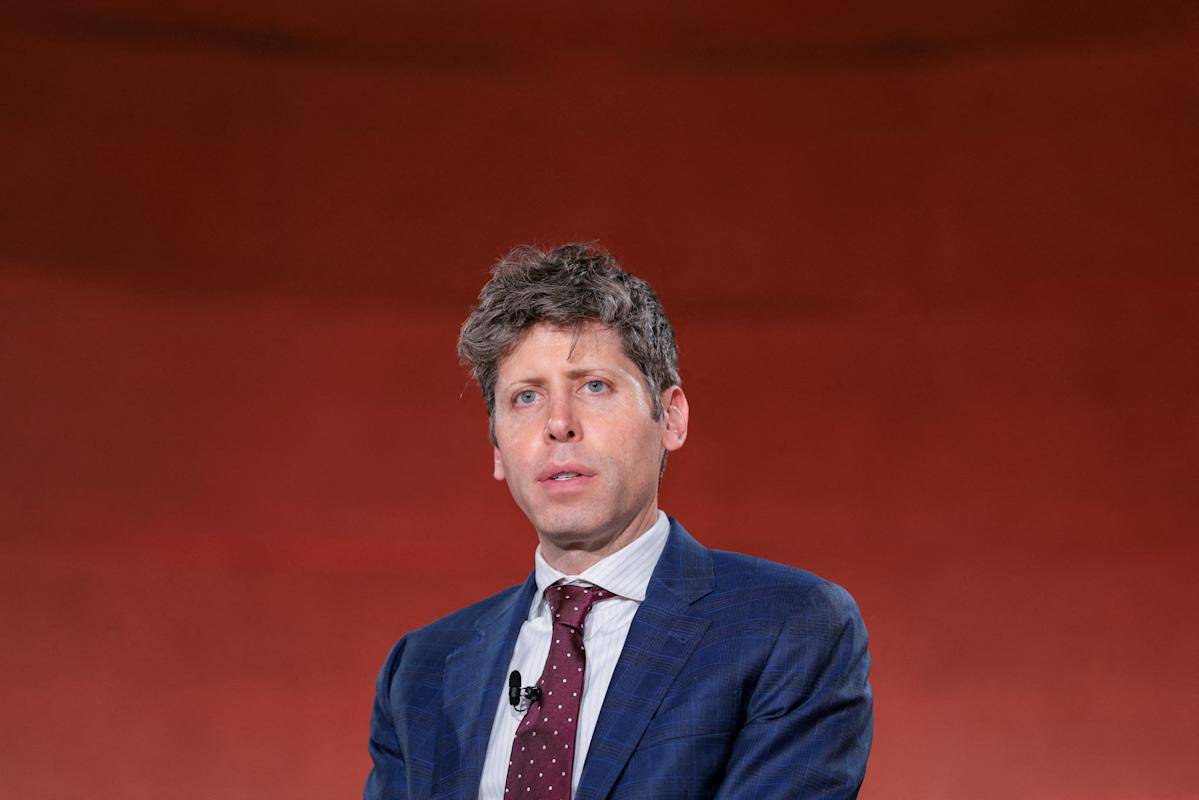
Beyond the war, police arrested a suspect in an alleged Molotov cocktail attack on OpenAI CEO Sam Altman’s home Friday morning. The fire burned an outer gate, but no one was injured. The same suspect reportedly threatened to burn down OpenAI’s headquarters.

CoreWeave (CRWV) stock rocketed more than 10% higher after the company announced it is entering a multiyear agreement with Anthropic (ANTH.PVT) that will see the AI cloud company provide Anthropic with computing capabilities to build and power its AI models.

Reuters also reported on Friday that Anthropic is exploring designing its own AI processors to address the ongoing demand crunch for the highly sought-after chips.

Elsewhere, TSMC (TSM) reported its first quarter revenue jumped 35% year over year on strong demand for its own AI chips.

Meanwhile, anticipation continues to build around two major IPOs: one from Anthropic (ANTH.PVT), expected as early as this year, and the public debut of Elon Musk’s rocket company, SpaceX (SPAX.PVT).

Read more about today's market action.

Police have arrested a 20-year-old suspect in connection with an alleged Molotov cocktail attack on OpenAI (OPAI.PVT) CEO Sam Altman’s San Francisco home on Friday morning, according to a statement by the San Francisco Police Department. The individual allegedly also made threats against OpenAI’s headquarters.

The suspect reportedly threw the device at Altman’s home, setting fire to an exterior gate, before fleeing on foot. The same person was then spotted near 3rd Street, threatening to burn down a building later that morning. No one was injured in either incident.

Police haven’t released any additional details about the suspect or the motive behind the alleged attack.

Altman has quickly become the face of the global explosion in AI, with OpenAI’s ChatGPT serving as the fastest-growing app in history.

And while consumers and enterprises continue to sign up and use AI software, there’s also been backlash against the technology over fear of job losses and the environmental impact of the massive data centers that power the services.

Alphabet (GOOG, GOOGL) is increasing the price of its YouTube Premium service, including a $4 jump on its family plan option.

That means a family subscription, which supports up to 5 people in a household, how costs $26.99. An individual plan, meanwhile, jumps from $13.99 to $15.99, Reuters reported Friday.

The increase comes as other streaming services and platforms continue to raise their own prices.

Last month, Netflix (NFLX) hiked subscription fees across each of its US offerings. The ad-supported version of the service rose from $7.99 to $8.99, while the Premium plan increased from $24.99 to $26.99.

Read more here.

Taiwan Semiconductor Manufacturing Company (TSM) reported first quarter revenue on Friday, saying sales during the period climbed 35% on the continued strength of the ongoing global AI build-out.

The company’s revenue between January and March topped 1.13 trillion new Taiwan dollars ($35.7 billion), compared to estimates for the period. March revenue climbed 31% versus February and 45% versus March 2025.

The company will hold its first quarter earnings call on April 16.

The announcement is just the latest sign that global demand for AI chips shows no sign of abating for now.

On Wednesday, market research firm Gartner said worldwide semiconductor spending, including GPUs, memory, and storage chips, will reach $1.3 trillion in 2026, marking the largest growth in two decades.

Read more here.

Anthropic (ANTH.PVT) and CoreWeave (CRWV) announced they’re entering into a multi-year agreement under which the AI cloud company will provide computing capabilities to build and power Anthropic’s Claude AI models.

CoreWeave said Anthropic will use its cloud services to run workloads at “production scale,” and that it will initially focus on a phased rollout, with the option to expand the agreement in the future.

The announcement comes as Reuters reported that Anthropic is considering designing its own semiconductors to contend with the AI chip crunch and ensure it has the capacity to train and run its AI models.

It also follows news that CoreWeave is entering into a separate $21 billion deal with Meta (META) that will see CoreWeave power Meta’s AI services through December 2032.

CoreWeave said that the capacity will be spread out among a number of its data center locations and include some of the first deployments of Nvidia’s (NVDA) upcoming Vera Rubin system.

Anthropic (ANTH.PVT) is exploring getting into the chip game. According to Reuters, the company is looking into potentially designing its own AI processors to help it contend with the shortage of highly-coveted semiconductors.

The report comes the same week that Anthropic announced it is entering into an expanded chip agreement with Google (GOOG, GOOGL) and Broadcom (AVGO) that will see Anthropic access 3.5 gigawatts of Google’s next-generation TPUs. That agreement is dependent on Anthropic’s continued commercial success.

The custom chip trend is gaining steam across Silicon Valley.

In October, rival OpenAI entered into a partnership with Broadcom to develop upwards of 10 gigawatts of custom OpenAI-designed chips.

Last month, Meta revealed four new custom AI processors including its MTIA 400, which the company says has the kind of raw performance that can rival some of the top chips on the market.

Read more here.

Big Tech earnings will be highly scrutinized for returns on aggressive AI-driven capital expenditures this earnings season, as investors search for proof that the investments are paying off.

Yahoo Finance’s Brian Sozzi pointed out new charts from Barclays strategist Venu Krishna that detail capex among hyperscalers (tech companies spending a lot to scale up AI infrastructure), which is expected to surge 87.9% year over year.

See Krishna’s two other charts here.

OpenAI (OPAI.PVT) introduced a new pricing tier for its paid version of ChatGPT on Thursday.

The new $100 Pro plan is similar to the company's existing $200 Pro option, but cuts back on how much you can use the service. The $100 plan provides 5 times the usage of OpenAI's popular $20 Plus tier, while the $200 version provides 20 times the usage.

In total, the company now offers five plans for personal users: a free plan with limited usage and memory, an $ 8-per-month Go plan with expanded usage and memory, an expanded voice mode, and the Plus and two Pro options.

OpenAI is working to increase revenue to offset its massive spending plan ahead of a rumored initial public offering by the end of the year. The company has also begun testing advertisements in the free version of ChatGPT, which is expected to be a major source of income in the future.

CEO Sam Altman is also pushing its Codex coding capabilities as a strong alternative to rival Anthropic’s (ANTH.PVT) Claude Code and is working to further develop its enterprise products to gain share in the space.

Despite the revenue-boosting moves, The Information reported on Sunday that Altman and OpenAI CFO Sarah Friar disagree on whether the company will be ready for its IPO this year, with Friar cautioning colleagues that it may not meet the deadline.

Starlink and US Mobile announced a new partnership offering discounted service bundles for a limited time that combine home satellite internet with mobile data plans. The deal comes as SpaceX (SPAX.PVT), Starlink’s parent, plans its upcoming IPO.

Multicarrier prepaid service US Mobile said it is offering bundles for new and existing customers, including residential Starlink, for as low as $47 per month. Essentially, the cheapest plan combines US Mobile’s base unlimited plan at $17 per month with Starlink's residential plan at $30 per month, which offers 100 Mbps download speeds.

“We’re launching US Mobile + Starlink as a single bundle. Unlimited Standard or Premium on all three major US networks, plus reliable home internet from space. One plan. One bill. One app,” said US Mobile CEO Ahmed Khattak on Reddit.

Read more here.

Amazon (AMZN) CEO Andy Jassy released his annual shareholder newsletter on Thursday, outlining the company’s approach to AI and indicating that Amazon is thinking about selling its own AI processors to third parties, increasing competition with Nvidia (NVDA) and AMD (AMD).

According to Jassy, AWS’s AI revenue has a run-rate of more than $15 billion as of Q1 2026 and continues to grow. What’s more, he said the business could be growing faster, but despite adding 3.9 gigawatts of capacity in 2025 and plans to double that by 2027, the company is still capacity-constrained.

The CEO also took a shot at Nvidia, saying that while Amazon continues to use that company’s chips, customers want better “price-performance.” That, Jassy said, is why Amazon’s custom AI GPU Trainium2 chip is sold out, while is Trainium3 is “nearly fully-subscribed” despite the fact that it started shipping at the start of 2026.

And its Trainium4, which is still more than a year away from broad availability, is also selling well.

According to the chief executive, Amazon’s chip business has an annual revenue run rate of $20 billion and is growing at triple-digit year-over-year rates. But Jassy says that amount is understated because it only monetizes its chips through its AWS EC2 service.

If it were a standalone business, he said, Amazon’s chip revenue would have a run rate of roughly $50 billion.

“There’s so much demand for our chips that it’s quite possible we’ll sell racks of them to third parties in the future.”

Tesla’s (TSLA) on-again, off-again plans for a smaller, cheaper electric vehicle are back on.

Reuters reports that Tesla is developing a cheaper electric SUV, citing four people familiar with the matter. Tesla has recently approached suppliers to discuss manufacturing processes and component specifications for the new vehicle. However, the report notes that it’s still early days and that the company has made no concrete plans to proceed with production.

The car would be about 14 feet long, much smaller than the nearly 15-foot Model Y. Most importantly, the report suggests it would be a brand-new vehicle, not a variant of the existing Model 3 or Y lineup.

Reuters’ sources said the compact SUV would initially be produced in China for that market, then eventually expand to US and European production. Though Tesla has not officially greenlit production, supplier conversations suggest the project is moving forward.

Read more here.

Meta (META) and CoreWeave (CRWV) on Thursday announced an expanded $21 billion infrastructure agreement that will see CoreWeave provide the social media giant with AI cloud capacity through December 2032.

CoreWeave says that the capacity will be spread out among a number of its data center locations and include some of the first deployments of Nvidia’s (NVDA) upcoming Vera Rubin system.

“This is another example that leading companies are choosing CoreWeave’s AI cloud to run their most demanding workloads,” CoreWeave CEO Michael Intrator said in a statement.

Meta, like its Big Tech peers, is aggressively expanding its AI footprint. Just last month, the company announced it is developing four of its own chips, including its MTIA 400, which Meta says will be its first processor to offer cost savings and raw performance similar to leading commercial options, likely those from Nvidia and AMD (AMD).

Speaking of those companies, Meta also inked new deals with both in March. On the Nvidia side, Meta agreed to an expanded multiyear, multigenerational partnership that will see Nvidia provide the company with millions of its Blackwell and Rubin GPUs, as well as servers powered by Nvidia’s Vera CPU.

Meta’s tie-up with AMD also involves a multiyear agreement, which will see Meta purchase upward of 6 gigawatts' worth of AI chips as part of its massive AI build-out.

As part of the deal, AMD is issuing Meta 160 million shares of common stock that will vest in a series of tranches if AMD hits certain milestones, the first of which will hit when AMD ships its first 1 gigawatt of chips.

Meta (META) launched what it said is its most powerful AI model yet on Wednesday, a key piece of its broader AI rebuilding effort.

The model, called Muse Spark, is the first from the company’s Meta Superintelligence Lab (MSL), which CEO Mark Zuckerberg unveiled in June.

Meta founded the lab in response to criticisms that its prior AI models didn’t live up to expectations. Zuckerberg subsequently hired a host of AI heavyweights, including Scale.AI founder Alexandr Wang, and established MSL.

Meta stock rose more than 9% in midday trading.

In a Facebook post, Zuckerberg outlined the AI’s new capabilities, saying, “It's a world-class assistant and particularly strong in areas related to personal superintelligence like visual understanding, health, social content, shopping, games, and more.”

Read more here.

The world will spend a staggering $1.3 trillion on semiconductors in 2026, marking the largest growth in two decades, market research company Gartner reported on Wednesday.

The figure shows a 64% year-over-year revenue increase for semiconductor companies, and it’s not just AI chips doing the heavy lifting.

According to Gartner, memory chips and networking capabilities will play a major role in the ongoing boom.

“Amid high demand for AI processing, data center networking and power, and memory price inflation (memflation), the semiconductor industry is projected to achieve a third consecutive year of double-digit growth in 2026 — a milestone that underscores the sector’s pivotal role in the AI technology stack,” Gartner senior principal analyst Rajeev Rajput said in a statement.

Memflation refers to the continuing price hikes on memory chips needed to power AI servers. Only a small number of companies make memory semiconductors, including Micron (MU), Samsung (005930.KS), and SK Hynix (000660.KS).

And because data center memory carries higher margins than consumer-grade memory, those companies are focusing on producing data center memory chips rather than those that slot into laptops or smartphones.

Read more here.

Yahoo Finance’s Brian Sozzi writes:

Read more here.

It’s no wonder artificial intelligence companies are trying to get ahead of the economic and political disruption their technology could bring in the coming years, Yahoo Finance’s Hamza Shaban writes in today’s Morning Brief newsletter.

Hamza continues:

Read more here.

Anthropic (ANTH.PVT) on Tuesday announced a cybersecurity partnership with companies including Amazon (AMZN), Apple (AAPL), and Microsoft (MSFT) that it said will help defend against the rise of AI-powered cyberattacks.

Called Project Glasswing, the initiative relies on Anthropic’s new Claude Mythos Preview, a frontier model that the company said will only be made available to a handful of organizations.

A group of roughly 40 other companies that work on critical software infrastructure will be able to use the model to secure their own software and open-source offerings.

Anthropic said Claude Mythos Preview is already proving effective at detecting software vulnerabilities, stating that the AI has “identified thousands of zero-day vulnerabilities, many of them critical.”

Zero-day vulnerabilities are previously unknown errors in software that developers need to address before they can be exploited, or errors that have already been exploited by attackers and need to be fixed before they can cause any more harm.

It’s also detected flaws in every major operating system and web browser, and found one software bug that's 27 years old and another that’s 16 years old.

Read more here.

Apple (AAPL) stock pared losses in afternoon trading Tuesday after Bloomberg’s Mark Gurman reported that the company’s planned foldable iPhone is still on track for a September release.

Shares of Apple had slid in earlier trading after Nikkei Asia reported that Apple was contending with engineering issues with its long-rumored foldable that threatened to delay mass production and shipments of the smartphone.

Gurman, however, said that the foldable is still on track for Apple’s normal September release schedule. The company generally announces its phones in the second week of that month and begins selling them the next week.

The foldable iPhone will mark the biggest change to the lineup in years and could help spark broader interest in the product category more broadly.

Samsung, which has been selling foldable smartphones for years, currently offers its Galaxy Z Fold 7 and Galaxy Z Flip 7.

Consumers have been warming up to the phone line over the years, with the Fold 7 generating far better preorders and sales compared to its predecessors.

But foldables are also generally more expensive than standard smartphones due to their complex designs. That means the foldable iPhone could push against the upper limits of what Apple fans are willing to pay for their next phone.

Goldman Sachs pointed out this morning that tech stocks’ rough beginning to the year may be creating a buying opportunity in the sector.

"The underperformance of the technology sector is also starting to generate attractive valuation opportunities for investors as its valuation, relative to expected consensus growth, has fallen below that of the global aggregate market," Goldman Sachs strategist Peter Oppenheimer wrote in a new note on Tuesday.

Oppenheimer continued, "These factors have opened up an opportunity in the technology sector where growth rates remain strong, but valuations are now low. In the US, the valuation premium of the technology hyperscalers has fallen to close to the same as the rest of the market."

Read more from Yahoo Finance’s Brian Sozzi.

Apple’s (AAPL) iPhone continued strong sales last month, thanks to the popularity of the iPhone 17 line, Bernstein analysts wrote in an investor note on Monday.

According to the report, Global iPhone sell-through — that is, sales of iPhones from retailers to customers — increased 26% year over year in February. Overall, the analysts say iPhone 17 unit sales are up 20% versus last year’s iPhone 16 through September and January.

The base model iPhone 17 accounted for 39% of that growth, while the iPhone 17 Pro Max accounted for 21%.

Average selling price, or ASP, also climbed in February, growing 6.9% year over year. So far, ASP has improved each month since the iPhone 17 launched in September, except in October, Bernstein said.

The analysts said China provided the biggest boost to ASP, with growth of 20.2% year over year.

Read more here.

Broadcom (AVGO) deepened its collaboration with Google (GOOG) and Anthropic (ANTH.PVT) with a pair of deals, sending the stock up 3% in premarket trading.

The chipmaker agreed to produce Google’s artificial intelligence chips known as tensor processing units, or TPUs, and will give Anthropic access to around 3.5 gigawatts of computing capacity starting in 2027, according to filings.

Broadcom will also provide networking infrastructure for Google’s AI racks through 2031.

Anthropic’s consumption of the expanded AI compute is dependent on the AI startup’s continued commercial success, the filing said. Anthropic said the significant expansion of its compute infrastructure will power its frontier Claude models and meet “extraordinary demand” from customers.

Anthropic added in a blog post that its revenue run rate has now topped $30 billion, up from $9 billion at the end of 2025.

Read more here.
Comments
You must be logged in to comment.